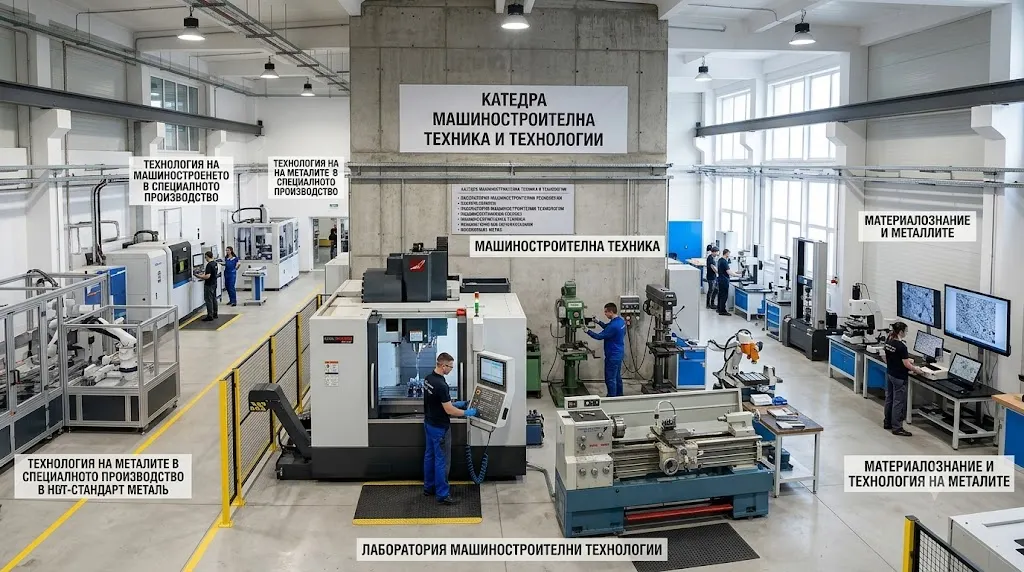
Department "Machine Engineering and Technologies" (MET) is responsible for the education of students majoring in "Machine Engineering and Technologies". The duration of study is four years for bachelor's degree students in mechanical engineering and one and a half years for master's degree students who have completed a bachelor's degree. The master's program at the department is offered in two specializations: "Technology of Machine Engineering and Metals" - full-time study, and "Technology of Machine Engineering" - distance learning.
Students at the department are enrolled in the following key specializations:
- Machine engineering technologies;
- Machine engineering equipment;
- Materials science and metal technology";
- Technology of machine engineering in special production;
- Metal Technology in Specialized Production;
Department "Machine Building Equipment and Technologies" traces its origins to the establishment of the Faculty of Specialized Training in 1985. And at TU-Sofia, Plovdiv branch in 1986. The first name was United Department "Machine Building", and later a Scientific-Educational Center "Machine Building Technologies" was created. At a later stage, it was transformed into a department "Machine Building Technologies and Production Equipment", and since 2005 it has had its current name.
From the United Department "Machine Building", independent educational centers "Machine Building Technologies", "Mechanical Instrumentation", and "Chain and Wheeled Machines" were separated.
MTT Department works on research projects in three main areas:
- Technology and Automation of Mechanical Engineering;
- Cutting, Tools, and Metal-Cutting Machines;
- Materials Science and Technology of Mechanical Engineering Materials.
Specialty: "Mechanical Engineering Equipment and Technologies"
ESTK Code: BMTT; MMTT
Educational and Qualification Degrees: The specialty offers training for obtaining the educational and qualification degree of "Bachelor" and "Master".
Forms of Study: The training is conducted in full-time form.
Duration of study:
- The duration of study for obtaining a "Bachelor" degree is four years;
- The duration of study for obtaining a "Master" degree is one and a half years for candidates who already hold a "Bachelor" degree.
Completion: Regardless of the form and level of study, completion is certified by successfully defending a diploma thesis.
Admission:
- For admission to the "Bachelor" educational-qualificational level, candidates take a competitive exam in mathematics or are ranked based on their results from the state maturity exam (matura) in mathematics or physics;
- For admission to the "Master" educational-qualificational level, a document-based competition is held, evaluating the academic achievements of the candidates.
Access to further study:
- Graduates with a bachelor's degree have the right to continue their studies to obtain a master's degree;
- Graduates with a master's degree can apply for studies in the educational and scientific degree of "doctor".
The specialty in which students are trained has a wide range of implementation in industrial production. The need for specialists with higher education in the specialty MTT has increased significantly with the introduction of complex production equipment and modern computer systems into contemporary production, which require high professional qualification in the preparation and implementation of production. The role of engineering staff in scientific research and the implementation of modern technologies, where intellectual resources play a predominant role, is increasing substantially.
All this determines the relevance of the specialties in mechanical engineering.
Students of the specialty "Mechanical Engineering and Technologies", educational-qualificational degree "bachelor", are trained as broad-profile specialists capable of working in almost all branches of mechanical engineering. They undergo a well-balanced fundamental, general professional, general specialty, and specialized engineering preparation.
Training in the specialty "Mechanical Engineering" is built on a solid foundation of fundamental knowledge in the fields of mathematics, physics, chemistry, mechanics, informatics, and foreign language. These disciplines form the analytical thinking and logical preparation necessary for mastering more specialized engineering sciences.
In the next stage, students move on to general engineering disciplines, which are directly related to the professional direction. Among them are applied geometry and engineering graphics, materials science and material technology, strength of materials, theory of mechanisms and machines, metrology and measuring technology, machine elements, lifting and transport equipment, fluid mechanics, thermal engineering, hydraulic and pneumatic drives, electrical engineering and electronics, production equipment management, economics, industrial management, engineering ecology, and technical safety.
Specialized training covers in-depth study of key technological processes, including metal cutting, heat treatment of metals, foundry production technology, metal processing by plastic deformation, cutting tools, metal-cutting machines, mechanical engineering technology, technological equipment, and automation of mechanical engineering production.
To ensure maximum practical orientation, the specialized engineering training is organized through nine elective disciplines, grouped into two main directions: machine construction technology and metal-cutting machines, and metal technology and metalworking equipment.
Practical training is an important part of the educational process, linking theoretical knowledge with real engineering practice. It includes academic, academic-production, specialized, and pre-graduation internships, evenly distributed throughout the entire period of study. In this way, students gain valuable practical experience that prepares them for successful professional implementation.
Graduates of the "Mechanical Engineering" specialty possess a broad professional background that allows them to implement in all industries of the industry where higher education and specialized engineering knowledge are required. They are prepared to develop and implement technological processes for the production of various mechanical engineering products, as well as to design technological equipment necessary for their manufacture.
Among their competencies are also diagnostics and organization of maintenance of production equipment, as well as control and management of technological processes. Their skills in designing and implementing technological processes for machines with computer numerical control (CNC) are particularly valued, which are at the heart of modern automation.
In addition to purely technical tasks, graduates of the specialty are prepared to take on organizational and managerial functions related to the activities of production units and small companies. In this activity, they actively use modern computer techniques and technologies, which allows them to effectively manage production processes and optimize resources.
The training in the specialty "Mechanical Engineering Equipment and Technologies" at the educational and qualification level "master" provides in-depth fundamental training, combined with specialization in the field of mechanical engineering. Students receive knowledge in: mathematical and computer methods for engineering research, design of machines, processes and systems, marketing and management of mechanical engineering. Specialization according to the preferences of the trainees is carried out by selecting a set of 5 elective disciplines, which results in in-depth professional training in:
- high-efficiency mechanical engineering technologies;
- design and operation of high-performance production equipment;
- metalworking technologies through casting, plastic deformation, welding, and chemical-thermal treatment.
Graduates with a Master's degree in Mechanical Engineering possess in-depth knowledge and skills that enable them to achieve a high level of expertise in various fields of professional activity. They are prepared to conduct and lead scientific research, as well as to manage the design of highly efficient technologies and equipment in the field of mechanical engineering.
Masters in Mechanical Engineering master modern methods of modeling and research, actively using computer products and automation equipment for engineering work. This gives them the opportunity to develop, implement, and apply innovative solutions in the production process.
Furthermore, they are prepared to formulate the technical and technological policies of companies, as well as to lead or hold responsible positions in enterprises in the mechanical engineering sector. Thanks to their comprehensive training, they can be valuable assets for business and industry.
Last but not least, Master's degree graduates have the opportunity to participate in competitions and work as "assistants" in higher education institutions, thereby contributing to the development of the next generation of engineers.