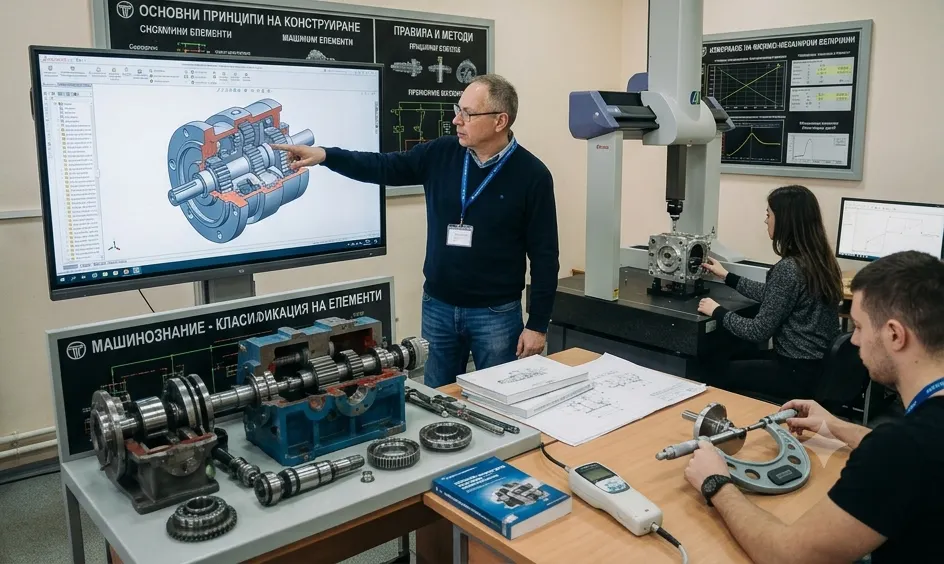
The Department of Mechanical Engineering and Instrumentation is the successor to the Scientific-Educational Center "Mechanical Instrumentation and Mechanical Engineering" (until 1992), and subsequently to the Department of "Special Mechanical Engineering and Instrumentation" (from 1992 to 1995).
Laboratory exercise on "Metrology and Measuring Technology".
The spheres of competence and the conduct of educational-teaching and research activities are in the field of:
- basic principles, rules, methods, and tools for design in mechanical engineering and instrumentation;
- application of modern methods for computer-aided design and engineering (CAD & CAE);
- machine elements and mechanical engineering (with an emphasis on mechanical transmissions and elements of rotational motion);
- mechanisms and machines (analysis and synthesis);
- metrology and measuring technology in mechanical engineering;
- quality control and management;
- instruments for measuring physical and mechanical quantities;
- application of optical technology for control and measurement;
- automation and robotics in mechanical engineering production;
- lifting and transport equipment and logistics;
- design, operation, and manufacturing of small arms and ammunition;
Laboratory 3217 - Technical Measurements in Mechanical Engineering.
The Department of Mechanical Engineering and Instrumentation is engaged in ensuring the educational process for such fundamental disciplines that form the basis of engineering education in the field of mechanical engineering and general engineering, such as “Fundamentals of Design and CAD”, “Engineering Graphics”, “Fundamentals of Engineering Design”, “Machine Elements”, “Theory of Mechanisms and Machines”, “Lifting and Transport Equipment”, “Metrology and Measuring Technology”, and many others.
Laboratory 4401 – Design in Instruments and Machines
The Department of Mechanical Engineering and Instrumentation is accredited to train students at the educational and qualification levels (EQL) of "Bachelor" and "Master" in the specialty "Mechanical Engineering and Instrumentation". To this end, it has:
- a well-resourced laboratory base located in 14 laboratories;
- a modern computer classroom for computer-aided design, 3D modeling, and simulation research in mechanical engineering and instrumentation;
- a highly qualified academic and research staff consisting of 7 associate professors and 7 senior assistants in the respective scientific fields.
Laboratory – Computer-Aided Design (CAD&CAE) in Mechanical Engineering.
The duration of study is four years for Bachelor's degree Mechanical Engineers and one and a half years for Master's degree students who have completed a Bachelor's degree.
In fulfilling its tasks related to the training of engineering and technical personnel and to scientific research activities, the Department of Mechanical Engineering and Instrumentation relies on and receives full support from all other departments of the Faculty of Mechanical Engineering and Instrumentation and the Faculty of Electronics and Automation at TU-Sofia, Plovdiv branch.
The training provided by the Department of Mechanical Engineering and Instrumentation is focused on the field of mechanical engineering with a specialization in the design of machines and instruments. Graduates of the specialty receive a qualification to perform design, production, organizational, and control activities in state and private manufacturing enterprises.
Students have the opportunity to choose from the following modules:
- Precision Engineering
- Armament Production
- Ammunition Production
Laboratory 4404 – Armament Technology
Through the free targeted selection of disciplines, students acquire the theoretical knowledge and practical skills that enable them to quickly and successfully adapt to work in mechanical and instrumentation engineering enterprises, in enterprises for the production and repair of military equipment, in consulting and entrepreneurial services, or in research units of companies, regional metrology centers, or in the field of technical education.
Anti-hail rocket "Loza - 3" - training model