The Department of Theory of Mechanisms and Machines was established as an independent unit in June 1974. However, its roots trace back to 1945, when the teaching and development of the academic disciplines and research areas that shape the department's current profile began. Since then, they have developed in sync with the achievements of technology and science in the field of machine mechanics.
Today, the department's teaching and research activities are based on years of experience, established traditions, and continuity. The first lecturer in the core academic discipline 'Theory of Mechanisms and Machines' (TMM) was Prof. Mikhail Konstantinov, who began his teaching career in 1954 and subsequently became the first head of the department after its establishment. Prof. Mikhail Konstantinov (1921–1991) is rightfully recognized as the founder of the department and as a teacher to generations of its lecturers and researchers. With the school he established and his immense creative output, Prof. Konstantinov established himself as a scientist of international renown and made a significant contribution to the development of 'Theory of Mechanisms and Machines' as a science.
Currently, the TMM Department offers instruction in 10 mandatory academic disciplines, two of which are in master's programs, and two elective disciplines. The main goal of the taught academic disciplines is to provide students with the necessary knowledge of the mechanical nature of machines, to facilitate the transition from general engineering to constructive and technological knowledge. The disciplines contribute to the formation of engineering-technical culture and the development of creative and inventive thinking in the design and improvement of machines and mechanical devices.
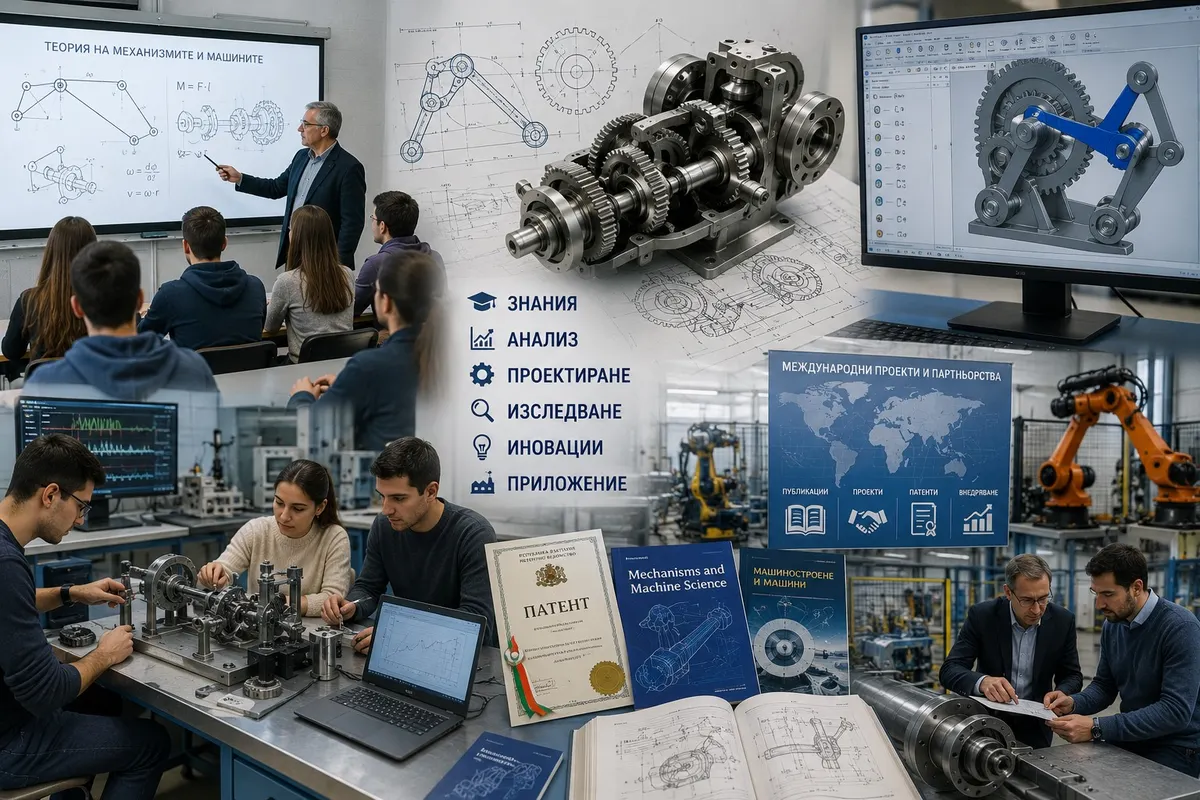
The research activities of the department members are vast and diverse – publications in the country and abroad, participation in international projects, contracts with companies, patents and inventions, a large number of developments implemented in industry with significant economic and social impact. Many of the lecturers are engaged as consultants by companies. The participation of all lecturers in research work allows for continuous updating of the curricula and is a guarantee of quality in the educational process.
Currently, the Department of Mechanical Engineering offers instruction in 10 required courses, two of which are part of master’s programs, and two elective courses. The primary goal of these courses is to provide students with the necessary knowledge of the mechanical nature of machines, enabling them to transition from general technical knowledge to design and manufacturing knowledge. These courses help build engineering and technical expertise and foster creative and inventive thinking in the design and improvement of machines and mechanical devices.
The research activities of the department’s faculty members are extensive and diverse—including publications in Bulgaria and abroad, participation in international projects, contracts with companies, patents and inventions, and a large number of developments implemented in industry with significant economic and social impact. Many of the faculty members are engaged as consultants for companies. The participation of all faculty members in research work allows for the continuous updating of the curricula and ensures the quality of the educational process.