History and Development
The Department of Mechanics was established in 1965 when the Department of Theoretical Mechanics was split into two independent departments – Mechanics and Strength of Materials. The origins of the Department of Theoretical Mechanics date back to 1941when the first higher technical institution in Sofia was founded.
The Department of Mechanics continues to be a leading center for education and scientific research in the field of engineering mechanics, combining tradition, innovation, and practical orientation.
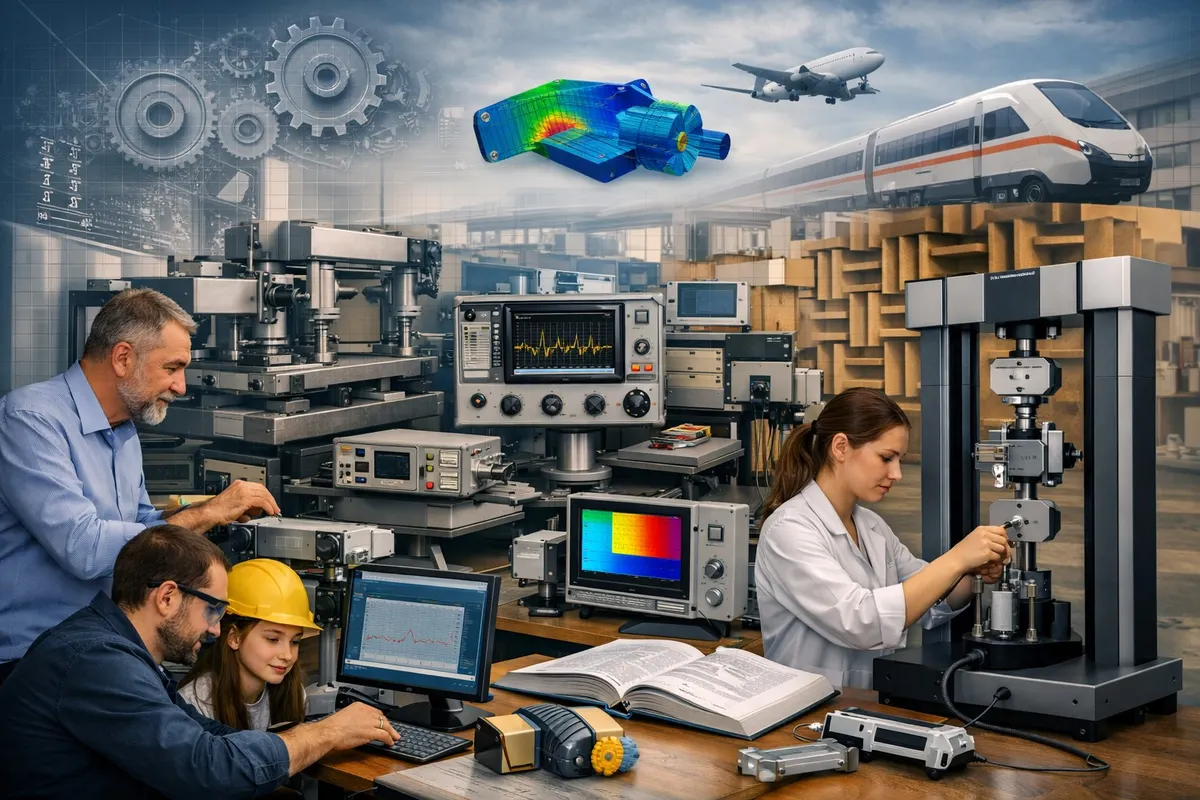
Educational ActivitiesThe qualified teaching staff of the Department of Mechanics teaches courses in all engineering faculties of the university. The department has modern laboratories equipped with testing machines, test benches, measuring instruments, computers, and presentation equipment necessary for the training of students and doctoral students.
For the main disciplines, the team has developed a complete set of modern textbooks and study aids. Students from various specialties of almost all faculties of the Technical University – Sofia receive training at the department.
Research activitiesThe department conducts active
research and development in many areas. The teachers participate in national and international scientific forums with their developments, and work on the execution of contracts with companies and state organizations.
In this regard, the
scientific-production laboratories "Vibrations and Acoustic Noise" and "Strainometry" have been created, as well as the website
"Assistant in Material Resistance", intended to support students.
Connection between theory and practice Theoretical and experimental scientific activities are closely linked with practice, which directly impacts the preparation of instructors. This allows the lecture material to be continuously updated with current examples from real engineering practice, while laboratory exercises address practical topics.
Laboratory equipment developed through research and applied projects is actively used in the educational process – both in laboratory exercises and in the development of graduation theses and dissertations.
Research Activities
The department conducts active research and development activities in a wide range of fields. Faculty members present their research at national and international scientific conferences and also work on projects under contracts with companies and government organizations.
In this regard, the
“Vibrations and Acoustic Noise” and “Tensometry” research-production laboratories have been established, as well as the website
“Strength of Materials Assistant”, designed to support students.
The Link Between Theory and Practice
Theoretical and experimental research are closely linked to practice, which directly influences the training of faculty members. This allows lecture material to be continuously updated with current examples from real-world engineering practice, while laboratory exercises address practical topics.
Laboratory equipment developed through research and applied projects is actively used in the educational process—both in laboratory exercises and in the preparation of theses and dissertations.