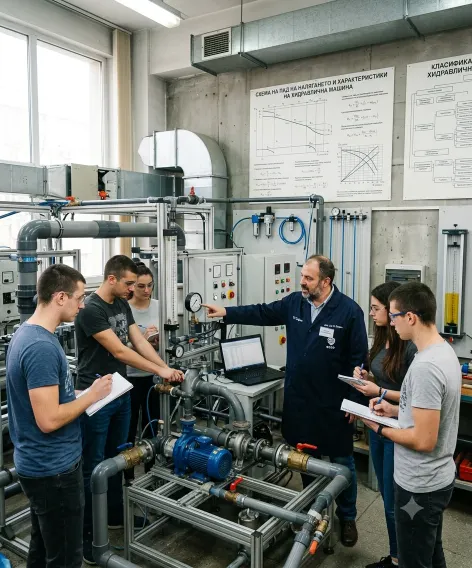
The Department of Hydroaerodynamics and Hydraulic Machines (HAD and HM) in its current form has existed since 1998, when the previously separate departments of "Hydroaerodynamics" (HAD) and "Hydraulic Machines" (HM) were merged.
The Department of "Hydraulic Machines" was established during the 1945/46 academic year upon the opening of the Machine-Technological Faculty of the State Higher Polytechnic Institute. The Department of "Hydroaerodynamics" was established a year later, in 1947. When the Energy Machinery Faculty was created in 1963, both departments were included in it. The long-standing history, accumulated material base, and inherited and acquired teaching experience provide very good opportunities for general engineering and specialized training of students and for conducting high-quality research and engineering activities.
Department of "HAD and HM" provides both general engineering and specialized training in the fields of hydroaerodynamics, hydraulic and pneumatic machines, drives, and technologies. Specialized training is for bachelors and masters from the specialty "Hydraulic and Pneumatic Engineering" (HPE) at the Energy Machinery Faculty. The general engineering training provided by the department is for students from the Machine-Technological Faculty, Mechanical Engineering Faculty, Faculty of Transport, Faculty of Electrical Engineering, College of Energy and Electronics of the TU in Sofia, as well as for other specialties at the Energy Machinery Faculty. The department also participates in training for students from the Faculty of English Engineering Education and the Faculty of German Engineering Education and Industrial Management.
The Department of "HAD and HM" conducts research activities and supervises doctoral students in three scientific specialties.
In the scientific specialty "Fluid Mechanics", research activities are in the following areas:
- experimental and numerical study of fluid flows under various conditions;
- experimental and numerical study of air quality and thermal environment in rooms;
- numerical study of processes in industrial combustion installations, as well as fires in enclosed spaces and open areas.
In the scientific specialty "Hydraulic and Pneumatic Drive Systems", research activity develops in two directions:
- study and improvement of the design, responsiveness, and stability of elements constituting such systems;
- increasing the energy efficiency of the systems.
In the scientific specialty "Hydraulic and Pneumatic Machines and Equipment", water and wind turbines and hydroenergy systems, various other hydraulic and pneumatic machines (pumps, compressors, fans), energy recovery systems are studied, developed, and implemented. Work is carried out in the field of computer modeling of hydraulic and pneumatic machines and equipment. Tests are conducted under laboratory and operational conditions on pumps, fans, pipe fittings, and various flow measurement devices.