SECTION "WESTERN AND SLAVIC LANGUAGES"
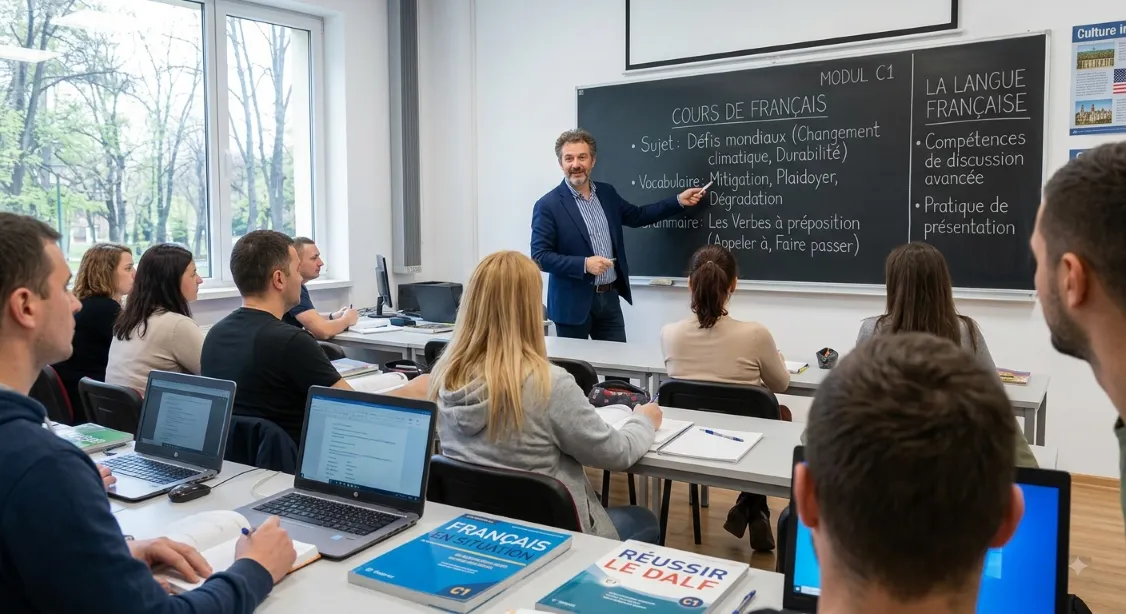
The Section is a unit of the Department of Foreign Language Education and Applied Linguistics and has the status of a university department. It is managed by the Section Head and their deputy - Head of Teaching Load. The Section's structure includes subsections for German, French, Russian, and Bulgarian for Foreigners, with subsection heads responsible for the respective languages' academic and methodological work.
The faculty members In German, French, Russian, and Bulgarian for foreigners, there are highly qualified philologists with pedagogical experience in teaching foreign languages. In order to improve their qualifications, the linguists from the Section annually conduct lectures and training programs for teaching mobility in EU countries, participate with their applied research in national and international scientific forums related to modern foreign language teaching methodologies. Also, part of their activity is the writing of educational materials and literature for specialized foreign language training, as well as updating the foreign language curricula for academic purposes.
In addition to training for students from I and II year of all faculties of TU - Sofia, teachers from ZSE lead specialized training in German at the Faculty of German Engineering Education and Industrial Management and in French at the Faculty of French Education in Electrical Engineering at the Technical University - Sofia.
SECTION „WESTERN AND SLAVIC LANGUAGES“
Section is a unit of the Department of Foreign Languages and Applied Linguistics and holds the status of a university department. It is headed by the Head of the Section and his deputy – the Person Responsible for Teaching Load. The structure of the Section includes subsections German Language, French Language, Russian Language and Bulgarian for Foreigners. The educational and methodological activities for the respective languages are carried out by the heads of the subsections.Teachers of German, French, Russian languages and Bulgarian for Foreigners are highly qualified philologists with teaching experience in foreign languages. In order to improve their qualifications, linguists of the Section annually conduct lectures, as well as training under teacher mobility programs in EU countries, and participate with their scientific-applied developments in national and international scientific forums related to modern foreign language teaching methodology. Part of their activity also includes the development of educational materials and literature for specialized foreign language training, as well as updating foreign language curricula for academic purposes.
In addition to teaching students I and II courses of all faculties of TU - Sofia, teachers of the Section "Western and Slavic Languages" conduct specialized training in German at the Faculty of German Engineering Education and Industrial Management and in French at the Faculty of French Education in Electrical Engineering of the Technical University of Sofia.
DEPARTMENT "WESTERN AND SLAVIC LANGUAGES"
The Department belongs to the Department of Foreign Language Teaching and Applied Linguistics and has the status of a chair. It is headed by a department head and his deputy, who is responsible for teaching duties. The department consists of the sub-departments German, French, Russian and Bulgarian for Foreign StudentsFor the methodological work in the respective languages, the deputy heads of sub-departments are responsible.
The lecturers in German, French, Russian and Bulgarian for foreigners are highly qualified philologists with pedagogical experience in foreign language teaching. For their further training and professional development, the linguists from the department annually organize lectures and training courses in mobility programs for university teachers in EU countries and participate with their own scientific-applied papers at national and international scientific forums in the field of modern methodology in foreign language teaching. Their activities also include compiling teaching materials and textbooks for foreign language subject teaching, as well as revising the foreign language teaching programs for academic purposes.
In addition to the German as a Foreign Language (DaF) classes for students in the 1st and 2nd year of study of all faculties of the Technical University – Sofia the lecturers from the Department of "West European and Slavic Languages" also teach German for specific purposes at the Faculty of German Engineering and Business Administration and French for specific purposes at the Faculty of French Electrical Engineering of the Technical University – Sofia.
THE SECTION "WEST EUROPEAN AND SLAVIC LANGUAGES"
The Section is part of the Department of Foreign Languages and Applied Linguistics. It is headed by a Section Head and a Deputy Head - responsible for teaching. The Section includes the sub-units German Language, French Language, Russian Language and Bulgarian as a Foreign Language, headed by heads of teaching and didactic work.
The teaching staff consists of teachers of German, French, Russian and Bulgarian as a Foreign Language who possess high professional qualifications and benefit from rich experience in the field of foreign language teaching. The linguist teachers of the Section continuously improve their qualifications by attending training within the framework of European mobility programs for professors and by presenting their applied research in the field of contemporary didactics of foreign languages at national and international scientific forums. They also participate in the preparation of didactic works in foreign language teaching for specific purposes and in the development and updating of foreign language teaching programs for academic purposes.
The teachers of the Western and Slavic Languages Section provide foreign language training to first- and second-year university students from all faculties of the Technical University, as well as specialized training in German to students at the Faculty of German Engineering and Industrial Management and in French to students at the Francophone Faculty of Electrical and Computer Engineering of the Technical University of Sofia.
PUBLICATIONS
SECTION „WESTERN AND SLAVIC LANGUAGES“
“Terminological Reference Book”, under the general editorship of Assoc. Prof. Dr. Petar Stankov, Sofia: 1992, Technical University - Sofia.
The Terminological Reference Book was compiled under the general editorship of Assoc. Prof. Dr. Petar Stankov. Authors: Assoc. Prof. Dr. Yani Arnaudov, Assoc. Prof. Dr. Marin Marinov - Part I. Mathematics; Assoc. Prof. Dr. Elka Nikolova - Part II. Physics; Prof. Dr. Zdravka Cherneva, Assoc. Prof. Dr. Petar Stankov - Part III. Mechanics; Prof. Dr. Dimitar Filipov - Part IV. Mechanical Engineering; Prof. Dr. Ivan Chorbadzhiski - Part V. Energy; Assoc. Prof. Dr. Dimcho Tsanov - Part VI. Electrical Engineering; Assoc. Prof. Dr. Racho Tsanov - Part VII. Electronics; Senior Lecturer Dr. Vasil Vasiliev - Part VIII. Transport. Translation and editing into foreign languages: Russian - Senior Lecturer Liliana Rusinova; English - Senior Lecturer Snezhana Vasileva; French - Senior Lecturer Yulia Ivanova; German - Senior Lecturer Nevena Tsareva.
“Educational Russian-Bulgarian Dictionary”, N. Encheva, A. Bozhkova, Sofia: 1992, Technical University - Sofia.
This educational Russian-Bulgarian dictionary on energy is intended for all specialties related to the field of energy. It contains 1500 terms, based on which various term combinations are proposed.
In the dictionary entry, along with the morphological characteristics of the Russian term and its corresponding Bulgarian equivalent, a definition of the scientific concept is provided, at the discretion of the authors.
“Russian-Bulgarian Terminological Dictionary of Computer Science. Contains about 4200 terms”, P. Martinov, S. Noeva, Sofia: 1990, Technical University - Sofia.
Computer science is developing at an exceptionally rapid pace. In recent years, microprocessor technology has had significant importance, enriching the terminological system in this field with new terms that have found their place in this dictionary.
"A Guide to the Bulgarian Language for Foreign Students from VMEI 'Lenin'", Margarita Atanasova, Moni Almalekh, Kitsa Diamandieva, Sofia: 1989, Printing Base of VMEI 'V. I. Lenin' - Sofia.
The study aid is intended for first-year foreign students at VMEI 'V. I. Lenin' - Sofia. The material is organized according to the functional-semantic principle and is adapted to the knowledge and skills acquired by students in Bulgarian language at the Center for Foreign Students 'G. A. Nasar'.
"A Textbook of Bulgarian Language for Foreign Students of the Second Year at TU - Sofia", Margarita Atanasova Atanasova, Sofia: 1994, Publishing House of the Technical University - Sofia.
The textbook is intended for teaching Bulgarian language to second-year foreign students, postgraduates, and specialized students (from all faculties and specialties) at TU - Sofia. The phonetic, morphological, and lexical material is presented comprehensively, while simultaneously, through the systematic review of previously studied material, students have the opportunity to acquire new knowledge and skills in Bulgarian.
"A Study Aid in Bulgarian for Academic Purposes", Ivaylo Peev, Sofia: 2016, Publishing House of the Technical University - Sofia.
The study aid is based on developments in Bulgarian for academic purposes under two projects - 'Center for Electronic Distance Learning and Services for Acquiring Academic and Professional Language Skills and Competencies at the Center for Foreign Students and Language Training of TU - Sofia' and 'Support for the Development of Doctoral Students, Postdoctoral Researchers, and Young Scientists in the Field of Virtual Engineering and Industrial Technologies', implemented at TU - Sofia.
"Methodology of Teaching Western Languages in Higher Education Institutions with Regard to the Features of Specialized Text", working group under the methodological guidance of Assoc. Prof. Dr. V. Vapordzhiev, Sofia 1988, Printing Base at VMEI "V. I. Lenin" - Sofia.
The development of foreign language education on a global scale increasingly and unequivocally shows that the main problem in this field is nothing other than the renewal of the methodology of teaching foreign languages, which applies especially to non-philological universities.
"Study Guide for Translation of Scientific and Technical Literature (German)", V. Vapordzhiev, N. Tsareva, L. Tsvetanova, Z. Gitsova, Sofia 1990, Printing Base at VMEI "V. I. Lenin" - Sofia.
The proposed "Study Guide for Translation of Scientific and Technical Literature" (German) aims to help students and teachers at VMEI "Lenin" achieve the objectives set in the curriculum and prepare students for reading, translating, understanding, and using technical literature. The guide is part of the series of textbooks and study materials on foreign languages for non-philological universities.
"Computer- und Kommunikationstechnik. Deutsch für Studenten" (2003), Senior Lect. Pavlina Zlateva.
The German language study aid "Computer- und Kommunikationstechnik. Deutsch für Studenten" was prepared within the framework of the international project "Türen" under the supervision of Prof. Dagmar Bley, TU Dresden, and with the financial support of TU Sofia. The specialized texts, whose main theme includes computers and peripheral devices, as well as activities related to their use, develop different types of reading depending on the type of text and the purpose of extracting relevant information. The exercises focus on grammatical structures and word formation models characteristic of technical texts. It is intended for students of technical specialties. Its theme allows application to a wide range of trainees studying German.
"Bulgarian Language for Foreign Students from VMEI "V. I. Lenin". SECOND COURSE. ELECTRICAL ENGINEERING SPECIALTIES", Dobrinka Yordanova Raycheva, Sofia - 1983, Printing Base at VMEI "V. I. Lenin" - Sofia.
"When compiling a textbook, it is difficult to determine the scope and find the most appropriate way to distribute and present the material within that scope" - writes Academician Angel Balevsky in the foreword to the textbook "Metal Science". This textbook includes some of the texts I used in my eight years of work and some of the exercises I offered to students.
"Bulgarian Language for Foreign Students from VMEI 'V. I. Lenin'. SECOND COURSE. MACHINE BUILDING SPECIALTIES", Dobrinka Yordanova Raycheva, Sofia: 1984, Printing base at VMEI 'V. I. Lenin' - Sofia.
The textbook contains two sections, the first of which includes 20 lessons, and the second - exercises for developing written and oral speech. The first 16 lessons contain text /lexical unit/, exercises for the text, a new grammatical unit, exercises for it, and additional exercises. The additional exercises are not mandatory. They will be performed only if there is time left.
"Bulgarian Language and Academic Communication", Ivelo Peev, Publishing House of the Technical University - Sofia, 2017.
Contact with a foreign language is primarily a touch with the culture of the country and its people, with the present and past of the state and the personalities who have built it. Familiarity only with the language, with its rules and grammar limits, closes, leaves too many gaps, blank spots in the knowledge and skills of the person studying it. This provokes us to present a different perspective, linking the study of the Bulgarian language with the specifics of national culture and mentality, with the history of education in Bulgaria and academic etiquette.
"Russian Language. Textbook-Chrestomathy for Students of FA, FETT, FKTT, FKSU", D. Rafailova, L. Zadorozhnaya, S. Noeva, Sofia - 1989, Printing base at VMEI 'V. I. Lenin - Sofia.'
The textbook is intended for students of the specialties FA, FETT, FKTT, FKSU. It contains texts selected from original technical literature in the field of measuring technology, radio and television, communication technology, electronics and computing technology, automation and robotics, with tasks for them, as well as an appendix and a Russian-Bulgarian dictionary.
"Russian-Bulgarian Educational Dictionary of Radioelectronics", Draga Rafailova, Milena Mihova, Sofia: 1992, Technical University - Sofia.
The dictionary contains about 3300 terms from the following fields: radio engineering, electronics, communication technology, measuring technology, optics, laser technology, cybernetics, robotics, etc.
"Russian Language. Textbook-Chrestomathy for Students of the Technical University", Aneliya Bozhkova, Dimitar Dyankov, ICK "SLAVIKA - RM", Sofia 2002.
This educational manual is intended for students from various specialties at TU - Sofia studying Russian as a foreign language, but it can also serve for independent preparation. The material included in it is intended as supplementary to the main student textbook.
"Non-verbal Aspects in Foreign Language Teaching. An Extralinguistic Approach to Language", Ivaylo Peev. Sofia: 2018, Publishing House of the Technical University - Sofia.
"Non-verbal Aspects in Foreign Language Teaching. An Extralinguistic Approach to Language" is a monographic study devoted to foreign language teaching and, more specifically, to teaching Bulgarian to foreigners.
The book presents in detail various approaches to studying the language of the body from different fields of the humanities and the non-verbal aspects of communication, linking them with the teaching of a foreign language.
"Studies on Microstyle in the 21st Century". Collection of studies, editor Ivaylo Peev, Sofia: 2018, Publishing House of the Technical University - Sofia.
The collection of studies "Studies on Microstyle in the 21st Century" is published under a project of the NIS of TU - Sofia on the topic "Linguistic Specifics of Microstyle. Contemporary Discourse in Short Written Genres - Verbal and Visual Expression", with Senior Lecturer Dr. Ivaylo Peev as the supervisor. The publication contains three scientific studies: "Modern Explications of Discourse - Microstyle and Microgenre in the 21st Century", Ivaylo PEEV; "Concepts, Arts, Design. The Artistic 'Microingredients'", Maria EVTIMOVA; "Meanings and Values Conveyed through the Language of the Pages of the Magazine 'Woman Today' during the Period of Socialism 1944-1989", Yoana PAVLOVA.
"Bulgarian Language for Preparatory Academic Year. 100 Steps in the Bulgarian Language", Ivaylo Peev, Sofia: 2019, Publishing House of the Technical University - Sofia.
The textbook contains the basic knowledge of the Bulgarian language for successful communication and quick adaptation in the Bulgarian language environment. Over 30 dialogues, over 1000 words, dozens of everyday situations. Grammar ... is not difficult, it is the foundation of the language, and the language is dialogue! You won't realize when you have mastered it and successfully use it in communication. How to introduce ourselves; To get acquainted; The Family; Education and professions; Culture and art; Travel and transport; In the cafe and restaurant; ... and many other topics. Language in action! Let's act - let's speak Bulgarian!
The Phraseology of the Bulgarian Language, Marta Kostov, Veselin Vapordziev, Sofia: 1986.
The manual 'The Phraseology of the Bulgarian Language' is the first coherent presentation of Bulgarian phraseology in German. It is intended for users with German as their native language. For this reason, particular attention is paid to the questions of the confrontation of Bulgarian with German in the field of phraseology and the problems of translating phraseologisms from one language to the other.
'THE PHRASEOLOGICAL DICTIONARY OF MODERN GERMAN', Vesselin Vapordshiev, Sofia: 1992
Wittgenstein's words apply fully to the phraseologisms of a language, because these bindings are born precisely in their use in speech as 'secondary nominatives'. Modern linguistics is characterized by increased interest in secondary naming as a semiotic process, which is directly predetermined by the pragmatic or communicative sphere of language.
German-Bulgarian Phraseological Dictionary of the Category of Objectivity, Vesselin Vapordshiev. Verlag BDV Sofia: 1996.
The present dictionary includes phraseologisms that, by their overall meaning, denote concepts of the category of objectivity in the broad sense of the word, i.e., persons, objects, and phenomena of nature, everyday life, and public life of humans. In its form, it is intended to fulfill two functions. On the one hand, this dictionary functions as a bilingual phraseological dictionary for a broad range of users – pupils, students, teachers, translators. On the other hand, it serves as a corpus for the comparative study of German-Bulgarian phraseologisms of the category of objectivity, which appears as an independent book. The dictionary contains 460 phraseologisms.
TECHNICAL GERMAN MECHANICAL ENGINEERING A READING AND EXERCISES BOOK, Vesselin Vapordshiev, Minka Kotscheva. Sofia: 1991.
This textbook-reader is intended for all specialties from the faculties of MTI, MF, EF, and TF at the Technical University - Sofia. By its concept, the book is a direct successor to foreign language learning textbooks used worldwide: unity of grammar and vocabulary and their interrelation and alignment with the communicative intentions of the user. In this way, the achievements of modern textbook theory on an international scale have been realized.
"GERMAN IDIOMS (A Study Guide in Linguoculturology)", V. Vapordjiev, E. Mirchi. Sofia: 1987.
It is well known that it is precisely the idioms that contain the figurative richness of the language to a large extent. They gather the centuries-old experience of a people, their wisdom, and history. However, in different languages, idioms differ in structure and figurativeness, which is why their translation presents a difficulty. The aim of this present study guide in Linguoculturology is to assist the reader in mastering the subtleties of the German language, to acquaint them with the richness of its expressive means, and to expand their vocabulary.
"Dictionary of German Idioms", V. Vapordjiev, E. Mirchi, Sofia: 1993, Publishing House "Science and Art".
The dictionary contains about 1000 idiomatic expressions from spoken and literary German. The expressions are explained in German and translated into Bulgarian through their phraseological equivalents. The dictionary is intended for anyone who wishes to master the subtleties of the German language, to acquaint themselves with the richness of its expressive means, and to expand their vocabulary.
"GERMAN FOR ENGINEERING STUDENTS A TEACHING AND EXERCISE BOOK", Vesselin Vapordjiev, Krassimira Mantcheva-Baykova, Sofia: 2011, Publishing House of the Technical University - Sofia.
The reading and exercise book for engineering students is intended for students of the Technical University in Sofia who have chosen German as a foreign language in their first year of study. It is designed for 60 teaching units and covers topics from various engineering sciences. Almost all texts were taken from recent technical-scientific publications.
none