
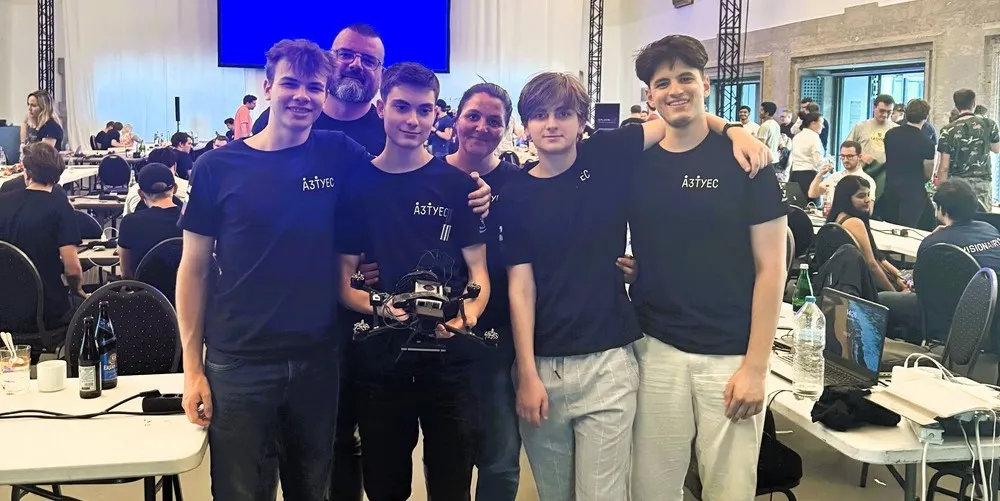
With their innovative project, students from the Technological University "Electronic Systems" at the Technical University – Sofia won third place at one of the most authoritative technology events in Europe.
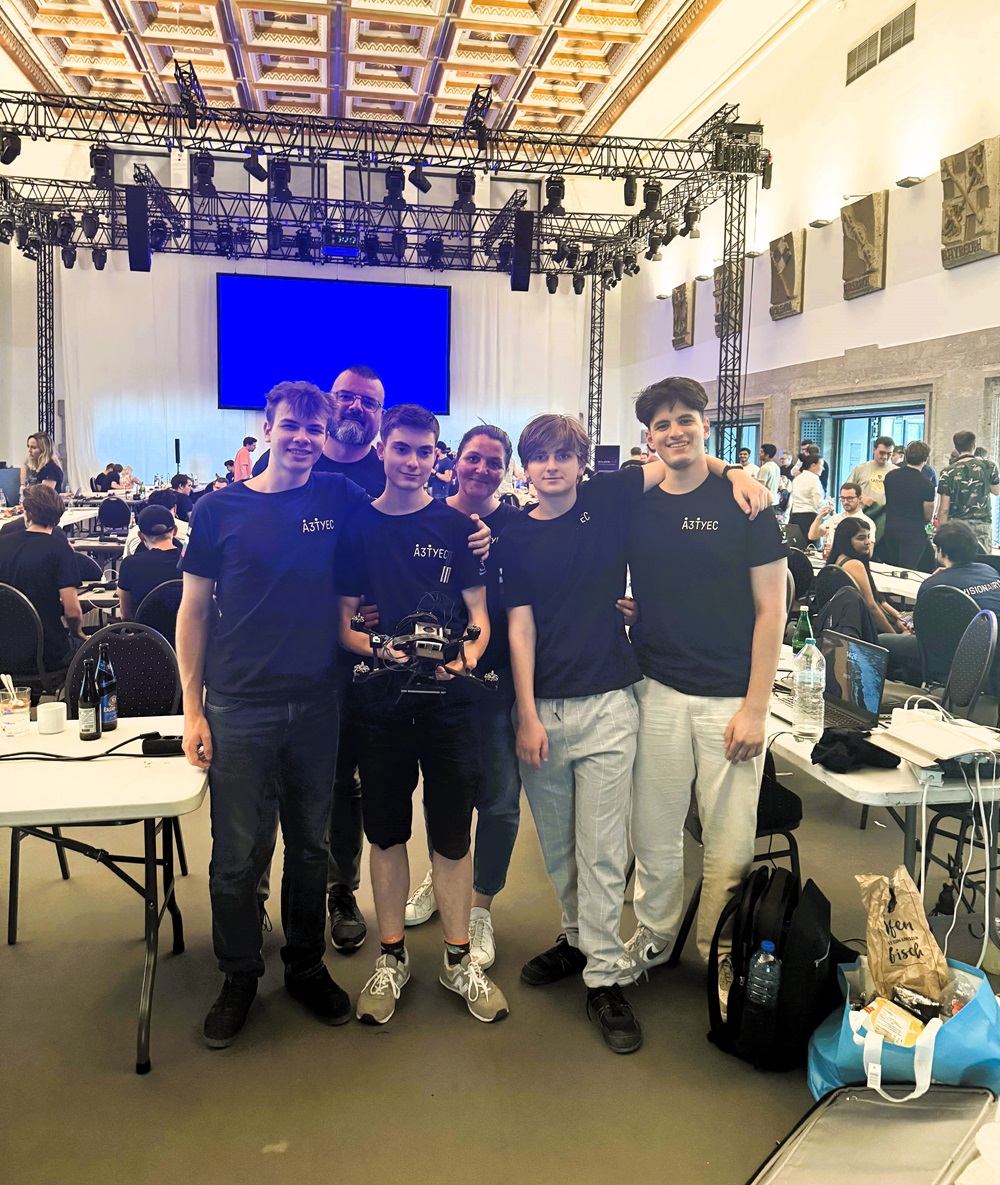
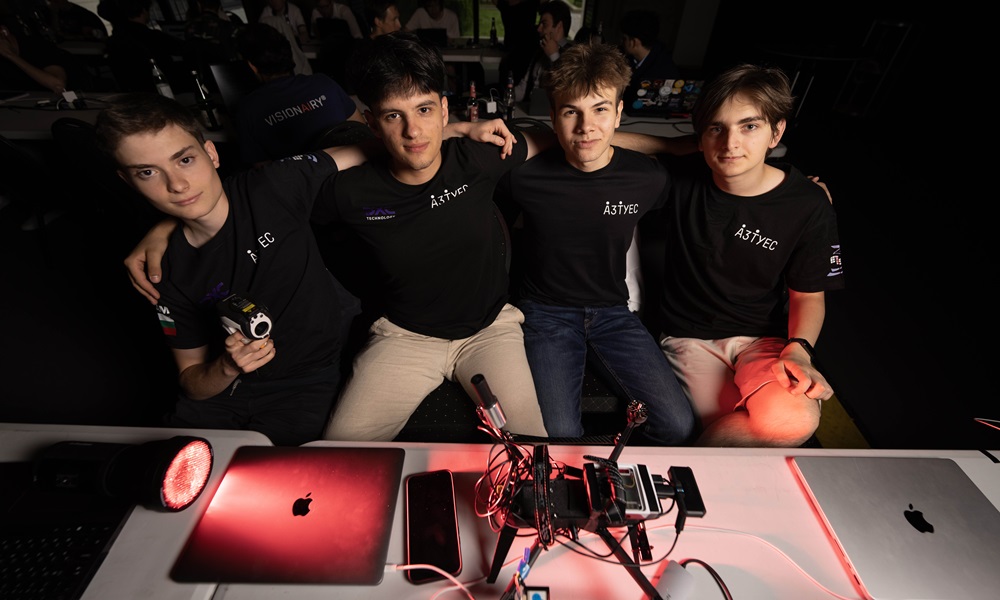
Eleventh-grade students Kaloyan Miladinov, Ognyan Rassadov, Filostatos Titopoulos, Aleksandar Mechkarov, as well as their mentors Petar Kirkov (a graduate of TU ES in 1997) and Kirilka Angelova, Executive Director of the Association of TU ES Graduates, participated in the first edition of the European Defense Tech Hackathon in Munich, as part of the Festival of the Future - Festival der Zukunft. The event aimed to provoke some of the most brilliant minds in Europe and stimulate innovation in key areas for the continent such as preserving life in conflicts and controlling the information environment.
The TU ES students, who were the only participants from Bulgaria, stood shoulder to shoulder with startup creators, cybersecurity specialists, and students from leading universities worldwide. The topic chosen by the Bulgarian team was "Identification of anti-personnel mines using drones and artificial intelligence." The Bulgarian teenagers demonstrated their work on technologies for saving human lives, showcasing their abilities and desire to prove themselves on the international stage.
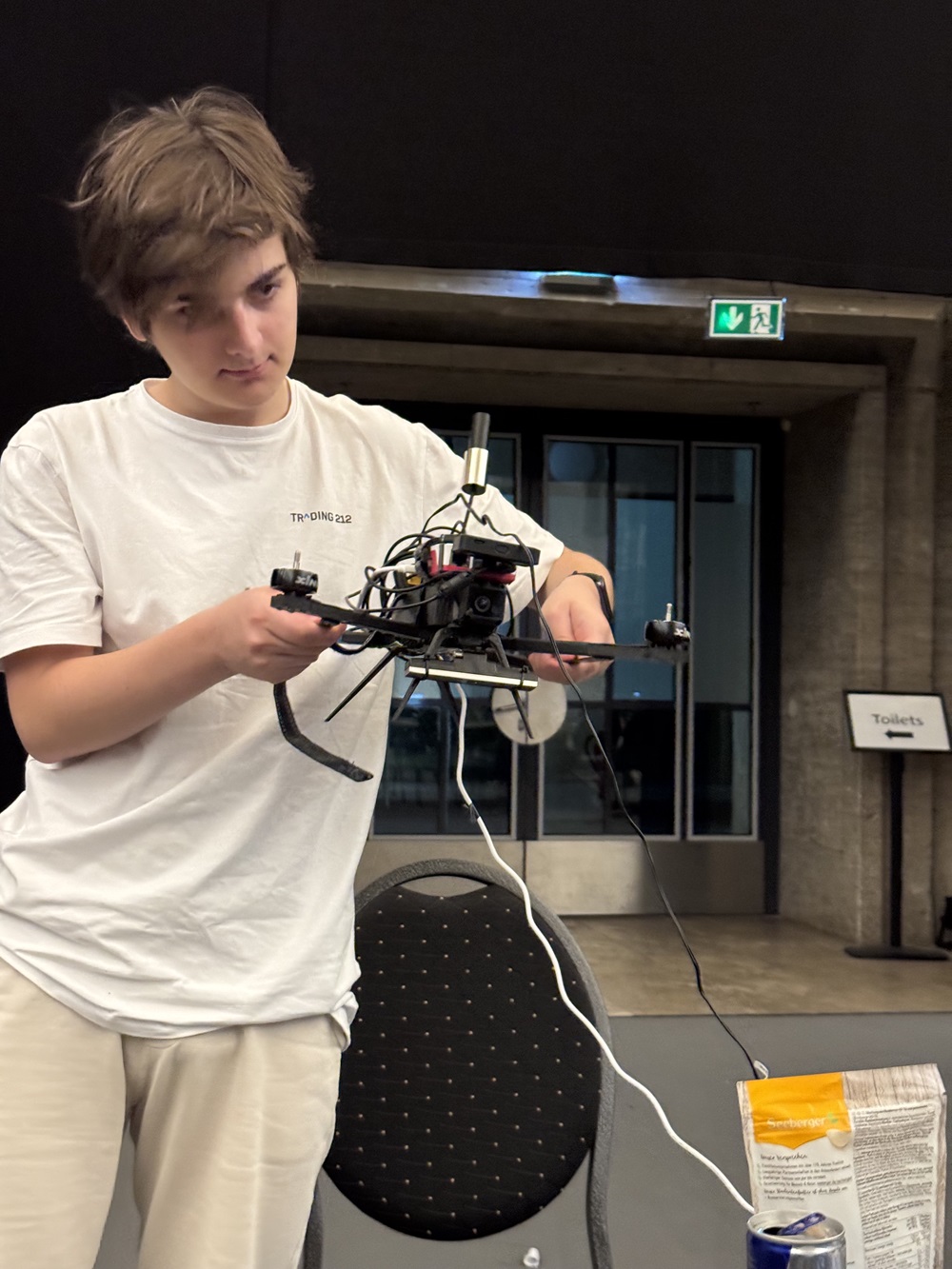
For the technology event, our team developed a drone module that localizes anti-personnel mines in the scanned area and visualizes their location on the map. Mine localization is achieved through analysis of the thermal image of the scanned area. The project began with a study of scientific research on the issue, and a week before the hackathon, the team, with the support of the Institute of Defense "Professor Tsvetan Lazarov," successfully conducted observations and generated a dataset to train computer vision algorithms - a type of artificial intelligence at the core of the module. The goal of the project is to significantly facilitate and reduce the costs of identifying anti-personnel mines, as this is a major problem that delays the restoration of normal societal and economic functioning after the end of hostilities. Minefields left after military conflicts continue to claim innocent victims for decades, and according to the World Bank, demining Ukraine alone will cost $37 billion.
The module for detecting and localizing anti-personnel mines based on their thermal signature won third place at the European Defense Tech Hackathon 2024, with only two ideas ahead of the Bulgarian team: "distributed signal and target detection using software-defined radio (SDR) and TdoA" and "microMANPAD, a tool for protection against unmanned aerial systems".
The Hackathon (https://eurodefense.tech/) in Munich took place from June 28 to 30, 2024, as a satellite event of the Festival of the Future (https://festival.1e9.community/). The goal of the hackathon was to bring together scientific research, the public sector, investors, and end-users of dual-use and defense products, with a focus on prototyping and validating ideas in the fields of defense and human life protection. The hackathon was supported by numerous companies in the fields of technology, robotics, artificial intelligence, and the aerospace industry, as well as by the Ministry of Defense of Ukraine. The students from the Technological University "Electronic Systems" at TU-Sofia were the only representatives from Bulgaria, and the team's project and participation in the hackathon were realized with the help of the Association of TU-ES Alumni.