
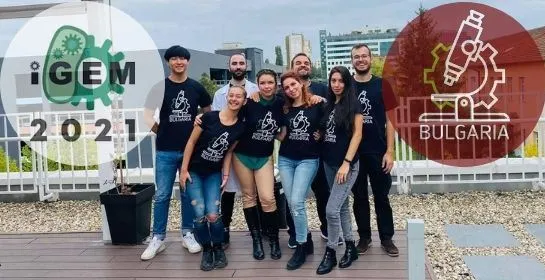
The Bulgarian team won a silver medal at the finals of the world's largest synthetic biology competition, iGEM, surpassing teams from Beijing Institute of Technology, United State Air Force Academy, and Johns Hopkins University. The team consisted of seven students from Sofia University "St. Kliment Ohridski" and Technical University – Sofia:
1. Teodora Gamizova – Master's student, major "Gene and Cell Engineering" – team captain
2. Alexander Popov (TU – Sofia) – Bachelor's student, major "Mechatronics"
3. Paschalina Karadakova – Master's student, major "Gene and Cell Engineering" – laboratory manager
4. Iva Vladimirova – Bachelor's student, major "Molecular Biology"
5. Paula Nikolova – Bachelor's student, major "Molecular Biology"
6. Rosen Ivanov – Master's student, major "Cell Biology and Pathology"
7. Jong Park – Master's degree, major in "Biochemistry"
The team's instructors were Mikaela Stancheva – Master's degree, major in "Genetics and Genomics" and Antonio Stoichkov – Bachelor's degree, major in "Philosophy", while the scientific supervisors were Assoc. Prof. Dr. Eng. Boris Kirilov (TU – Sofia) – the team's first scientific supervisor and Assoc. Prof. Dr. Slavil Peykov (Sofia University "St. Kliment Ohridski") – the team's second scientific supervisor. The project that brought the team the distinction is directly related to the current epidemic situation and the increased intake of antibiotics. It is well known that sporadic and excessive intake of antibiotics often leads to antibiotic resistance or, put simply, at some point, antibiotics stop working. In connection with the problem of antibiotic resistance, the team focused on identifying specific genes that cause it. The developed project offers a scientific basis for creating an information database, through which it will be easy to determine the correct antibiotic therapy for a specific individual. Based on the results obtained, scientific communities around the world can reconsider the entire process of creating antibiotics. The team's work focuses on two key approaches to studying antibiotic resistance:
1st approach: based on the discovery of specific genes that cause antibiotic resistance
2nd approach: focuses on the discovery of mutations that alter the normal proteins of bacteria, thereby making them resistant.
Alexander Popov – barn engineer, developed a system based on computer vision that allows monitoring the growth rate of cells. The iGEM International Genetically Engineered Machine competition has a long history and is the largest and only one of its kind. Participants have the opportunity to engage in the development of comprehensive scientific projects to address global challenges. In the latest edition of the iGEM competition, over 350 teams from around the world participated, including both small universities and large institutions such as Harvard University and the Massachusetts Institute of Technology. The finals of the competition were held from 04.11.2021 to 14.11.2021 in a remote format. Bulgaria participated once again, and the Bulgarian team has so far won one silver medal and two bronze medals, which proves that Bulgarian scientists have a place on the global scientific stage in the field of synthetic biology. The team's successes over the years were made possible thanks to the enormous support from "Sofia Tech Park", Sofia University "St. Kliment Ohridski", the Student Council at Sofia University "St. Kliment Ohridski", the Technical University – Sofia, the Student Council at the Technical University – Sofia, Ridacom, and many other organizations.