
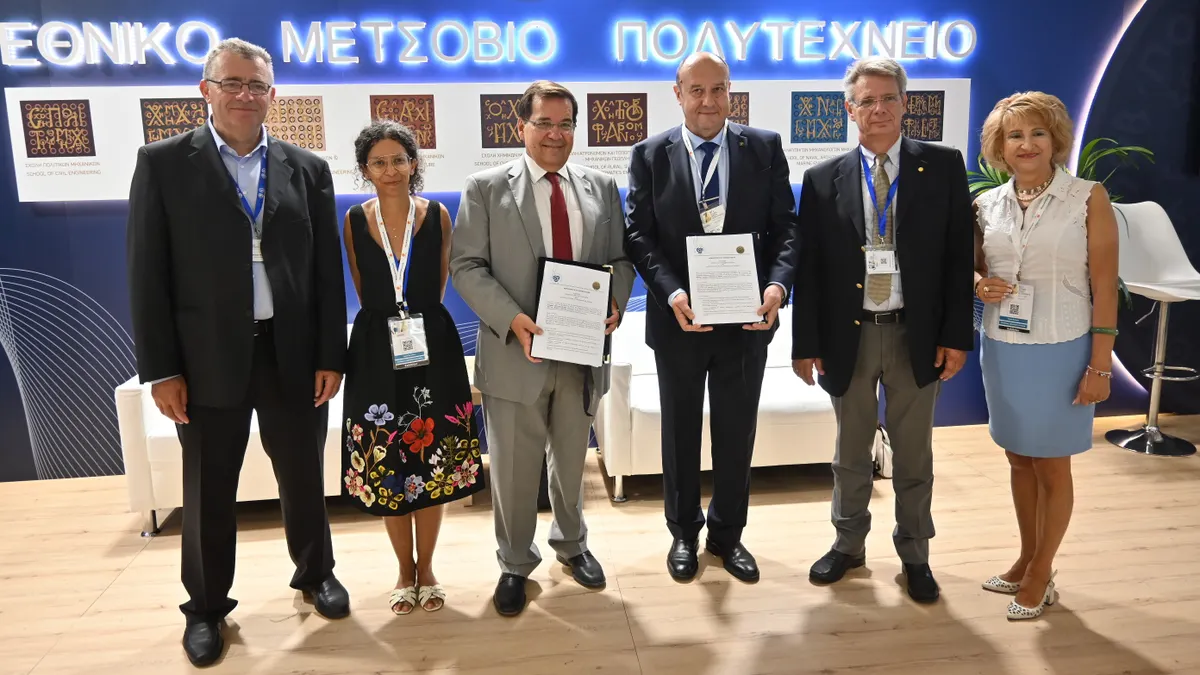
Prof. Králov expressed hope that strengthening ties with the National Technical University of Athens - NTUA will contribute to better interaction and future work between scientists - engineers and between the two largest technical universities in the region.
"The future is now," the rector noted, "there is no need to waste more time; we must quickly exchange scientific research and joint development programs. Business is waiting for ready proposals. The time is dynamic, and if we do not unite in knowledge, we will lose students, research, and most importantly - long-term and fruitful cooperation."
Prof. Andreas Buduvís said that there is much dynamic work ahead, that our ties and relationships are deepening, and that we are becoming closer friends and partners.
Faculty members from the Athens Polytechnic demonstrated various of their developments and products to the Bulgarian group of specialists. The electronic pass for people with disabilities or those recovering from severe injuries made the strongest impression. The other demonstration was a GPS system for tracking vehicles, people, and those with severe physical disabilities. The Greek colleagues work with sponsors, and their developments are the result of joint work with the Ministry of Health, the Ministry of Education, the Ministry of Transport, the Ministry of Internal Affairs, and talented high school students in Greece.
"There are different levels of interaction, both with the government and business, as well as with every gifted student," Professor Buduvís added.
The leadership of the Athens Polytechnic also visited the pavilion of the Technical University - Sofia.
Later, a round table was held to outline future steps for joint work in the fields of telecommunications, information technology, and other areas.
The National Technical University of Athens - NTUA is structured according to the European system of engineering education, with an emphasis on solid training. The duration of courses, leading from the acquisition of 300 credit units to a master's degree, is five years. The valuable work of NTUA and its international reputation are due to its well-organized educational and research system, the quality of its staff and students, and the adequacy of its technical infrastructure. NTUA graduates have been key to Greece's pre-war development and post-war recovery. Graduated engineers working in public and private technical services and companies are on par with their European colleagues. Many of them have been selected for distinguished teaching and research positions at renowned universities around the world.
The University provides higher education of exceptional quality in science and technology through its integrated complex of studies and research.
To this end, NTUA operates as a state university with nine schools that are self-governing through the Senate, the Rector, the Vice-Rectors, the school directors, representatives of the academic staff and students from each school, as well as representatives from other university bodies.
It is no coincidence that the Technical University – Sofia is the only university present at this event; it is the largest and most important in the region, has extensive international activities, and these activities continue to develop and expand. We will sign a memorandum of cooperation and future mutual actions with the National Technical University of Athens, the largest Technical University in Greece, and this is a natural continuation of our ties with Greek researchers. The Technical University – Sofia is not only well known in Europe and around the world; it is also already part of the European alliance called the European Technological University EuT+. The International Technical Exhibition in Thessaloniki is a suitable place where we present our vision of building a technical university for future generations, a university that transcends the borders of Bulgaria and prepares specialists in engineering fields, the next generation that will define engineering specialties, the new services that will benefit society, people, business, and regions. There is no area of human development that does not involve engineering activity. We are creating the future; the technical elite of nations turns the future into reality.