
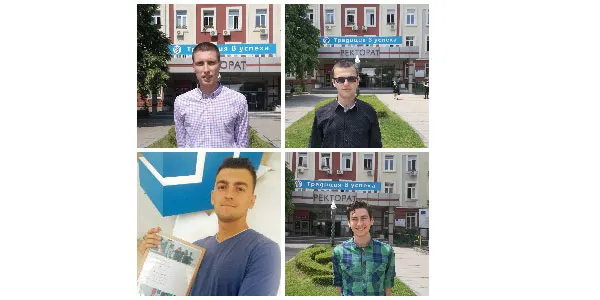
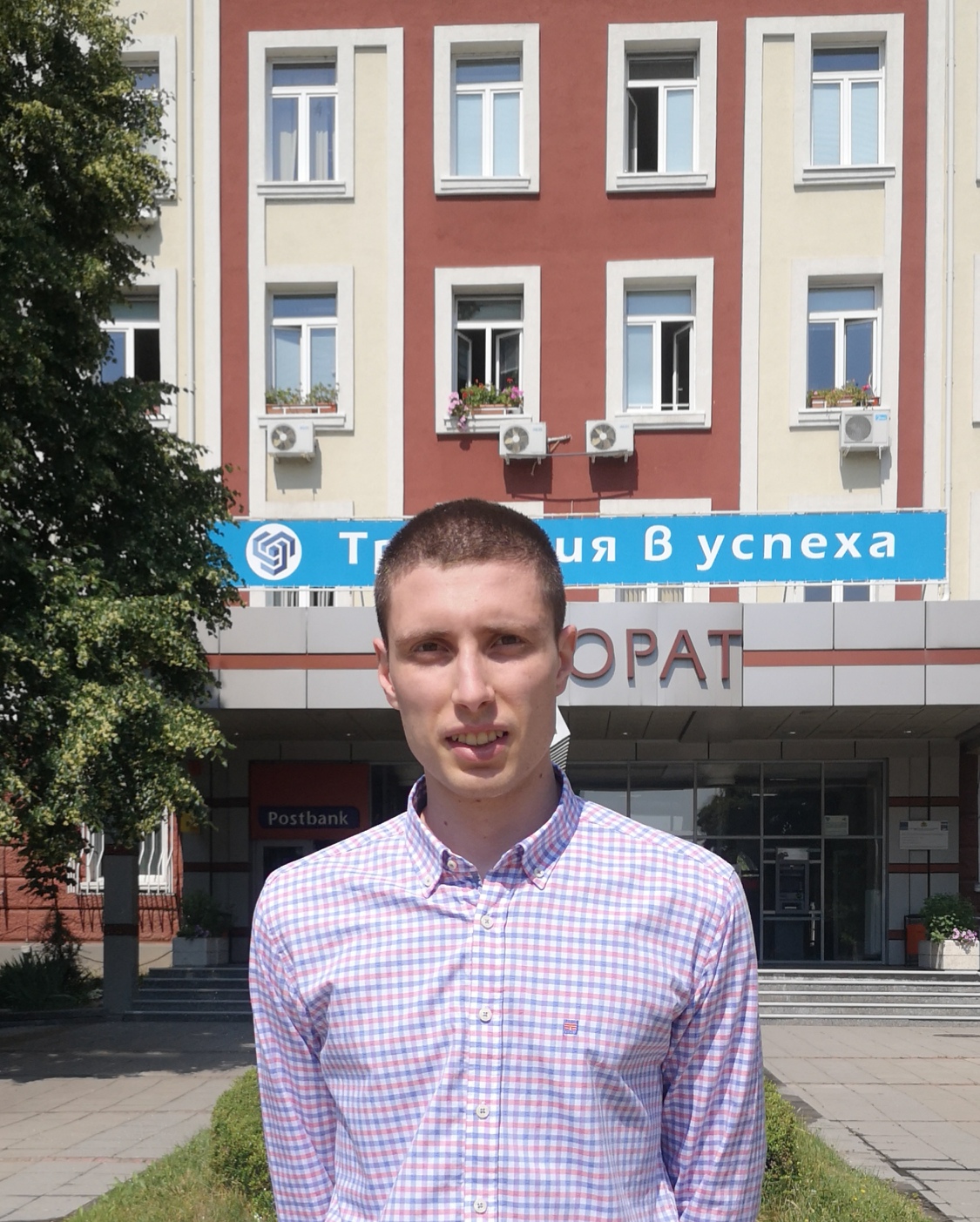
Denislav Trifonov
1st-year student, Higher Education Level "Master"
Specialty: "Electronics"
Faculty of Electronic Engineering and Technologies
1. What is the competition and how did it go? What motivated you to participate? Who were your strongest competitors?
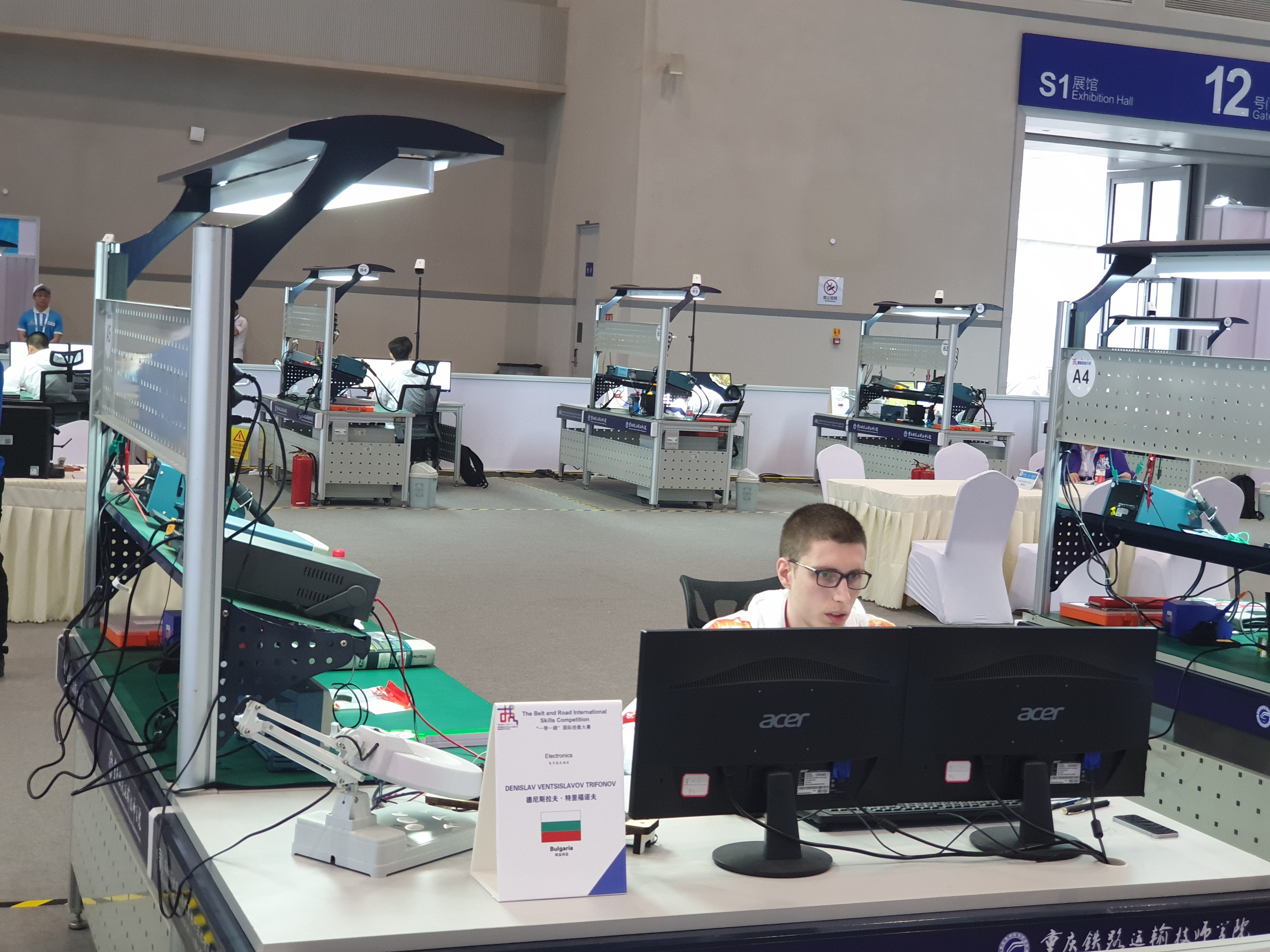
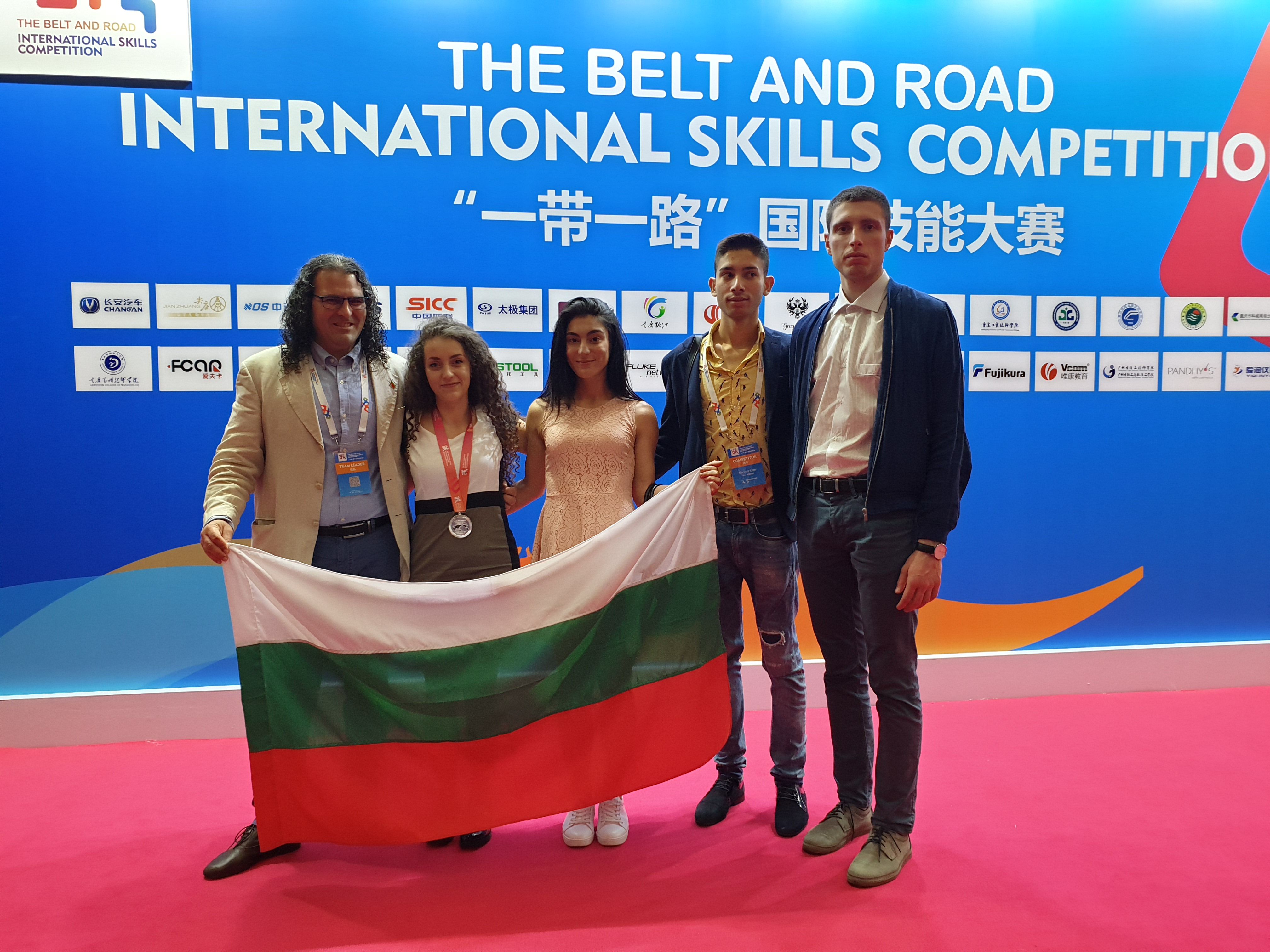
The competition includes 18 different disciplines. Over 700 people from 44 countries participated, with an age limit of up to 24 years. The Bulgarian team consisted of two school students and two university students who competed in the disciplines of "Hairdressing", "Cosmetology", "Logistics", and "Electronics". I participated in the "Electronics" discipline, where there were 18 competitors. I ranked 10th with 677 points, while the fourth-place competitor had 679 points, meaning the difference was very small. The competition took place from May 25th to May 31st this year in Chongqing, China, and was organized by the Ministry of Human Resources and Social Security, National Development and Reform Commission, National Development Cooperation Agency, and Chongqing Municipal People's Government. It is part of the "One Belt, One Road" initiative of the President of the People's Republic of China, Xi Jinping. The competition in my discipline was divided into three parts. The first part involved designing electronic circuits, in the second part the task was to design a printed circuit board for a given electrical circuit, and in the third part, we had to program a microprocessor system. My motivation for participating was primarily to test my knowledge and compare it with that of my colleagues from other countries. All participants were at a quite serious level. The representatives of South Korea, Russia, and China took the top three places.
2. How do you see your future professional development?
I would like to continue developing in engineering sciences, in the field of electronics, and specifically in Bulgaria. I would like to succeed in combining science and industry, because theory and practice go hand in hand.
3. What is your advice to young people - what profession should they choose? Why should they come to study at TU - Sofia?
I advise young people to choose an engineering specialty, because this is a profession that has always been in demand and has many prospects for us as specialists. I personally convinced myself in conversations with colleagues from other countries that the preparation provided here at TU - Sofia is at a high level. So, I can tell prospective students that here they will receive diverse knowledge that will be useful in many fields.
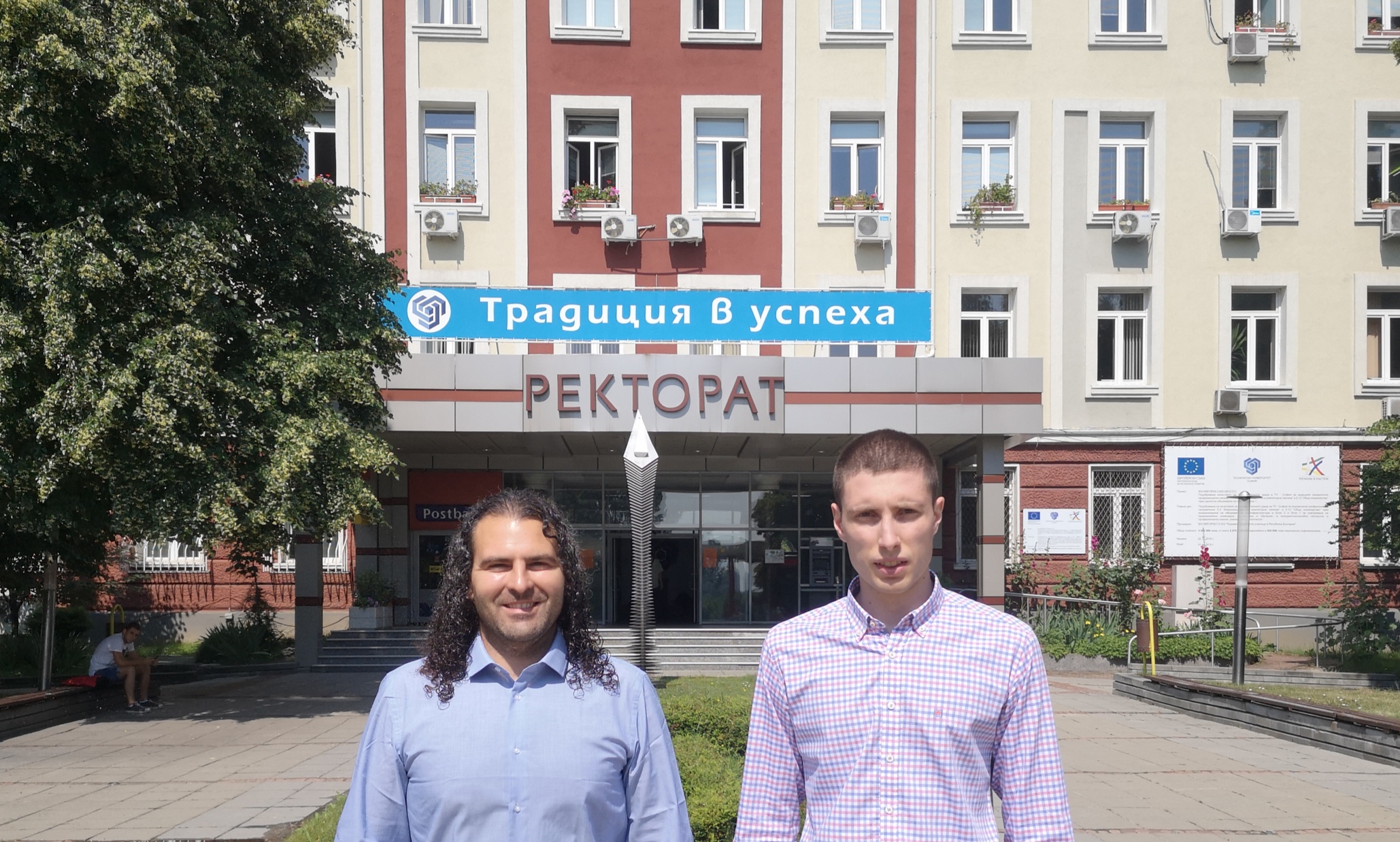
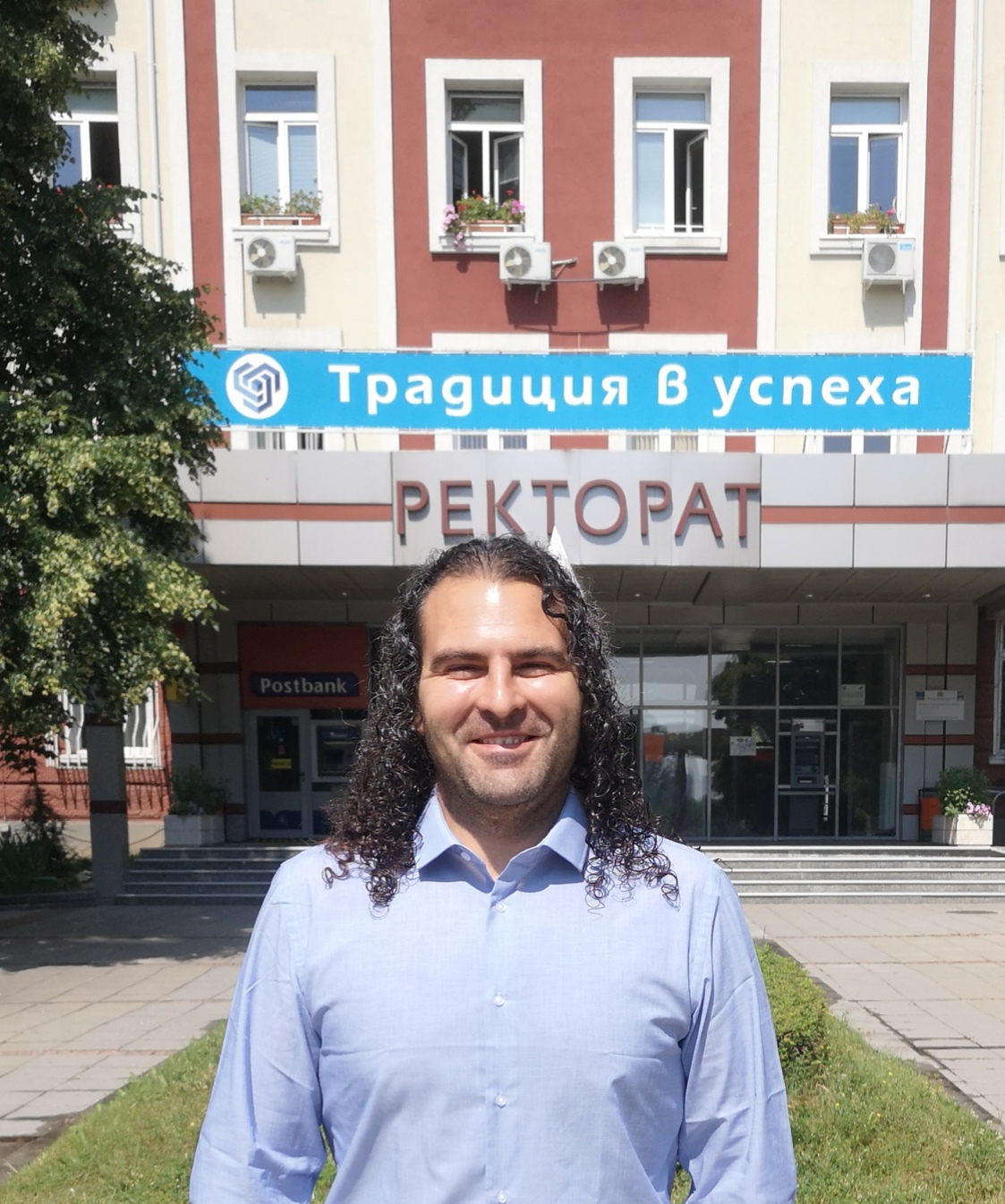
Assoc. Prof. Dr. Dimitar Nikolov,
Senior Assistant at the Department of "Electronic Engineering"
Faculty of Electronic Engineering and Technologies
1. What was your role in the competition?
The Ministry of Education and Science assigned me to be the head of the Bulgarian delegation. Regarding Denislav's preparation, I helped him with advice, but he prepared mainly on his own. Unfortunately, we did not know the exact format of the competition, and nevertheless, he did excellently, because in my opinion his knowledge was better than that of many of his competitors.
2. How can young university lecturers be attracted?
In my opinion, they should primarily come from among the student body. Therefore, I believe that one of the best approaches is to increase work with students and encourage their greater participation in research projects, so they can understand what academic activity entails, namely a combination of research and teaching. It brings a different kind of satisfaction. Of course, their financial incentives should also be considered, as it is well known that a recently graduated engineer receives significantly higher pay in industry.
3. What is your advice to young people - which profession should they choose? Why should they come to study at TU-Sofia?
My advice is to choose an engineering specialty, because there is a huge demand for engineers in all fields and everywhere in the world. And why should they come to study at TU-Sofia? Because it is the best higher technical university in Bulgaria. For example, Lena Todorova – the other student participant in the 'Logistics' competition, a graduate of the Economics Academy in Ruse – is considering continuing her education at our university in the field of transport.
Steven Kachulkov from the Technical University - Sofia won the 'Become a CEZ Scholar' competition for students, 2018-2019 edition. His certificate was presented on the eve of the Day of Bulgarian Education and Culture and of the Slavic Script by the Regional Manager of CEZ for Bulgaria, Karel Kral.
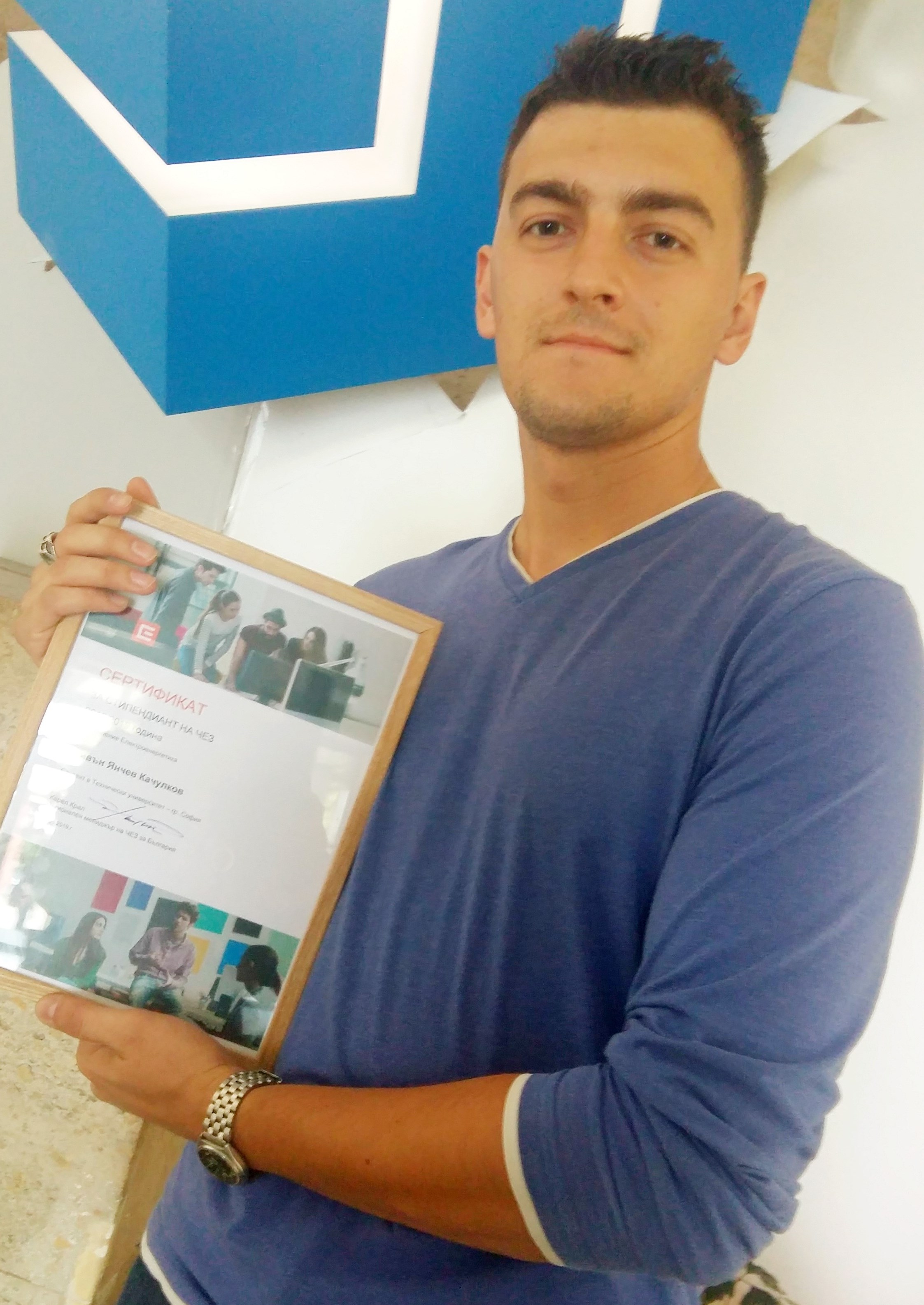
Steven Kachulkov
graduate with a Master's degree from the Faculty of English Engineering Education
specialty 'Industrial Engineering' in English"
BSc in Transport Engineering, Faculty of Transport, major "Aircraft Technology and Engineering"
CHEZ Scholarship recipient for 2018/2019
1. HHello Steven! What motivated you to apply for this scholarship?
I liked the fact that CHEZ wants to help young people who want to invest in their education. One should never stop learning, improving, and increasing their competence. Lack of education and competence is detrimental to someone who wants to add the title of engineer before their name. In the requirements for this CHEZ scholarship, I saw myself, so I decided to apply and won it.
I will invest the scholarship in training and improving my knowledge. I have a desire to learn Russian.
2. What is the connection between aircraft technology, industrial engineering, energy, and electricity distribution?
I enrolled in a Master's program in "Industrial Engineering" after my Bachelor's in "Aircraft Technology and Engineering" because I wanted to develop further as an industrial engineer. It covers everything necessary as basic knowledge for an industrial engineer. The training is in English, which helps to build upon both language skills and engineering sciences. Thus, with all the acquired knowledge and skills, we can help the Bulgarian industry develop and not rely solely on trade and outsourcing from abroad. The engineer must provoke and initiate the development of the Bulgarian industry. Good engineers are sought everywhere.
3. How do you see your future?
First, as a master's graduate in Industrial Engineering, then as a PhD student at TU-Sofia, as a competent engineer who can learn from older colleagues and teach younger ones. To work and develop in Bulgaria.
4. Would you recommend TU-Sofia, the Faculty of English Instruction in Engineering, or the Faculty of Transport to young people seeking higher education?
FEIE is an excellent faculty, and the dean, Prof. Tasho Tashev, is a very warm and responsive person. He always talks with students, receives them in his office, and encourages them to participate in international programs and internships. He is the coordinator for TU-Sofia for the EU project 'Erasmus+' for student mobility. The lecture courses are diverse and there is much to learn. I really like the teachers. The supervisor of my thesis, Assoc. Prof. Dimo Stoilov, is a great person; I learned a lot from him when designing my thesis. The Faculty of Transport is also a very good faculty. I recommend it! It provides a very good basic engineering education. It is difficult, but that is exactly what shapes a person and makes them confident in themselves and their results. A lot of emphasis must be placed on self-study and learning at home.
Iliyan Kordov
1st-year student
Specialization: "Informatics and Software Sciences"
Faculty of Applied Mathematics and Informatics
1. Why did you choose to continue your education at TU-Sofia?
I graduated from the Technological College "Electronic Systems" at TU-Sofia. After that, I decided that the best choice for my professional development was to choose the Faculty of Mathematics and Applied Informatics.
2. Do you see a perspective to continue your career development at TU-Sofia?
Yes. I would like to continue my development at TU-Sofia, as well as engage in scientific research. I already have participation with a publication at an international conference. Currently, I am preparing another report for an upcoming conference.
3. What would you say to your future colleagues at TU-Sofia?
I would advise them, in addition to attending lectures and exercises, to make the best use of the resources and opportunities offered by the university, such as participation in national and international projects, summer internships, scientific-applied activities, and participation in foreign exchange under the "Erasmus" program.+“.
Nikolay Marinov
1st year student
Specialty: "Telecommunications"
Faculty of Telecommunications
1. What motivated you to apply for such an attractive competition?
Actually, my participation in the national round was quite a coincidence, because the school maintains very good relations with my English teacher. I love this language, she knew it, and we worked on many different projects related to English, and one day she came and asked me if I would like to participate in a national public speaking competition in English as a representative of my school. At first, I wondered a lot whether to go or not, because after all, I was a bit ashamed to speak in front of an audience. But I decided. I said: "I will go, I will do it." I signed the necessary documents, sent a brief summary of my speech content, and on April 1st, the competition took place. Without much prior preparation, I went and delivered the speech. The jury did not seem either very impressed or very indifferent to the speech. It was quite neutral. And after they started announcing the winners, 3rd place, 2nd place, I told myself that there was no longer any chance. And after a short speech by the chairman of the Union of English Speakers in Bulgaria, from whose union the competition was organized, my name was mentioned for first place, and I was in shock. And my first thought was: "I'm going to London," because for me this was a very big dream - to go to the Island, which was actually fulfilled by this competition.
2. Tell us more about the competition you participated in
The competition takes place in multiple rounds, with the national round in Bulgaria being the primary one, followed by the world round, in which representatives from over 50 countries participate, one from each country, held in London. After my participation in the national round, I worked extensively with the chairman of the Union of English Speakers in Bulgaria to standardize the way representatives are selected from schools and to promote public speaking as an activity that is not formally taught but with which students become familiar at school, rather than simply selecting specific individuals. Having visited schools for the second year to conduct workshops and show children how they can improve, how to behave in front of an audience, and some small tricks regarding body language, I have seen how to prevent their legs from shaking, etc. The voice and mouth are slightly more difficult, as there are tricks for the knees, but not specifically for the voice. If the voice trembles, it is very difficult; one must simply master it mentally. The competition itself, the national round, requires participants to deliver a speech of 5 minutes on a pre-determined topic, in English, of course. This is followed by 2 minutes of questions from the jury and the audience regarding the content. The topics are common to all, but they are always chosen so as not to be too broad. In my year, the topic was "Peace does not mean the absence of war." This topic existed at both the national and world levels, and people interpreted the text in so many different ways. Some interpreted it with heat waves, with weapons, while others, including myself, decided to speak about the war between people. We ourselves can communicate with each other and set aside differences. And the topics are always like this. The world round is a bit different. From these 52 people, 6 are selected to go to the finals. In the qualifications, there are two types of speeches: again, a 5-minute speech on a pre-assigned topic, which allows for preparation, and another speech called the "In Pronto" speech, for which 3 topics are given, and 15 minutes before going on stage to speak, the participant actually has 15 minutes to prepare a 3-minute speech, without using any help, any sources, only an English dictionary and their imagination.
However, something that is very close to my heart regarding public speaking in general is that it reveals the way of thinking, the colorfulness, because a topic can be interpreted by three people in three different ways, and I have seen, because I have been a jury member at the school and at the national level, such interpretations, but not the same ones, no matter how many people speak on the same topic. This is actually the thing about public speaking that always excites me when I know I will hear a speech.
3. What would you say to your future colleagues at TU-Sofia?
Perhaps I will continue the legacy of my high school Bulgarian language teacher, because she believed that absolutely every person, regardless of their field—whether languages, mathematics, physics, chemistry, or any other profession—can be an active citizen of society and express their opinion in a dignified manner, and I believe this is very important.
Although colleagues at the Technical University emphasize mathematics and the exact sciences more, activities such as public speaking and debating should not be forgotten. Because they develop thinking and the expression of opinion, which is especially important for our generation in Bulgaria, so that we can change the status quo and create a civil society.