

Assoc. Prof. Georgi Todorov, Dean of the Faculty of Industrial Technologies at TU-Sofia, on "Futurism"
At the Technical University, work is underway on a project with European funding for electric vehicle architecture, aiming to make them lighter, more reliable, more economical, and with greater range. The goal is for the vehicle to be cheaper than current gasoline models. For this purpose, Europe is allocating significant resources, and we hope to see a breakthrough in this regard within 2-3 years. This was stated by Assoc. Prof. Georgi Todorov, Dean of the Faculty of Industrial Technologies at TU-Sofia, in the show "Futurism" hosted by Anton Gruev.
In the "cell-to-chassis" electric vehicle project, battery cells are part of the chassis structure, unlike current models where batteries are mounted as a separate package. Prof. Todorov stated that the concept uses only seven large elements made of light metals, thereby reducing the number of parts, carbon footprint, and production costs. Additionally, the battery cells are solid-state, making them safer and more durable, with 40% of their capacity consisting of portable and replaceable modules that can be swapped in minutes, similar to batteries in internal combustion engine vehicles.
"These three innovations are not visible to the end user; they see a familiar vehicle that is, however, lighter, cheaper, and has a greater range." According to the guest, the innovations allow for a range of 800-1000 km with a charging time of 10-15 minutes. He announced that a patent for the architecture has already been submitted, and a ready prototype is expected soon. "Once we prove its efficiency, the industry will be able to industrialize it."
At the Technical University, work is underway on a project with European funding for electric vehicle architecture, aiming to make them lighter, more reliable, more economical, and with greater range. The goal is for the vehicle to be cheaper than current gasoline models. For this purpose, Europe is allocating significant resources, and we hope to see a breakthrough in this regard within 2-3 years. This was stated by Assoc. Prof. Georgi Todorov, Dean of the Faculty of Industrial Technologies at TU-Sofia, in the show "Futurism" hosted by Anton Gruev.
In the "cell-to-chassis" electric vehicle project, battery cells are part of the chassis structure, unlike current models where batteries are mounted as a separate package. Prof. Todorov stated that the concept uses only seven large elements made of light metals, thereby reducing the number of parts, carbon footprint, and production costs. Additionally, the battery cells are solid-state, making them safer and more durable, with 40% of their capacity consisting of portable and replaceable modules that can be swapped in minutes, similar to batteries in internal combustion engine vehicles.
"These three innovations are not visible to the end user; they see a familiar car, but it is lighter, cheaper, and has a longer range." According to the guest, the innovations allow for a range of 800-1000 km with a charging time of 10-15 minutes. He announced that a patent for the architecture has already been submitted and a ready prototype is expected soon. "Once we prove its efficiency, the industry will be able to industrialize it."
Functional and programmable coatings
The interviewee stated that TU-Sofia is also developing a new generation of diamond-like coatings – materials with exceptional hardness, reaching 70-80% of that of natural diamond, but with a thickness of 3 to 5 micrometers. "We do not want our industry to fall behind, as these coatings are used, but with technologies from outside the country. We want to make the technology accessible to companies in Bulgaria."
The ultimate goal is "programmable coatings," which change their properties according to their purpose, meaning that new functions can be added to these materials or the cost of existing applications can be reduced. "However, most applications of parts are rather invisible to the end user, but they contribute to having competitive products of high quality and at an accessible price."
3D printing of metal components
Prof. Todorov announced that the university has also developed its own patent, which allows for the creation of 3D printed elements with high performance. Geometric limitations are eliminated, allowing for the development of products with complex shapes, while simultaneously solving the problem of inaccuracy.
"By combining material addition and removal, we are able to produce complex parts that were previously impossible to manufacture." The guest said that this technology finds application in personalized bone, skull, and spinal implants, which are fully tailored to the patient's structure.
bloombergtv.bg
At the Technical University, work is underway on a project with European funding for electric vehicle architecture, aiming to make them lighter, more reliable, more economical, and with greater range. The goal is for the vehicle to be cheaper than current gasoline models. For this purpose, Europe is allocating significant resources, and we hope to see a breakthrough in this regard within 2-3 years. This was stated by Assoc. Prof. Georgi Todorov, Dean of the Faculty of Industrial Technologies at TU-Sofia, in the show "Futurism" hosted by Anton Gruev.
In the "cell-to-chassis" electric vehicle project, battery cells are part of the chassis structure, unlike current models where batteries are mounted as a separate package. Prof. Todorov stated that the concept uses only seven large elements made of light metals, thereby reducing the number of parts, carbon footprint, and production costs. Additionally, the battery cells are solid-state, making them safer and more durable, with 40% of their capacity consisting of portable and replaceable modules that can be swapped in minutes, similar to batteries in internal combustion engine vehicles.
"These three innovations are not visible to the end user; they see a familiar vehicle that is, however, lighter, cheaper, and has a greater range." According to the guest, the innovations allow for a range of 800-1000 km with a charging time of 10-15 minutes. He announced that a patent for the architecture has already been submitted, and a ready prototype is expected soon. "Once we prove its efficiency, the industry will be able to industrialize it."
At the Technical University, work is underway on a project with European funding for electric vehicle architecture, aiming to make them lighter, more reliable, more economical, and with greater range. The goal is for the vehicle to be cheaper than current gasoline models. For this purpose, Europe is allocating significant resources, and we hope to see a breakthrough in this regard within 2-3 years. This was stated by Assoc. Prof. Georgi Todorov, Dean of the Faculty of Industrial Technologies at TU-Sofia, in the show "Futurism" hosted by Anton Gruev.
In the "cell-to-chassis" electric vehicle project, battery cells are part of the chassis structure, unlike current models where batteries are mounted as a separate package. Prof. Todorov stated that the concept uses only seven large elements made of light metals, thereby reducing the number of parts, carbon footprint, and production costs. Additionally, the battery cells are solid-state, making them safer and more durable, with 40% of their capacity consisting of portable and replaceable modules that can be swapped in minutes, similar to batteries in internal combustion engine vehicles.
"These three innovations are not visible to the end user; they see a familiar car, but it is lighter, cheaper, and has a longer range." According to the guest, the innovations allow for a range of 800-1000 km with a charging time of 10-15 minutes. He announced that a patent for the architecture has already been submitted and a ready prototype is expected soon. "Once we prove its efficiency, the industry will be able to industrialize it."
Functional and programmable coatings
The interviewee stated that TU-Sofia is also developing a new generation of diamond-like coatings – materials with exceptional hardness, reaching 70-80% of that of natural diamond, but with a thickness of 3 to 5 micrometers. "We do not want our industry to fall behind, as these coatings are used, but with technologies from outside the country. We want to make the technology accessible to companies in Bulgaria."
The ultimate goal is "programmable coatings," which change their properties according to their purpose, meaning that new functions can be added to these materials or the cost of existing applications can be reduced. "However, most applications of parts are rather invisible to the end user, but they contribute to having competitive products of high quality and at an accessible price."
3D printing of metal components
Prof. Todorov announced that the university has also developed its own patent, which allows for the creation of 3D printed elements with high performance. Geometric limitations are eliminated, allowing for the development of products with complex shapes, while simultaneously solving the problem of inaccuracy.
"By combining material addition and removal, we are able to produce complex parts that were previously impossible to manufacture." The guest said that this technology finds application in personalized bone, skull, and spinal implants, which are fully tailored to the patient's structure.
bloombergtv.bg
Latest News and Events
View all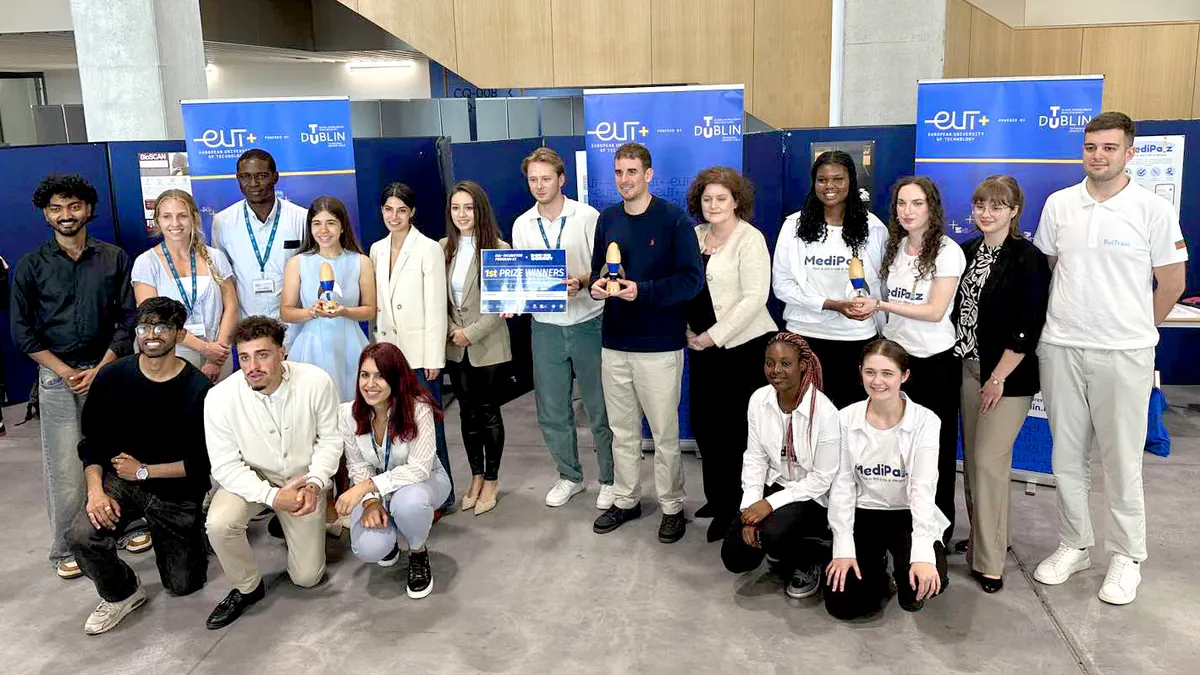
Events
The Technical University – Sofia with a worthy performance at the final of the international Incubation Program for Entrepreneurship in Dublin
July 04, 2026
Read more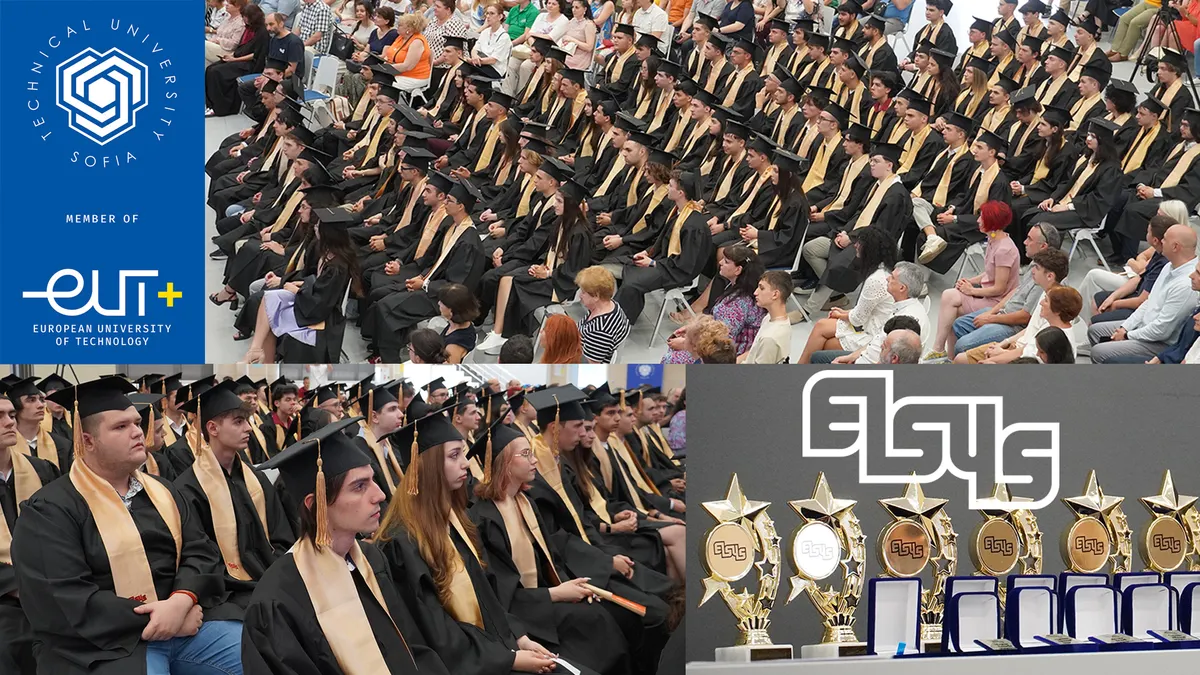
Events
The talented 34th Graduation Class of TUT received their graduation diplomas
June 23, 2026
Read more
Events
The Technical University – Sofia conquered Rila
June 23, 2026
Read more