
Where does the new Bulgarian military reconnaissance drone "Teres" take off from? From the laboratories of the Technical University – Plovdiv Branch. The minds of the best scientists, professors, doctoral students, and even students of this higher education institution are at the core of the new reconnaissance asset of the Bulgarian army. According to Associate Professor Dr. Eng. Hristian Panayotov (Deputy Director of the Technical University – Plovdiv Branch), it is logical that the new unmanned aircraft was created precisely in Plovdiv.
"Because Plovdiv has a nearly 60-year tradition in the development and production of military unmanned aerial vehicles, and we continue this activity. Over the last decade, we developed jet targets, and their production was carried out by the company "Telesys," whose manager is our colleague Senior Assistant Dr. Stoyan Avramov. It was precisely he who formulated the task: can we, based on the experience in our department "Transport and Aviation Technology and Engineering," develop a tactical-type unmanned aircraft for observation and reconnaissance. Our answer was: we can."
Qualities of "Teres"
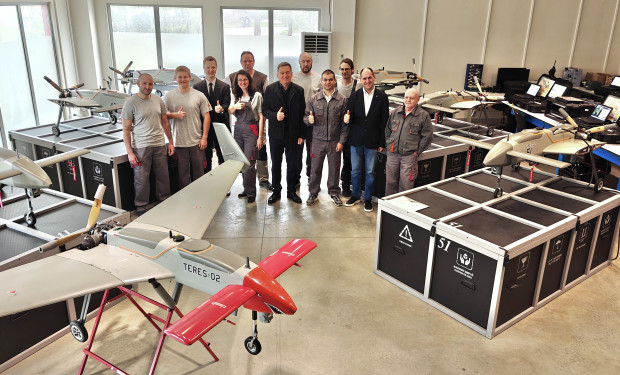
The Bulgarian reconnaissance drone is in no way inferior to similar aircraft produced in the USA, Europe, Israel, China, and Iran. The new unmanned aircraft has a flight duration of up to 5 hours, can reach an altitude of 4,500 meters, weighs approximately 50 kg, has a wingspan of 4 meters, and is equipped with equipment for observing the land and sea surface in the visible, infrared, and radio spectrum. The engine is gasoline-powered. It can patrol an area with a radius of over 100 kilometers.
The value of the deal between the Ministry of Defence and the association of companies "Telesys" and "Contract" is approximately 9 million leva without VAT, with the goal of developing and producing a total of 6 machines and ground control stations and equipment for this amount.
And yet, is the choice of "Teres" not emotional because it is Bulgarian? Associate Professor Dr. Hristian Panayotov gives a categorical answer to this question as well: "There is sufficient accessible information for comparison. The request from the Ministry of Defence was made through a public tender. The parameters of the unmanned aircraft are published; they are not secret. In terms of price/quality ratio, "Teres" is competitive because it won the tender. Moreover, it was accepted without remarks and is already in service. In short, "Teres" is competitive. It was chosen not for emotional reasons because it was produced by Bulgarian companies and developed by Bulgarian scientists and specialists.
It was chosen because it best meets the needs of our army. "Teres" meets the requirements and has the best price." Its godfather is Sr. Asst. Stoyan Avramov. Teres is the name of a Thracian king, but it is also an abbreviation (from English) – TElesys REconnaissance and Surveillance, which translates to Telesys, reconnaissance, and observation.
Where will the development go
If we have the opportunity to equip unmanned aerial vehicles with the most advanced and quite expensive sensors such as cameras, infrared sensors, radars, radio equipment, and navigation equipment, then we will have the best in the world. But it depends on the ability of our army to allocate such funds. Usually, only wealthy countries can afford this type of expensive equipment. However, there are also limitations in the supply of these expensive parts.
So our scientists must find competitive and effective solutions on their own. Since a large part of the cost of an unmanned aerial vehicle is formed by the value of the sensors embedded in it, it turns out that countries that allocate more funds will always be ahead.
However, the war in Ukraine has changed this perception. Bulgaria is no longer lagging behind in modern drone construction, because more and more high technologies are becoming price-accessible. What we see in Ukraine is that with technologies that are literally mass-market, more results can be achieved than with established companies, manufacturers of military equipment. We see that at some point, the military products of these established companies turn out to be outdated and inadequate to the requirements of modern warfare. So nothing is lost, and it is not a "law" that if we do not have the money of the richer, we will not be able to achieve high combat capability. Bulgaria has scientists who are sufficiently familiar with drone technologies. It is important for the state to support them so that they can realize their talent.
Can "Teres" be used for other purposes
The answer of Associate Professor Dr. Eng. Hristian Panayotov is: "Yes, of course. "Teres" has a dual purpose – if it can be used for reconnaissance and surveillance, it can safely be used for search and rescue. Currently, it is popular to purchase a service rather than expensive equipment. If you do not use the unmanned aircraft frequently, it will be difficult to recoup the investment, it will take at least 5-10 years, so it is more cost-effective for the mass consumer to pay for a service rather than a product."
focus-news.net
"Because Plovdiv has a nearly 60-year tradition in the development and production of military unmanned aerial vehicles, and we continue this activity. Over the last decade, we developed jet targets, and their production was carried out by the company "Telesys," whose manager is our colleague Senior Assistant Dr. Stoyan Avramov. It was precisely he who formulated the task: can we, based on the experience in our department "Transport and Aviation Technology and Engineering," develop a tactical-type unmanned aircraft for observation and reconnaissance. Our answer was: we can."
Qualities of "Teres"
The Bulgarian reconnaissance drone is in no way inferior to similar aircraft produced in the USA, Europe, Israel, China, and Iran. The new unmanned aircraft has a flight duration of up to 5 hours, can reach an altitude of 4,500 meters, weighs approximately 50 kg, has a wingspan of 4 meters, and is equipped with equipment for observing the land and sea surface in the visible, infrared, and radio spectrum. The engine is gasoline-powered. It can patrol an area with a radius of over 100 kilometers.
The value of the deal between the Ministry of Defence and the association of companies "Telesys" and "Contract" is approximately 9 million leva without VAT, with the goal of developing and producing a total of 6 machines and ground control stations and equipment for this amount.
And yet, is the choice of "Teres" not emotional because it is Bulgarian? Associate Professor Dr. Hristian Panayotov gives a categorical answer to this question as well: "There is sufficient accessible information for comparison. The request from the Ministry of Defence was made through a public tender. The parameters of the unmanned aircraft are published; they are not secret. In terms of price/quality ratio, "Teres" is competitive because it won the tender. Moreover, it was accepted without remarks and is already in service. In short, "Teres" is competitive. It was chosen not for emotional reasons because it was produced by Bulgarian companies and developed by Bulgarian scientists and specialists.
It was chosen because it best meets the needs of our army. "Teres" meets the requirements and has the best price." Its godfather is Sr. Asst. Stoyan Avramov. Teres is the name of a Thracian king, but it is also an abbreviation (from English) – TElesys REconnaissance and Surveillance, which translates to Telesys, reconnaissance, and observation.
Where will the development go
If we have the opportunity to equip unmanned aerial vehicles with the most advanced and quite expensive sensors such as cameras, infrared sensors, radars, radio equipment, and navigation equipment, then we will have the best in the world. But it depends on the ability of our army to allocate such funds. Usually, only wealthy countries can afford this type of expensive equipment. However, there are also limitations in the supply of these expensive parts.
So our scientists must find competitive and effective solutions on their own. Since a large part of the cost of an unmanned aerial vehicle is formed by the value of the sensors embedded in it, it turns out that countries that allocate more funds will always be ahead.
However, the war in Ukraine has changed this perception. Bulgaria is no longer lagging behind in modern drone construction, because more and more high technologies are becoming price-accessible. What we see in Ukraine is that with technologies that are literally mass-market, more results can be achieved than with established companies, manufacturers of military equipment. We see that at some point, the military products of these established companies turn out to be outdated and inadequate to the requirements of modern warfare. So nothing is lost, and it is not a "law" that if we do not have the money of the richer, we will not be able to achieve high combat capability. Bulgaria has scientists who are sufficiently familiar with drone technologies. It is important for the state to support them so that they can realize their talent.
Can "Teres" be used for other purposes
The answer of Associate Professor Dr. Eng. Hristian Panayotov is: "Yes, of course. "Teres" has a dual purpose – if it can be used for reconnaissance and surveillance, it can safely be used for search and rescue. Currently, it is popular to purchase a service rather than expensive equipment. If you do not use the unmanned aircraft frequently, it will be difficult to recoup the investment, it will take at least 5-10 years, so it is more cost-effective for the mass consumer to pay for a service rather than a product."
focus-news.net