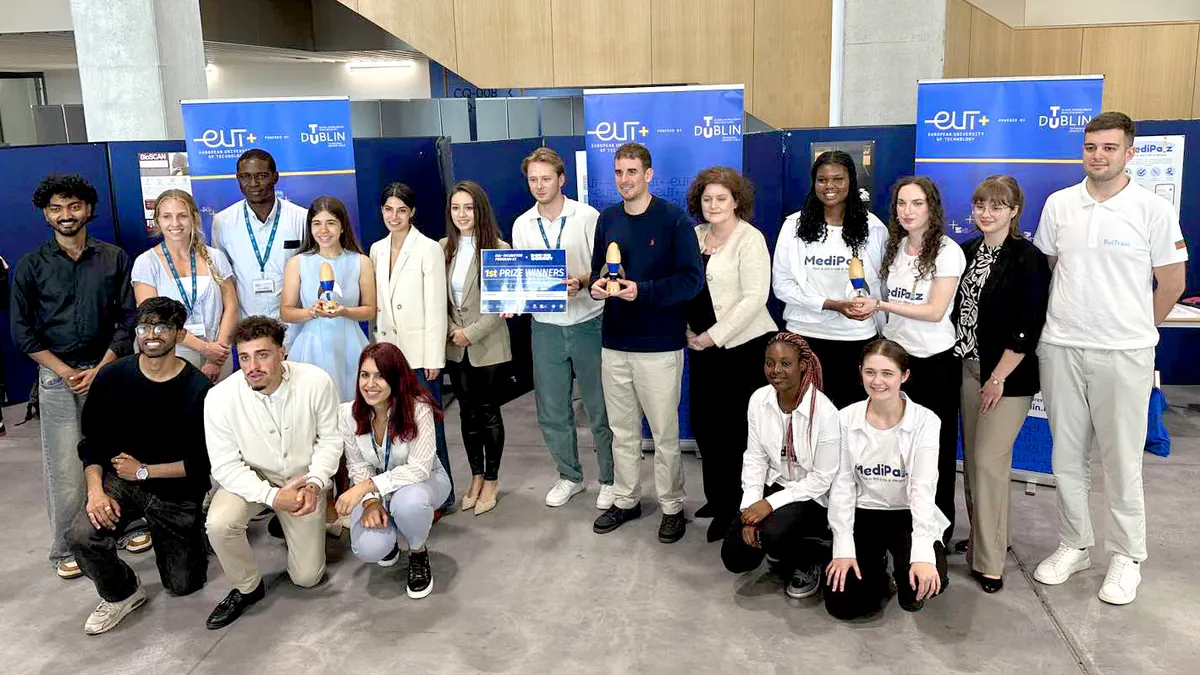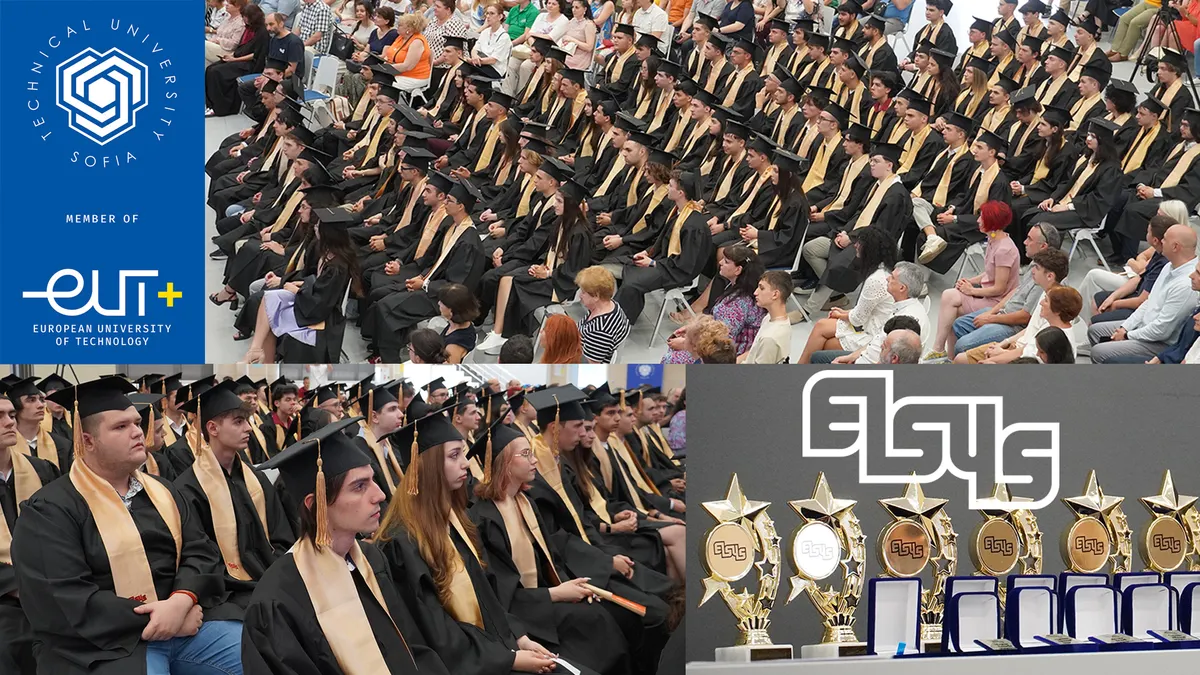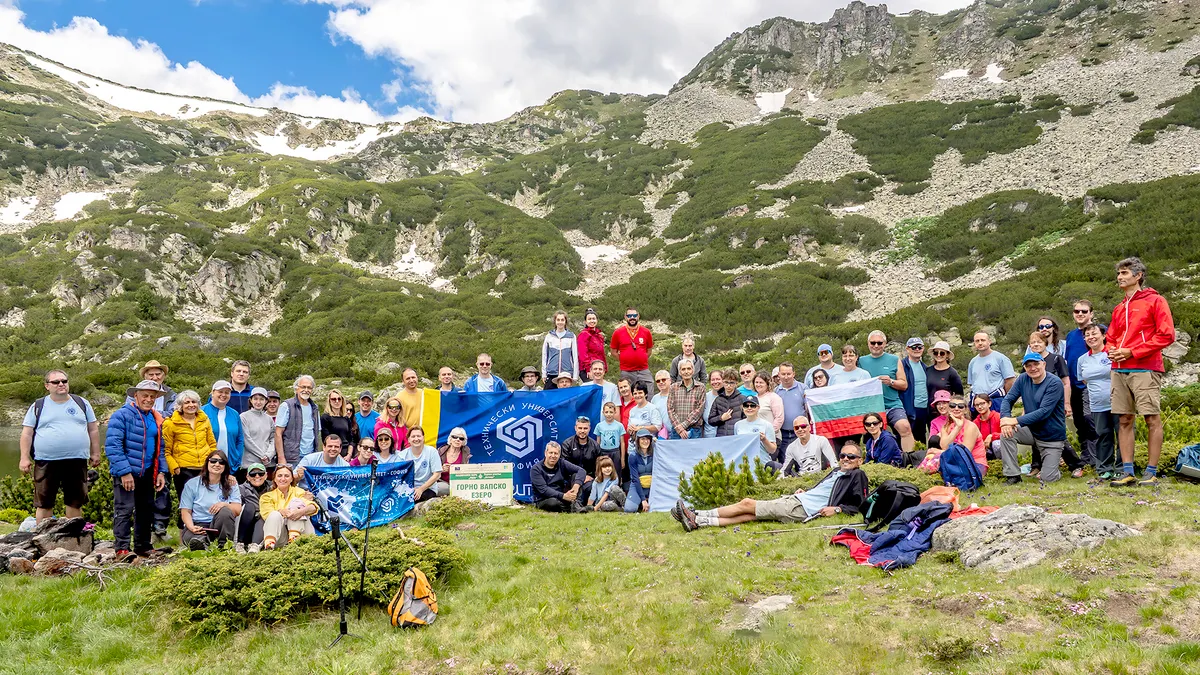

In the laboratory, they capture carbon dioxide and put it into agriculture, showing businesses how to create successful biotopes, good thermal insulation, and sturdy panels for construction from waste.
From the new academic year, students are preparing for the big challenge - which block will generate the least emissions.
From the new academic year, students are preparing for the big challenge - which block will generate the least emissions.
One of the leading Bulgarian universities in the field of environmental protection and circular economy innovations - TU - Sofia, has received worldwide recognition for its activities for the first time. The efforts of the rector's team, Prof. Georgi Venkov, were rewarded not by just anyone, but by the international rating system Times Higher Education Impact in the green technology category.
In the prestigious ranking, no educational institution can accidentally appear - it is necessary to prove through a number of indicators what systematic efforts are made not only to reduce its carbon footprint, but also to develop green technologies and innovations.
The main credit for this goes to the Sustainability Center, whose head is the rector of TU - Sofia, Prof. Georgi Venkov.
He is a mathematician who specialized in Italy and is firmly determined to pass on his vision for protecting life on the planet to the next generation of engineers.
Guided by this noble aspiration, he and his team developed a methodology for calculating the university's carbon emissions.
It is universal and can be adapted to the activities of any university, school, institution, or company. Not coincidentally, the methodology was published in the scientific journal Sustainability, which has a high impact factor and is in quartile Q1. A sign that the publication is among the leading ones in the respective field with the most citations and other various indicators.
Behind this breakthrough lies the team's strong desire to protect the planet as much as possible from global warming, minimize the damage caused by human activity, and pass on their love for the "small blue dot" to students.
"Nearly 2,000 people work at TU - Sofia, there are tens of thousands of students and their number is growing every year, so we set ourselves the goal of teaching them how to save water and energy, develop complex thinking, and constantly look for ways to minimize their carbon footprint," Prof. Venkov told "24 Chasa". Thus, a classic viral challenge is born within the team, filling students and staff with enthusiasm. Currently, student dormitories are being prepared for the competition of the year - which block will generate the least emissions.
There will be boards for each one that will precisely record the data, and at the end of the year, the winner will be determined.
"Next to each board, there will also be tips on how everyone can reduce their impact," Assoc. Prof. Dr. Eng. Denitsa Zgureva - Filipova explains.
"We really want to share this project with schools as well, because if children realize from an early age what kind of footprint they leave, and if they know how they can limit it, they will develop the necessary thinking right now and look for ways to reduce it," the rector smiles.
But the ambitious team does not stop there; currently, there are containers for separate waste collection next to every building within the university, and not coincidentally, the university has been awarded by "EKOpak".
Obviously, this approach yields results, as student teams from TU - Sofia frequently participate in competitions with projects focused on high sustainability. For example, their blinds, which are actually solar energy panels, were highly rated in Darmstadt.
Students enthusiastically responded to the challenge issued by former president Rosen Plevneliev, under whose patronage the "Green Technologies" competition was organized by "Lozen Tech Park" EOOD in partnership with TU - Sofia and other universities. Students from TU - Sofia participated with two projects, among which the idea of collecting rainwater from gutters to be used in the most rational way stood out.
"Innovations and new technologies are unthinkable without sustainability - the rector says thoughtfully. - This is a totality - a single whole. We claim that we educate the younger generation in academicism, but in today's times, a new paradigm, a new academic ethic for preserving nature, the future of humanity, the planet, is needed more than ever, to pass on this eternal aspiration to students and children as well."
It is no coincidence that the Center for Mechatronics and Clean Technologies with ultra-modern laboratories and equipment is located at TU - Sofia, whose building is designed to have a zero carbon footprint.
A true breakthrough in a world where almost every device leaves its carbon footprint.
"Therefore, it is more than ever necessary to form a new type of thinking in future engineers - notes Prof. Venkov. - Only in this way will they be able to construct environmentally friendly mobile devices, computers, laptops, lighting, household appliances, new generation materials, smart cities, and not heat islands like the current ones, etc."
Driven by this ambition, the team constructs smart devices that are mounted on faucets in restrooms, and a person, while washing their hands, observes how much energy "generates" from the flowing water.
The students themselves are also "infected" by the relentless ambition of their teachers and often, without any need for mentorship, surprise them with their innovative ideas. Whether these are cup holders made from recycled plastic from bottle caps, or university keychains created from recycled materials - fun and science always go hand in hand. But it is precisely this combination of the useful with the pleasant and the interesting keychains that impressed everyone at the Times Higher Education exhibition dedicated to sustainability in Istanbul.
This month, the scientific team working at the Sustainability Center successfully completed a project dedicated to the sustainable development of universities, funded by the National Recovery and Resilience Plan within the project: No.: BG-RRP-2.004-0005 "Improving the research capacity and quality for international recognition and sustainability of TU-Sofia."
However, the ambitions of Prof. Venkov and his team are by no means exhausted, as they have a far-sighted view of the future.
"The great goal that inspires us every day is to reduce our carbon footprint despite the increasing number of students each year," he says. He admits that it won't be easy, that there are objective difficulties, but the team is becoming more and more inventive and involving more and more young people in the initiative.
When asked if artificial intelligence helps them in finding new applications for waste, the professor pointed out that at this stage it is important to teach students how to use it correctly.
"In various circles, the idea of imposing serious restrictions is being discussed, but AI can be very useful in the educational process - with its help, new applications for waste can be discovered, new but valuable properties of materials can be identified, a new generation of coatings can be developed, and it can be a useful partner in any field related to technology and innovation. At the same time, we must explain to students that when they use it without realizing the information provided, without verifying it, and without subjecting it to critical analysis, this is extremely harmful to themselves."
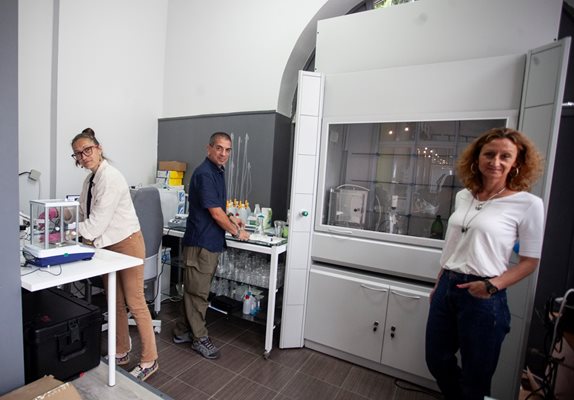
When we enter the team's laboratory, academia emanates from every corner, elegantly combined with fun and a friendly wink to students, which should accelerate the birth of new ideas.
To the left of the door, they show us the bicycle ergometer that generates electricity for the coffee machine - so anyone who wants coffee can personally generate the electricity needed for a cup.
"An engineer's work is always associated with achievements that lead to business success and higher profits - notes Assoc. Prof. Dr. Eng. Denitsa Zgureva - Filipova. - But when we manage to change their thinking alongside this - to strive for even lower emissions - then at some point the companies will also change. Some of them are already doing this and successfully highlighting these advantages."
Institutions and business are also extremely interested in innovative ideas.
"We are working with the fire department on a new initiative for a disaster and emergency response center using artificial intelligence - explained Prof. Venkov. - Currently, when there is a fire, people try to escape quite chaotically, but with the help of neural networks, they will be guided in a safe direction. With the chairman of the Bulgarian Chamber of Commerce and Industry, we have created a partnership for the development of a new type of cargo drones with a payload capacity of up to 50 kg - they will be very useful for spraying agents in agriculture, fire fighting, feeding wild animals, etc."
The industry is also looking for scientists, and the results show that an exceptionally interesting and beneficial partnership for all is underway. The laboratory is currently working under a grant on such a project.
"Two companies contacted us; one was interested in what to do with waste - sunflower husks, while the other develops materials - carriers for fertilizer substances," explains Assoc. Prof. Denitsa Zgureva-Philippova. "We established a connection between them and participated in the conceptual and technical design. Thanks to this, today we have a company that produces biofertilizer from ash obtained by burning sunflower husks - a typical example of a circular economy." The reason is that ash has long been categorized as hazardous waste that must be managed, with fees paid for landfilling, landfills requiring waterproofing, and transportation needed, which, in addition to being costly, also emits greenhouse gases and harmful emissions.
"We crossed out this part of the linear economy," the three scientists smile.
After that, the team focused on the next task - how to obtain biofertilizer that does not fall short of synthetic ones, which are definitely not safe for nature.
"Therefore, the decision was to invest minimal additional energy, without additional resources, and thus we obtained fertilizer that turned out to contain all the necessary nutrients for typical agricultural crops and has a low carbon footprint," Assoc. Prof. Denitsa Zgureva-Philippova smiled. "It not only matches synthetic fertilizers in quality but is their absolute analog and is currently in high demand."
"Another interesting project of ours is related to carbon dioxide capture and its subsequent utilization - the goal is to make this process profitable without investing much energy," shared Assoc. Prof. Kalin Philippov.
Thus, while conducting experiments and seeking solutions to their highly complex tasks, the scientists accidentally discovered how to produce methane from carbon dioxide.
"We catalyzed the Sabatier reaction, but the process is still not profitable," explained Assoc. Prof. Zgureva-Philippova. "At the same time, we launched a project for local carbon dioxide absorbers for the CO2 exhaled by students. It will be captured through filters, without synthetics, and when they are saturated, we will transport them to the greenhouse to 'feed' the plants."
However, continuing with the experiments, scientists have found that ash can also be an excellent thermal insulation material. Persisting in the search for new applications, during the testing process they noted that much stronger tiles can be made with it, including those for sidewalks. At the same time, it can also be an excellent material in road construction. "Now we are looking for these secondary products, which we can use to purify water contaminated with heavy metals," Assoc. Prof. Filipov noted. "We are currently working on such a study and believe that we will obtain results. In previous studies, we achieved good results with biochar produced by us, but this process is energy-intensive."
"Modern science has reached a level where interdisciplinary teams are needed, and achievements are difficult to make without teamwork," Assoc. Prof. Dr. Mina Daskalova explained. "In our field, knowledge of various sciences is required - physics, chemistry, energy, economics, law, administration." Thanks to this, scientists have achieved another victory - when announcing public tenders, the criterion will no longer be only the lowest price, but sustainability with a minimal environmental footprint. At first glance, this may seem like a small step, but it is a huge leap for the future with the potential to change all fields in a planet-friendly way.
24chasa.bg
In the prestigious ranking, no educational institution can accidentally appear - it is necessary to prove through a number of indicators what systematic efforts are made not only to reduce its carbon footprint, but also to develop green technologies and innovations.
The main credit for this goes to the Sustainability Center, whose head is the rector of TU - Sofia, Prof. Georgi Venkov.
He is a mathematician who specialized in Italy and is firmly determined to pass on his vision for protecting life on the planet to the next generation of engineers.
Guided by this noble aspiration, he and his team developed a methodology for calculating the university's carbon emissions.
It is universal and can be adapted to the activities of any university, school, institution, or company. Not coincidentally, the methodology was published in the scientific journal Sustainability, which has a high impact factor and is in quartile Q1. A sign that the publication is among the leading ones in the respective field with the most citations and other various indicators.
Behind this breakthrough lies the team's strong desire to protect the planet as much as possible from global warming, minimize the damage caused by human activity, and pass on their love for the "small blue dot" to students.
"Nearly 2,000 people work at TU - Sofia, there are tens of thousands of students and their number is growing every year, so we set ourselves the goal of teaching them how to save water and energy, develop complex thinking, and constantly look for ways to minimize their carbon footprint," Prof. Venkov told "24 Chasa". Thus, a classic viral challenge is born within the team, filling students and staff with enthusiasm. Currently, student dormitories are being prepared for the competition of the year - which block will generate the least emissions.
There will be boards for each one that will precisely record the data, and at the end of the year, the winner will be determined.
"Next to each board, there will also be tips on how everyone can reduce their impact," Assoc. Prof. Dr. Eng. Denitsa Zgureva - Filipova explains.
"We really want to share this project with schools as well, because if children realize from an early age what kind of footprint they leave, and if they know how they can limit it, they will develop the necessary thinking right now and look for ways to reduce it," the rector smiles.
But the ambitious team does not stop there; currently, there are containers for separate waste collection next to every building within the university, and not coincidentally, the university has been awarded by "EKOpak".
Obviously, this approach yields results, as student teams from TU - Sofia frequently participate in competitions with projects focused on high sustainability. For example, their blinds, which are actually solar energy panels, were highly rated in Darmstadt.
Students enthusiastically responded to the challenge issued by former president Rosen Plevneliev, under whose patronage the "Green Technologies" competition was organized by "Lozen Tech Park" EOOD in partnership with TU - Sofia and other universities. Students from TU - Sofia participated with two projects, among which the idea of collecting rainwater from gutters to be used in the most rational way stood out.
"Innovations and new technologies are unthinkable without sustainability - the rector says thoughtfully. - This is a totality - a single whole. We claim that we educate the younger generation in academicism, but in today's times, a new paradigm, a new academic ethic for preserving nature, the future of humanity, the planet, is needed more than ever, to pass on this eternal aspiration to students and children as well."
It is no coincidence that the Center for Mechatronics and Clean Technologies with ultra-modern laboratories and equipment is located at TU - Sofia, whose building is designed to have a zero carbon footprint.
A true breakthrough in a world where almost every device leaves its carbon footprint.
"Therefore, it is more than ever necessary to form a new type of thinking in future engineers - notes Prof. Venkov. - Only in this way will they be able to construct environmentally friendly mobile devices, computers, laptops, lighting, household appliances, new generation materials, smart cities, and not heat islands like the current ones, etc."
Driven by this ambition, the team constructs smart devices that are mounted on faucets in restrooms, and a person, while washing their hands, observes how much energy "generates" from the flowing water.
The students themselves are also "infected" by the relentless ambition of their teachers and often, without any need for mentorship, surprise them with their innovative ideas. Whether these are cup holders made from recycled plastic from bottle caps, or university keychains created from recycled materials - fun and science always go hand in hand. But it is precisely this combination of the useful with the pleasant and the interesting keychains that impressed everyone at the Times Higher Education exhibition dedicated to sustainability in Istanbul.
This month, the scientific team working at the Sustainability Center successfully completed a project dedicated to the sustainable development of universities, funded by the National Recovery and Resilience Plan within the project: No.: BG-RRP-2.004-0005 "Improving the research capacity and quality for international recognition and sustainability of TU-Sofia."
However, the ambitions of Prof. Venkov and his team are by no means exhausted, as they have a far-sighted view of the future.
"The great goal that inspires us every day is to reduce our carbon footprint despite the increasing number of students each year," he says. He admits that it won't be easy, that there are objective difficulties, but the team is becoming more and more inventive and involving more and more young people in the initiative.
When asked if artificial intelligence helps them in finding new applications for waste, the professor pointed out that at this stage it is important to teach students how to use it correctly.
"In various circles, the idea of imposing serious restrictions is being discussed, but AI can be very useful in the educational process - with its help, new applications for waste can be discovered, new but valuable properties of materials can be identified, a new generation of coatings can be developed, and it can be a useful partner in any field related to technology and innovation. At the same time, we must explain to students that when they use it without realizing the information provided, without verifying it, and without subjecting it to critical analysis, this is extremely harmful to themselves."
When we enter the team's laboratory, academia emanates from every corner, elegantly combined with fun and a friendly wink to students, which should accelerate the birth of new ideas.
To the left of the door, they show us the bicycle ergometer that generates electricity for the coffee machine - so anyone who wants coffee can personally generate the electricity needed for a cup.
"An engineer's work is always associated with achievements that lead to business success and higher profits - notes Assoc. Prof. Dr. Eng. Denitsa Zgureva - Filipova. - But when we manage to change their thinking alongside this - to strive for even lower emissions - then at some point the companies will also change. Some of them are already doing this and successfully highlighting these advantages."
Institutions and business are also extremely interested in innovative ideas.
"We are working with the fire department on a new initiative for a disaster and emergency response center using artificial intelligence - explained Prof. Venkov. - Currently, when there is a fire, people try to escape quite chaotically, but with the help of neural networks, they will be guided in a safe direction. With the chairman of the Bulgarian Chamber of Commerce and Industry, we have created a partnership for the development of a new type of cargo drones with a payload capacity of up to 50 kg - they will be very useful for spraying agents in agriculture, fire fighting, feeding wild animals, etc."
The industry is also looking for scientists, and the results show that an exceptionally interesting and beneficial partnership for all is underway. The laboratory is currently working under a grant on such a project.
"Two companies contacted us; one was interested in what to do with waste - sunflower husks, while the other develops materials - carriers for fertilizer substances," explains Assoc. Prof. Denitsa Zgureva-Philippova. "We established a connection between them and participated in the conceptual and technical design. Thanks to this, today we have a company that produces biofertilizer from ash obtained by burning sunflower husks - a typical example of a circular economy." The reason is that ash has long been categorized as hazardous waste that must be managed, with fees paid for landfilling, landfills requiring waterproofing, and transportation needed, which, in addition to being costly, also emits greenhouse gases and harmful emissions.
"We crossed out this part of the linear economy," the three scientists smile.
After that, the team focused on the next task - how to obtain biofertilizer that does not fall short of synthetic ones, which are definitely not safe for nature.
"Therefore, the decision was to invest minimal additional energy, without additional resources, and thus we obtained fertilizer that turned out to contain all the necessary nutrients for typical agricultural crops and has a low carbon footprint," Assoc. Prof. Denitsa Zgureva-Philippova smiled. "It not only matches synthetic fertilizers in quality but is their absolute analog and is currently in high demand."
"Another interesting project of ours is related to carbon dioxide capture and its subsequent utilization - the goal is to make this process profitable without investing much energy," shared Assoc. Prof. Kalin Philippov.
Thus, while conducting experiments and seeking solutions to their highly complex tasks, the scientists accidentally discovered how to produce methane from carbon dioxide.
"We catalyzed the Sabatier reaction, but the process is still not profitable," explained Assoc. Prof. Zgureva-Philippova. "At the same time, we launched a project for local carbon dioxide absorbers for the CO2 exhaled by students. It will be captured through filters, without synthetics, and when they are saturated, we will transport them to the greenhouse to 'feed' the plants."
However, continuing with the experiments, scientists have found that ash can also be an excellent thermal insulation material. Persisting in the search for new applications, during the testing process they noted that much stronger tiles can be made with it, including those for sidewalks. At the same time, it can also be an excellent material in road construction. "Now we are looking for these secondary products, which we can use to purify water contaminated with heavy metals," Assoc. Prof. Filipov noted. "We are currently working on such a study and believe that we will obtain results. In previous studies, we achieved good results with biochar produced by us, but this process is energy-intensive."
"Modern science has reached a level where interdisciplinary teams are needed, and achievements are difficult to make without teamwork," Assoc. Prof. Dr. Mina Daskalova explained. "In our field, knowledge of various sciences is required - physics, chemistry, energy, economics, law, administration." Thanks to this, scientists have achieved another victory - when announcing public tenders, the criterion will no longer be only the lowest price, but sustainability with a minimal environmental footprint. At first glance, this may seem like a small step, but it is a huge leap for the future with the potential to change all fields in a planet-friendly way.
24chasa.bg