
The multifunctional DNA sample preparation machine is the size of a toaster, but it will reduce research time by days and save thousands of leva. For a few hundred leva, a small machine the size of a toaster replaces expensive laboratory equipment for genetic sample preparation worth hundreds of thousands. It drastically reduces research time from days to hours. Something extremely important when it is necessary to quickly determine what children at a summer camp or green school are suffering from.
Or when it is necessary to take samples from a cafeteria to understand what microorganisms are causing poisoning, or when it is necessary to quickly collect samples so that veterinarians and farmers can understand what is sickening the animals and herds.
The answer to all these challenges lies in a compact microfluidic device developed under a project within the National Recovery and Resilience Plan by a team led by the Dean of the Faculty of German Engineering Education and Industrial Management at TU - Sofia, Prof. Dr. Marin Marinov.
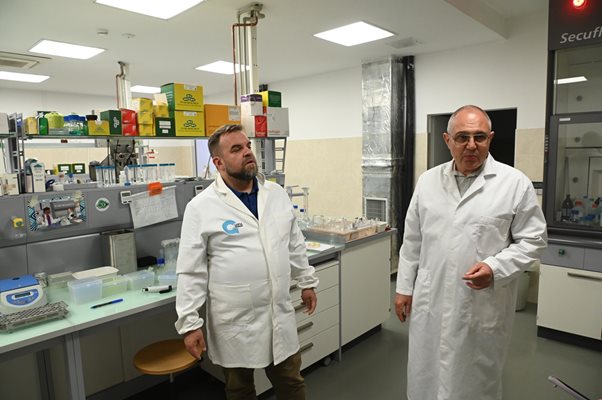
We meet with the creators of the innovation Assoc. Prof. Dr. Eng. Vasil Galabov, Assoc. Prof. Dr. Eng. Borislav Ganev, Senior Assistant Slavil Peykov, Senior Assistant Boris Kiryov at "Sofia Tech Park", and we have a phone conversation with Dr. Eng. Emil Grigorov, who is abroad.
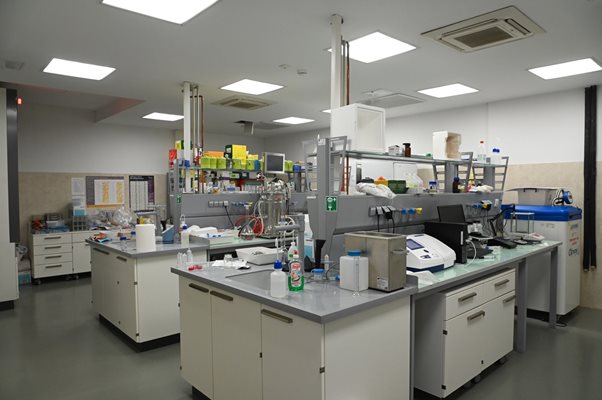
We enter a room with modern equipment, around which there are solutions, flasks, and various tools everywhere. In the corner, they show us a prototype of the PCR module of the device, which against the background of traditional PCR machines is indeed some kind of dwarf. But this little thing, together with other modules, does the work of a well-equipped laboratory, loaded with expensive consumables and serviced by highly qualified specialists. Unlike other similar devices that require significant costs, this one has a number of impressive advantages.
"The innovation automates the most labor-intensive stages of genetic research - breakdown of cells in the sample, extraction of pure DNA/RNA, preparation for subsequent analysis - explained Dr. Boris Kiryov to "24 Chasa". - With it, anyone can make a test, because you simply introduce the sample, whether it is blood, saliva, feces, etc., and regardless that it has a minimal amount of DNA. In the device, it is prepared and multiplied. Then it is sent for sequencing and reading of the information".
"It's like having a miniature laboratory that processes samples in hours instead of days", explains Assoc. Prof. Galabov.
The key advantages of the innovation are that it replaces expensive equipment (hundreds of thousands vs. hundreds of leva), does not require special qualification - anyone can use it, the cost of consumables is minimal, it is portable and fits in an ordinary bag.
"We wanted the technology to be simple, which will also support education – adds Assoc. Prof. Galabov. - Now STEM centers are being widely established in schools, and it will be extremely important for students to see in biology labs how samples are taken, how DNA is extracted, and that they can do it themselves."
Scientists hope that in this way they will show the beauty of science to many young people and inspire them to conduct their own research.
In this way, not only the problem of the lack of sufficient qualified personnel will be solved, but the cost of research will also be sharply reduced.
At the same time, the device will find application in children's and educational institutions for rapid diagnosis to prevent epidemics, in farms for diagnosing infectious and parasitic diseases in animals, in small clinics without their own laboratory, during military and rescue operations.
"The idea is to democratize access to genetic research - says Slavil Peykov - Now every school or farm can afford professional sample preparation."
If the project within the "Research University" under the National Recovery and Resilience Plan has a continuation, scientists are already drawing up plans on which modules they can upgrade the smart machine with.
"One of the ideas is that everyone, including at home and at school, can test their antibiotic resistance, whether a given antibiotic would work or not – shares Dr. Emil Grigorov. – Already in my dissertation, which I developed and defended at the Faculty of German Engineering Education and Industrial Management, I developed the idea that the device will prepare genetic material for more complex analysis. In this way, a person will be able to quickly determine which virus they are infected with."
Or, to summarize this development by specialists at one of the research universities in Bulgaria, which is also a European Technological University, it makes the key part of genetic research - sample preparation - accessible to everyone. Moreover, without compromising on quality, the time will be 5 to 10 times shorter than in a classical laboratory.
24chasa.bg
Or when it is necessary to take samples from a cafeteria to understand what microorganisms are causing poisoning, or when it is necessary to quickly collect samples so that veterinarians and farmers can understand what is sickening the animals and herds.
The answer to all these challenges lies in a compact microfluidic device developed under a project within the National Recovery and Resilience Plan by a team led by the Dean of the Faculty of German Engineering Education and Industrial Management at TU - Sofia, Prof. Dr. Marin Marinov.
We meet with the creators of the innovation Assoc. Prof. Dr. Eng. Vasil Galabov, Assoc. Prof. Dr. Eng. Borislav Ganev, Senior Assistant Slavil Peykov, Senior Assistant Boris Kiryov at "Sofia Tech Park", and we have a phone conversation with Dr. Eng. Emil Grigorov, who is abroad.
We enter a room with modern equipment, around which there are solutions, flasks, and various tools everywhere. In the corner, they show us a prototype of the PCR module of the device, which against the background of traditional PCR machines is indeed some kind of dwarf. But this little thing, together with other modules, does the work of a well-equipped laboratory, loaded with expensive consumables and serviced by highly qualified specialists. Unlike other similar devices that require significant costs, this one has a number of impressive advantages.
"The innovation automates the most labor-intensive stages of genetic research - breakdown of cells in the sample, extraction of pure DNA/RNA, preparation for subsequent analysis - explained Dr. Boris Kiryov to "24 Chasa". - With it, anyone can make a test, because you simply introduce the sample, whether it is blood, saliva, feces, etc., and regardless that it has a minimal amount of DNA. In the device, it is prepared and multiplied. Then it is sent for sequencing and reading of the information".
"It's like having a miniature laboratory that processes samples in hours instead of days", explains Assoc. Prof. Galabov.
The key advantages of the innovation are that it replaces expensive equipment (hundreds of thousands vs. hundreds of leva), does not require special qualification - anyone can use it, the cost of consumables is minimal, it is portable and fits in an ordinary bag.
"We wanted the technology to be simple, which will also support education – adds Assoc. Prof. Galabov. - Now STEM centers are being widely established in schools, and it will be extremely important for students to see in biology labs how samples are taken, how DNA is extracted, and that they can do it themselves."
Scientists hope that in this way they will show the beauty of science to many young people and inspire them to conduct their own research.
In this way, not only the problem of the lack of sufficient qualified personnel will be solved, but the cost of research will also be sharply reduced.
At the same time, the device will find application in children's and educational institutions for rapid diagnosis to prevent epidemics, in farms for diagnosing infectious and parasitic diseases in animals, in small clinics without their own laboratory, during military and rescue operations.
"The idea is to democratize access to genetic research - says Slavil Peykov - Now every school or farm can afford professional sample preparation."
If the project within the "Research University" under the National Recovery and Resilience Plan has a continuation, scientists are already drawing up plans on which modules they can upgrade the smart machine with.
"One of the ideas is that everyone, including at home and at school, can test their antibiotic resistance, whether a given antibiotic would work or not – shares Dr. Emil Grigorov. – Already in my dissertation, which I developed and defended at the Faculty of German Engineering Education and Industrial Management, I developed the idea that the device will prepare genetic material for more complex analysis. In this way, a person will be able to quickly determine which virus they are infected with."
Or, to summarize this development by specialists at one of the research universities in Bulgaria, which is also a European Technological University, it makes the key part of genetic research - sample preparation - accessible to everyone. Moreover, without compromising on quality, the time will be 5 to 10 times shorter than in a classical laboratory.
24chasa.bg