
Our and foreign scientists have shown impressive results that have propelled the university forward in international ranking lists. Holographic "teleportation", chips, space studies, new materials that will push medicine and industry far ahead in the future, projects for smart cities with minimal harm to nature, an innovative watch plate studded with sensors tracking important body indicators, a mini-device the size of a toaster performing all the work of a large DNA sequencing laboratory, creating digital twins of power plants, smart energy management, new green technologies and approaches on how students can embrace and uphold the philosophy of the circular economy.
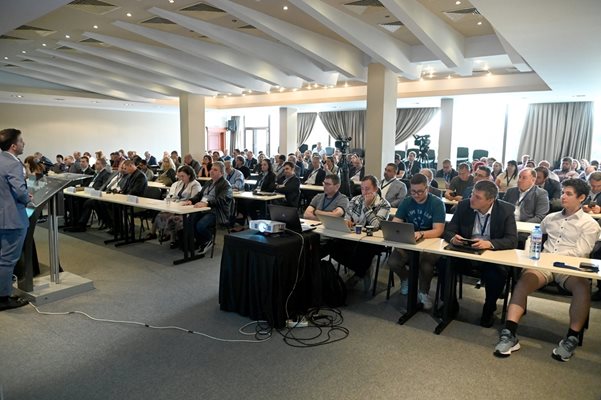
This is only a small part of the latest scientific achievements presented on the eve of May 24 at the 3-day annual scientific conference "Improving Research Capacity and Quality for International Recognition and Sustainability of TU - Sofia" in Plovdiv.
Scientists from France, Italy, the United Kingdom, Romania, Portugal, Finland, the USA, Jordan, Kosovo, India, and others participated in the forum. All of them were part of the scientific groups on the projects of TU - Sofia, funded under the National Recovery and Resilience Plan.
One of the most interesting projects was that of the group led by Assoc. Prof. Dr. Eng. Agata Manolova, focused on holographic "teleportation".
"Imagine that in this reality I am here holding a cup, but I can also be in another reality and there also have the sensation that the cup is in my hand," explained Senior Lecturer Dr. Eng. Nikol Hristova.
"The idea is to help people participate in various events around the world in real-time interactively and interact with the environment, to have real sensations - without physically moving from the place where we are," explained Assoc. Prof. Agata Manolova.
Therefore, they are currently researching how textures of different surfaces and materials are perceived in the virtual world - for this purpose, with the help of ultra-sensitive sensors and technologies, all visual information from the real world is transferred into the visual.
A super-complex task, but the young scientists in Assoc. Prof. Manolova's group know what the goal is - to have avatars similar to those from the legendary ABBA concert, where their movements and expressions were pre-recorded. The difference is that with holographic "teleportation" or communication, all this will happen in real-time and we will have specific sensations.
We can be in one space with an interviewee from the other end of the world, carefully examine a detail or product in their factory or warehouse abroad, and be convinced that the purchase is worth it. But with technology, we will be able to touch and feel almost anything - from a dinosaur to lunar regolith to the rocks around a dried-up lake on Mars.
At the conference, the group of Prof. Ivo Iliev presented their portable device, which is about 1 square centimeter in size and resembles a miniature plate. If we saw it somewhere around us, we would certainly overlook it, but this tiny device contains so much science and knowledge that it is hard to imagine.
But very soon this smart device will be able to conduct research for us, and only through sweat. It is known that its content is similar to that of blood, with the difference being that it is present in lower concentrations there.
Equally interesting was the project by the scientists from the group of Prof. Marin Marinov, PhD. At the conference, they explained how they created a device the size of a toaster that performs the work of a well-equipped laboratory, stocked with expensive consumables and staffed by highly qualified specialists.
The machine automates the most labor-intensive stages of genetic research - breaking down cells in the sample, extracting pure DNA/RNA, and preparing for subsequent analysis. With it, everyone will be able to take a test, because you simply insert the sample, whether it is blood, saliva, feces, etc., regardless of the minimal amount of DNA present.
In the device, it is prepared and amplified. Then it is sent for sequencing and information decoding. This is an innovation that will be extremely useful for schools when a certain infection needs to be quickly identified, for farms so veterinarians know how to treat herds, for dairies to monitor product quality, for military exercises, etc.
An Indian scientist from Mumbai, Hima Dipti Vankayalapati, is part of one of the most interesting scientific groups at TU - Sofia, which is about to revolutionize medicine. She and her colleagues collect images taken with nuclear magnetic resonance of patients.
"Then we show them to experienced doctors, oncologists, and they mark the tumor areas - explained Vankayalapati to '24 Chasa'. - We take this as a basis. In this way, we train our algorithm and then test it with new patient data to see if it is accurate." Along with this, the scientists in the group work with all kinds of organ images - a system that will be invaluable to doctors, as they will be able to consult the database and know whether there is anything concerning in the image.
According to Hima Dipti Vankayalapathi, this model training will allow tumors to be identified faster and then tested in a targeted manner, without wasting time. But in addition, the group is also creating a portable device that will collect data, analyze it, and warn whether an epileptic patient is about to have a seizure, so that measures can be taken.
"One of the directions is molding tools for plastic injection molding - Assoc. Dr. Eng. Yavor Sofronov from the group of Prof. Krasimir Marchev from Northeastern University, Boston/MA explained to "24 Chasa". - So far we have achieved a coating of the artificial diamond type
(DLC) with a 2.6 times lower coefficient of friction. That is, thin plastic parts can be easily removed from the injection mold without breaking, and less material is required for their production."
"We are also increasing the wear resistance and thermal conductivity of the tools due to the hard DLC coating, which so far is only made in a few countries in Western Europe - adds Prof. Dr. Georgi Todorov from the same group. - As a result of this
we shorten the cycle - more parts are produced, with less material, in less time and with less energy, which increases efficiency and reduces the cost of production."
But besides industry, scientists also add significant value in medicine. "We developed laser texturing on a titanium alloy for implants," Assoc. Sofronov explained. Since blood has a high water content, it will spread evenly over the surface, deposit cells, and thus improve the healing of implants. We are creating conditions for the implant to "stick," Sofronov smiles.
In the group, led by the university rector Prof. Dr. Georgi Venkov, "Defining indicators for the sustainability of higher education institutions and developing a methodology for their assessment through the conduct of experimental and modeling studies," the scientists have made a real breakthrough in the system for purchasing goods and services in a sustainable manner. Thanks to their efforts, everyone can now demand that the sought-after products be sustainable.
That is, they can be recycled, have a second use, and leave a minimal footprint on the environment. The university shares this policy, and with this indicator, along with many others such as scientific contributions and publications, it was included in the prestigious international ranking QS Sustainability Ranking 2025.
For the scientists in the group, it is important to change the value system and way of thinking of students and society and to show how many household items can be recycled or have a new use discovered for them.
One of the most entertaining examples is that the laboratory team transformed an old exercise bike and discarded car parts into a new system, and anyone who wants a cup of hot coffee has to pedal for 19 minutes. Of course, this playful initiative is just an interesting illustration of all the projects the group is working on in the field of industry and energy.
No less interesting is the one in which Alexander Gegov from the University of Portsmouth is engaged with his colleagues from TU - Sofia - the international group creates artificial intelligence systems that are understandable to users and that they can trust.
"This type of recommendations is very important for fields that are critical in terms of safety, medicine, defense, transport, etc., because in them, if a mistake is made, it can lead to serious consequences and loss of human lives - commented Gegov to '24 chasa'. - One of the examples is in the aviation industry, when a problem may arise due to the fact that the autopilot does not give an explanation or it may be different from that of the pilot."
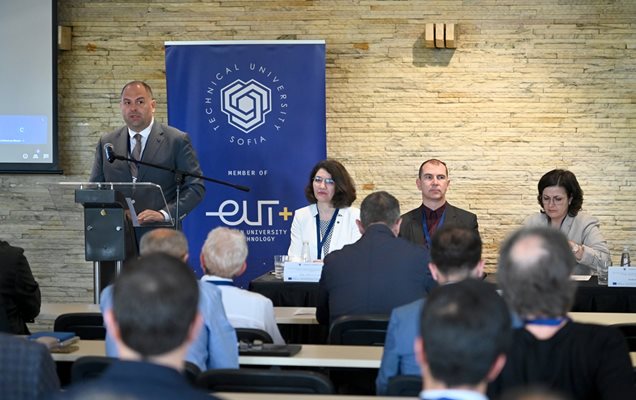
The newspaper pages will not be enough to tell us about all the breakthroughs of the university, but in his introductory speech, Prof. Lidia Galabova, Deputy Rector for "International Activities and Integration" and Chairman of the Project's Management Committee, hinted at some of them. "The conference tracks the progress of the university's strategic scientific directions and the achieved results in some areas such as: attracting foreign researchers to work at the Technical University - Sofia; creating a center for knowledge and technology transfer and financing innovative projects with potential for implementation in practice", she explained.
Prof. Galabova emphasized that the conference presents the real scientific results and the potential of the researchers generated since the beginning of the project.
Not coincidentally, TU - Sofia already owns 77 patents and utility models, which represent about 90 percent of all inventions and utility models created by Bulgarian higher education institutions.
"During the forum, artificial intelligence emerged as a main direction, presented in various fields: automation; electronics; energy; medicine, in the concept of smart cities; bioengineering, green technologies, circular economy and many others - explained Prof. Galabova to '24 chasa'. - This is a technological development that redefines the way of working in many scientific directions.
We see how successful the symbiosis between artificial intelligence in various developments and specific results is.
24chasa.bg
This is only a small part of the latest scientific achievements presented on the eve of May 24 at the 3-day annual scientific conference "Improving Research Capacity and Quality for International Recognition and Sustainability of TU - Sofia" in Plovdiv.
Scientists from France, Italy, the United Kingdom, Romania, Portugal, Finland, the USA, Jordan, Kosovo, India, and others participated in the forum. All of them were part of the scientific groups on the projects of TU - Sofia, funded under the National Recovery and Resilience Plan.
One of the most interesting projects was that of the group led by Assoc. Prof. Dr. Eng. Agata Manolova, focused on holographic "teleportation".
"Imagine that in this reality I am here holding a cup, but I can also be in another reality and there also have the sensation that the cup is in my hand," explained Senior Lecturer Dr. Eng. Nikol Hristova.
"The idea is to help people participate in various events around the world in real-time interactively and interact with the environment, to have real sensations - without physically moving from the place where we are," explained Assoc. Prof. Agata Manolova.
Therefore, they are currently researching how textures of different surfaces and materials are perceived in the virtual world - for this purpose, with the help of ultra-sensitive sensors and technologies, all visual information from the real world is transferred into the visual.
A super-complex task, but the young scientists in Assoc. Prof. Manolova's group know what the goal is - to have avatars similar to those from the legendary ABBA concert, where their movements and expressions were pre-recorded. The difference is that with holographic "teleportation" or communication, all this will happen in real-time and we will have specific sensations.
We can be in one space with an interviewee from the other end of the world, carefully examine a detail or product in their factory or warehouse abroad, and be convinced that the purchase is worth it. But with technology, we will be able to touch and feel almost anything - from a dinosaur to lunar regolith to the rocks around a dried-up lake on Mars.
At the conference, the group of Prof. Ivo Iliev presented their portable device, which is about 1 square centimeter in size and resembles a miniature plate. If we saw it somewhere around us, we would certainly overlook it, but this tiny device contains so much science and knowledge that it is hard to imagine.
But very soon this smart device will be able to conduct research for us, and only through sweat. It is known that its content is similar to that of blood, with the difference being that it is present in lower concentrations there.
Equally interesting was the project by the scientists from the group of Prof. Marin Marinov, PhD. At the conference, they explained how they created a device the size of a toaster that performs the work of a well-equipped laboratory, stocked with expensive consumables and staffed by highly qualified specialists.
The machine automates the most labor-intensive stages of genetic research - breaking down cells in the sample, extracting pure DNA/RNA, and preparing for subsequent analysis. With it, everyone will be able to take a test, because you simply insert the sample, whether it is blood, saliva, feces, etc., regardless of the minimal amount of DNA present.
In the device, it is prepared and amplified. Then it is sent for sequencing and information decoding. This is an innovation that will be extremely useful for schools when a certain infection needs to be quickly identified, for farms so veterinarians know how to treat herds, for dairies to monitor product quality, for military exercises, etc.
An Indian scientist from Mumbai, Hima Dipti Vankayalapati, is part of one of the most interesting scientific groups at TU - Sofia, which is about to revolutionize medicine. She and her colleagues collect images taken with nuclear magnetic resonance of patients.
"Then we show them to experienced doctors, oncologists, and they mark the tumor areas - explained Vankayalapati to '24 Chasa'. - We take this as a basis. In this way, we train our algorithm and then test it with new patient data to see if it is accurate." Along with this, the scientists in the group work with all kinds of organ images - a system that will be invaluable to doctors, as they will be able to consult the database and know whether there is anything concerning in the image.
According to Hima Dipti Vankayalapathi, this model training will allow tumors to be identified faster and then tested in a targeted manner, without wasting time. But in addition, the group is also creating a portable device that will collect data, analyze it, and warn whether an epileptic patient is about to have a seizure, so that measures can be taken.
"One of the directions is molding tools for plastic injection molding - Assoc. Dr. Eng. Yavor Sofronov from the group of Prof. Krasimir Marchev from Northeastern University, Boston/MA explained to "24 Chasa". - So far we have achieved a coating of the artificial diamond type
(DLC) with a 2.6 times lower coefficient of friction. That is, thin plastic parts can be easily removed from the injection mold without breaking, and less material is required for their production."
"We are also increasing the wear resistance and thermal conductivity of the tools due to the hard DLC coating, which so far is only made in a few countries in Western Europe - adds Prof. Dr. Georgi Todorov from the same group. - As a result of this
we shorten the cycle - more parts are produced, with less material, in less time and with less energy, which increases efficiency and reduces the cost of production."
But besides industry, scientists also add significant value in medicine. "We developed laser texturing on a titanium alloy for implants," Assoc. Sofronov explained. Since blood has a high water content, it will spread evenly over the surface, deposit cells, and thus improve the healing of implants. We are creating conditions for the implant to "stick," Sofronov smiles.
In the group, led by the university rector Prof. Dr. Georgi Venkov, "Defining indicators for the sustainability of higher education institutions and developing a methodology for their assessment through the conduct of experimental and modeling studies," the scientists have made a real breakthrough in the system for purchasing goods and services in a sustainable manner. Thanks to their efforts, everyone can now demand that the sought-after products be sustainable.
That is, they can be recycled, have a second use, and leave a minimal footprint on the environment. The university shares this policy, and with this indicator, along with many others such as scientific contributions and publications, it was included in the prestigious international ranking QS Sustainability Ranking 2025.
For the scientists in the group, it is important to change the value system and way of thinking of students and society and to show how many household items can be recycled or have a new use discovered for them.
One of the most entertaining examples is that the laboratory team transformed an old exercise bike and discarded car parts into a new system, and anyone who wants a cup of hot coffee has to pedal for 19 minutes. Of course, this playful initiative is just an interesting illustration of all the projects the group is working on in the field of industry and energy.
No less interesting is the one in which Alexander Gegov from the University of Portsmouth is engaged with his colleagues from TU - Sofia - the international group creates artificial intelligence systems that are understandable to users and that they can trust.
"This type of recommendations is very important for fields that are critical in terms of safety, medicine, defense, transport, etc., because in them, if a mistake is made, it can lead to serious consequences and loss of human lives - commented Gegov to '24 chasa'. - One of the examples is in the aviation industry, when a problem may arise due to the fact that the autopilot does not give an explanation or it may be different from that of the pilot."
The newspaper pages will not be enough to tell us about all the breakthroughs of the university, but in his introductory speech, Prof. Lidia Galabova, Deputy Rector for "International Activities and Integration" and Chairman of the Project's Management Committee, hinted at some of them. "The conference tracks the progress of the university's strategic scientific directions and the achieved results in some areas such as: attracting foreign researchers to work at the Technical University - Sofia; creating a center for knowledge and technology transfer and financing innovative projects with potential for implementation in practice", she explained.
Prof. Galabova emphasized that the conference presents the real scientific results and the potential of the researchers generated since the beginning of the project.
Not coincidentally, TU - Sofia already owns 77 patents and utility models, which represent about 90 percent of all inventions and utility models created by Bulgarian higher education institutions.
"During the forum, artificial intelligence emerged as a main direction, presented in various fields: automation; electronics; energy; medicine, in the concept of smart cities; bioengineering, green technologies, circular economy and many others - explained Prof. Galabova to '24 chasa'. - This is a technological development that redefines the way of working in many scientific directions.
We see how successful the symbiosis between artificial intelligence in various developments and specific results is.
24chasa.bg