
u4avplovdiv.com
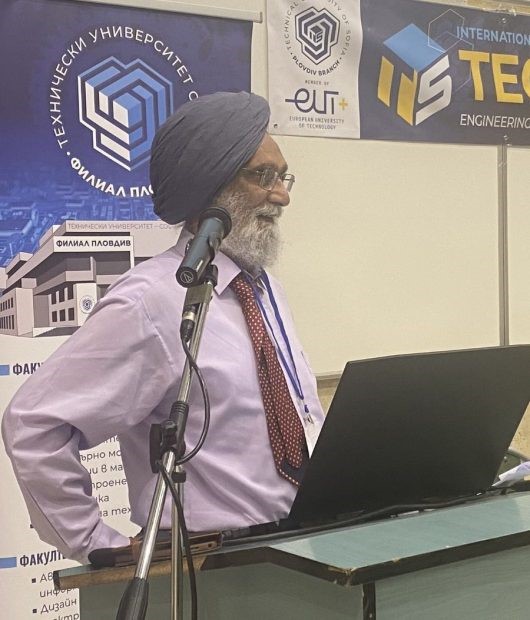
The Plovdiv branch of the Technical University hosted the thirteenth international scientific conference "Techsis", which was attended by 150 researchers, including Prof. Karamjit Gill from the University of Brighton.
Professor Gill has two passions – artificial intelligence and journalism. As a scientist, he teaches students disciplines related to engineering human-centered technologies at the University of Brighton. As a journalist, he has been the editor-in-chief of the magazine "Artificial Intelligence and Society" for 10 years.
"The subject of my scientific interests and journalistic practice is the relationship between humans and technologies," Professor Gill explains. In his introductory report, he described the trajectory of artificial intelligence from Eliza to ChatGPT, recalling how the term appeared.
"In 1976, Prof. Weizenbaum from the Massachusetts Institute of Technology in the USA published the book 'Computer Power and Human Reason'. It discusses the gradual transition from critical decision-making to a purely computational approach. In other words, machines that compute are to be taken as having the same level of intelligence as humans. One of the concerns in this transition is that we must be convinced of the ethics of the technology and not replace the transmission of data in pure form with their critical analysis. If data are published directly, our judgment and critical thinking are lost," Professor Gill explained.
From the report of the British scientist, it becomes clear that scientists begin to ask themselves whether the human brain, which is a kind of system with feedback – we perceive through our senses and process information and carry out activities based on the perception we have made and the assessment – whether the neurons in our brain are analog systems or discrete systems. For the first time, the idea of artificial intelligence is mentioned in the context of whether they can be recreated.
= Artificial Intelligence, Science, Morality =
"The serious internal conflict that people experience when talking about artificial intelligence comes from the fact that from its very inception it means recreating intelligence in a machine beyond the human brain. The idea to completely recreate thinking and consciousness outside the human body to some extent separates it from the mind. The question then arises where the soul goes. In my opinion, the conflict comes more from the fact that people see that artificial intelligence would lead to this separation between body and mind. The question is whether they want to achieve this separation or whether the body and mind should remain together," Prof. Gill commented.
He recalled that we are currently at a stage where we have algorithmic platforms like ChatGPT, capable of writing poetry and creating art. This technological leap is highly valuable in the essence of technological progress, but on the other hand, it creates a number of problems that need to be resolved legally. The problems are of a social nature – how to ethically and safely apply new technologies. Progress leads to the emergence of social questions about how humans would use this technology.
An interesting aspect of the introductory report at the conference was also the analysis of national differences in the perception of artificial intelligence. Developing countries such as India, China, and South America perceive it as a progressive technology and as a way to develop. Developed countries such as the USA, Canada, and the UK already have an established status, and there is more concern regarding cultural and ethical norms, as well as the social perception of technologies.
"Regardless of whether you are a philosopher, doctor, journalist, priest, teacher, or scientist, it is about how you use artificial intelligence to improve the lives of other people you interact with. My belief is that artificial intelligence technologies are significant only when they are included in the context of human relationships," concluded Prof. Karamjit Gill.
= Even robots need new knowledge =
Assistant Penko Mitev from the Technical University – Plovdiv branch came to the world of science after 15 years of practice in the family machine-building company producing controllers, including those for robots. He was the youngest speaker at the scientific conference, and his topic was related to robots.
The report "Development of a Power Supply System for Metal Bushings with Axial Grooves" was dedicated to the engineering "education" of robots. Through this system, industrial robots are oriented not only in space but also recognize holes in parts where components necessary for the manufactured machine can be placed.
"In general, my device automatically orients the parts so that the robot can work with them. The system has been implemented in practice, and this gave me the courage to talk about it. It is interesting that it is universal. Industrial robots are increasingly entering the industry. But if there is no one to hand them the parts and for them to take them, there is a problem. They can maneuver with them, but they must be placed in the exact location," explains Assistant Mitev.
u4avplovdiv.com, 18.05.2024