
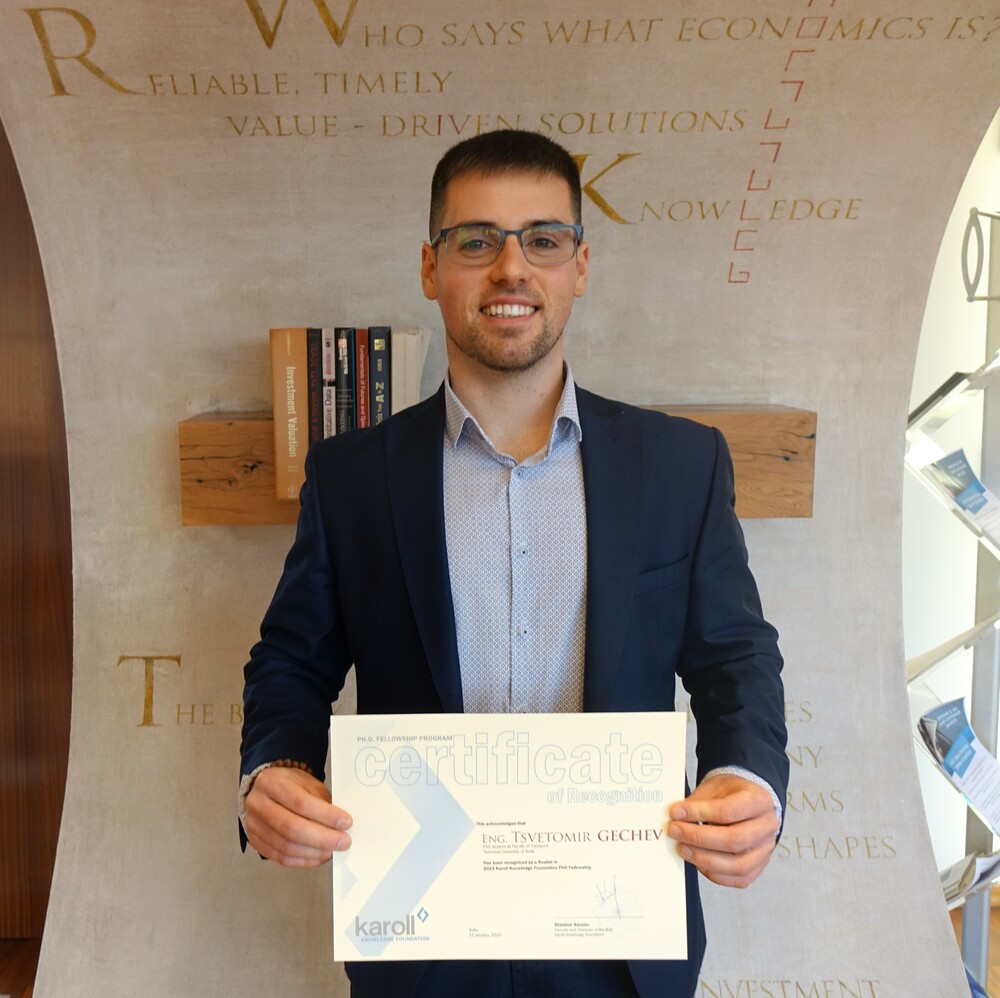
The doctoral scholarship of 10,000 BGN from the "Carol Knowledge" Foundation is won by Eng. Tsvetomir Gechev, photo: the competition organizers. "The eleventh Carol Knowledge Foundation Doctoral Scholarship Competition for 2023 set several records – the most equal participants, the longest discussions, the longest final duration, the most attractive presentations, and the most impressive personal presence. Following the strong equal final and the voting, the chairman of the jury, Mr. Stanimir Karolev, made an unprecedented decision and announced three awards: The Doctoral Scholarship of 10,000 BGN from the 'Carol Knowledge' Foundation is won by Eng. Tsvetomir Gechev, a doctoral student at the Technical University - Sofia. He also wins a place in the 'Entrepreneurs in Science' program and the new 'Startup Building' project. Monika Pramatarova, a doctoral student at Sofia University 'St. Kliment Ohridski', wins a special jury award for innovation - Phd Research Innovation Award – a scholarship of 2,000 BGN. Radoslav Simeonov, a doctoral student at Sofia University 'St. Kliment Ohridski', wins a special jury award - Outstanding Doctoral Research Award – a scholarship of 2,000 BGN." This was reported to BTA by the team of the 'Carol Knowledge' Foundation. For the first time in the history of the competition, special awards are given. We are convinced that the recognition received by the three doctoral students from the prestigious competition will motivate them even more and we will see impressive results in their work, commented Mr. Karolev on his decision. The awarding of the competition winners will take place on January 25, when the 'Entrepreneur in Science' award in the amount of 30,000 BGN will also be presented. Eng. Tsvetomir Gechev, a doctoral student at the Technical University – Sofia, literally handed over to the jury the elements from which he builds a stand for a combined cycle with a solid oxide fuel cell package and an internal combustion engine. When combined, they create a hybrid system with high efficiency, low harmful emissions, and wide applicability, say the organizers of the competition. This is also the goal of the dissertation project – to study their joint operation and the possibility of reducing CO2 emissions by using conventional hydrocarbon fuels. Such systems can be used for electricity generation or cogeneration, for household needs or in industry, as well as for primary propulsion of large transport vehicles such as ships, trains, lifting and transport machinery, and mining transport equipment. A solid oxide fuel cell can also be installed as an auxiliary unit to heavy-duty trucks and operate with CNG. As a final product, the doctoral student will create an innovative mobile stand for testing low-power CNG engines with different fuels, including testing with synthetic gas, mimicking the composition of anode gases of solid oxide fuel cell packages. Through it, the combined cycle will be studied, important operating parameters, harmful gas emissions, and application potential will be determined. Simulation models of solid oxide fuel cell packages and CNG engines have already been created, and a 3D model of the future stand. Part of the necessary equipment has been purchased. The engineer's ambitious long-term goal is the commercialization of the scientific work and local production in Bulgaria. Monika Pramatarova, a doctoral student at the Faculty of Biology of SU 'St. Kliment Ohridski', studies the application of vibroacoustics as a means for integrated management of insect pests. For the first time in our country, the competition jury heard bioacoustic signals emitted by six species of leafhoppers. The unique sounds were recorded by the doctoral student during fieldwork. This is the first study of the vibroacoustic method for controlling European species of leafhopper pests and the first bioacoustic comparison of closely related pest species. Upon locating the insects in the field, scientists study and record their stridulatory communication. This is done using a piezoelectric gramophone pickup and a digital recording device attached to the plant. Playback recordings, used to manipulate the vibroacoustic behavior of the species, are reproduced through a speaker placed in close proximity to the stem or branch of the plant. Additionally, insects are collected in absolute ethanol for subsequent PCR analysis of bacteria found in the insects' digestive system. The experimental work is conducted in the field and under laboratory conditions. The project uses interdisciplinary methods. Its practical application can solve the global ecological problem of increasing consumption of insecticides and the increasingly frequent occurrence of insecticide resistance. Radoslav Simeonov, a doctoral student at the Faculty of Physics of Sofia University and at the Niels Bohr Institute, Copenhagen, Denmark, did something even more special for the jury – he took them through the accelerators where the A Large Ion Collider Experiment (ALICE) and Positron annihilation into Dark Matter Experiment (PADME) experiments are located. He showed a video that he personally filmed in one of the accelerator complexes at CERN during tests of prototypes of ionizing radiation detectors, the organizers of the competition add. He also showed footage from the National Laboratory in Frascati, Italy, from the PADME detector complex. The doctoral student is working on a leading hypothesis that particles from the Standard Model interact with a hidden sector of particles via mediators, portal particles. His first studies on the topic are related to axion-like particles, which opened the portal for him to the scientific group of the PADME experiment. Thus, since 2017, the young physicist has been searching for new particles together with world-renowned scientists and has the ambition to ignite Bulgarian doctoral students, students, and schoolchildren to do the same. Moreover – to create his own scientific group, with which he will work on research into the nature of quark-gluon plasma and make a major scientific discovery in the field. The dark matter researcher, with years of serious scientific work, has won a place as a full member of the team working on the construction of an additional calorimeter for the ALICE experiment. He is currently actively involved in the development of prototypes for this calorimeter – FoCal-H Prototype."
See the article here
BTA, 13.01.2023
Utroruse.com, 13.01.2023
Karollknowledge.bg, 13.01.2023
MediaBricks, 13.01.2023