
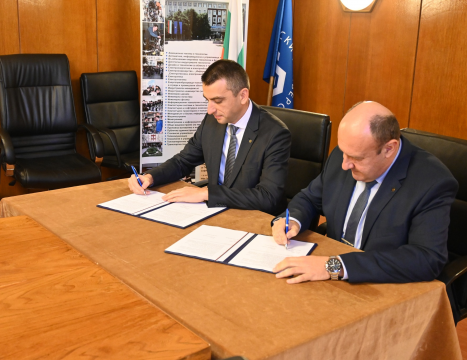
On 14.11.2022, Prof. Dr. Eng. Ivan Kralov – Rector of the Technical University – Sofia and Eng. Martin Georgiev, Executive Director of "National Electric Company" EAD, signed a memorandum of cooperation between the two organizations. The memorandum provides for TU – Sofia and NEC to cooperate and work jointly mainly in the following areas:
- Ensuring better opportunities for career development and realization of students from TU-Sofia, including through organizing on-site visits to NEC buildings and facilities, meetings with practitioners and experts – NEC employees, organization of educational and pre-graduation internships and practices, job fairs, and other initiatives;
- Supporting the quality of education for students and doctoral students at TU – Sofia through organizing public lectures and discussions, providing opportunities to ask questions on the educational content according to study plans and programs, and other initiatives of joint interest;
- Partnership in conducting studies and scientific research in the field of electrical engineering, network management and planning, and others;
- Conducting joint scientific events, training, competitions, and other matters of common interest.
Furthermore, the collaboration between partners may also include joint applications for projects and programs in areas of mutual interest, organizing public events to showcase best practices, and exchanging information. Prof. Králov emphasized the importance of energy as a key sector and the need to achieve synergy between the expert capacity of higher education, business dynamics, and the potential of young people in Bulgaria, stating: "Our university prepares multi-disciplinary specialists in the most modern fields – intelligent systems and artificial intelligence, cybersecurity, data analysis, and these skills are also applied in sectors such as energy, transport, communications, etc. We strive to meet business needs when developing curricula and include their representatives in the educational process. In recent years, we have established and participate in five Centers of Excellence and Centers of Competence. The equipment there is of the highest world level, and our researchers further develop technologies and create tools for their practical application. TU – Sofia is part of the European University of Technology, which unites eight universities from different parts of Europe and by 2030 is expected to become a confederal university under the motto "Technologies for People". Thus, we will fulfill our social commitment. This is especially true for achieving energy efficiency and protecting the environment through the so-called "green transition". "The goal of this memorandum is to make the profession of energy engineer and electrical engineer more attractive, motivating more and more students to choose these specialties. It is especially important to involve secondary schools; we have successful experience with two such schools within our structure. In this way, together with NEK, we will be able to provide both material and methodological assistance to schools, so that they can prepare qualified personnel for the energy sector who can also pursue higher education in this field," added Prof. Králov. "It is an honor for us to work together to deepen and develop our long-standing partnership and to restore the authority of the energy profession," said Eng. Georgiev. "We are impressed by the initiative, visionary thinking, and innovative approaches developed by the management, faculty, and students of the Technical University – Sofia. The successful combination of theory and practice that you have achieved is a guarantee of the high professionalism of the personnel we need. That is why signing the memorandum of cooperation with the leading technical university is so important for us," added Eng. Georgiev. After signing the memorandum, the guests from NEK were interested in touring the National Center for Mechatronics and Clean Technologies, the "Student City" campus, located on the territory of TU – Sofia, the largest center of its kind in the country in terms of capacity and concentration of scientific potential, and on-site they were convinced of the opportunities for scientific research and practical training offered by the university.
See the article here