
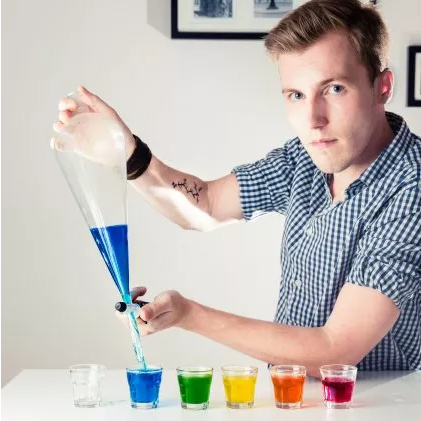
"When I see a five-euro banknote, my first thought is not about its value, but about the red-orange fluorescence under ultraviolet light of the yellow stars on the periphery, which is due to a compound of the element europium," says Dr. Bozhidar Stefanov, Senior Lecturer in the Department of Chemistry at the Technical University - Sofia, in an interview with BTA. His main scientific interests are in the field of nanostructured materials, functional coatings, and photocatalysis. Dr. Stefanov is an excellent science communicator, winner of the 2021 Bulgarian edition of "FameLab". For a week, we have been following his participation in the international edition of FameLab, where he competes alongside scientists from 22 other countries.
The FameLab competition started in 2005 as an event of the Cheltenham Science Festival in the UK. The format has not changed since then in terms of concept and rules - scientists and students from natural and mathematical sciences have three minutes to present their scientific topic in an understandable language and to capture mainly the audience (and through them, the jury). Slides and electronic presentations are not allowed, but props are permitted, provided they can be carried manually onto the stage by the presenter. The jury evaluates three things - clarity, scientific content, and charisma. In 2007, the competition became international, thanks to the British Council - first in nine countries, including Bulgaria, but over time their number has grown to over forty. An international final for all national winners has been organized since 2011.
The full interview follows:
Dr. Stefanov, please share your impressions of the International FameLab competition /"Laboratory of Fame/", which took place these days. Which of the other participants intrigued you the most and why?
Dr. Bozhidar Stefanov: At the two semi-finals of the international final of the competition this year, scientists, students, and researchers from 23 countries participated, which means 23 different cultures (in order of presentation: Malta, Qatar, Romania, South Africa, Poland, Italy, Switzerland, Netherlands, United Kingdom, Hungary, Bulgaria, Australia, Germany, Thailand, Mauritius, South Korea, Malaysia, Czech Republic, Egypt, Spain, Mexico, Ireland, Greece). Unfortunately, we did not get to meet in person, and the best we could organize to communicate directly was to create an online group on one of the online communication platforms. We have been writing continuously for two weeks across eight different time zones. I am proud to be part of this group, but I am sad that I cannot see these unique people in person.
Among the other participants, the colleagues who left the strongest impression on me were those whose presentations conveyed not only scientific expertise but also genuine passion. For example - Letaogo Kgomoeswana, a master's graduate in geography from South Africa, who studies how local populations in rural areas of South Africa adapt their knowledge of traditional farming methods in response to climate change. Or Dani Daniels - a bio-agriculture entrepreneur from the USA, who develops mini-farms for worms that decompose compost into organic fertilizer in Mexico. Or Alex Cloherty, a Canadian studying molecular biology in the Netherlands, who created a unique analogy: comparing the way Covid-19 penetrates our cells and replicates to the way the Alien by H.R. Giger does in the movies.
How did you choose the topic of your presentation?
Dr. Bozhidar Stefanov: I set myself the condition to speak only about things I have directly worked on. I often notice that a large number of participants simply choose a random topic from the field they studied. This is understandable for students, but I cannot accept it from communicators who also claim to be researchers. Isn't it most interesting to tell a story about something that has been occupying your mind during the long hours in the laboratory?
I spend most of my time in the laboratory conducting research on functional materials for energy conversion - in general terms, I perform experiments with materials that, upon absorbing light, generate so-called photogenerated charges and then use them to activate chemical reactions. The main material I research is called titanium dioxide, and it is indeed a harmless, non-toxic, and chemically inert mineral, which, however, becomes activated upon absorbing ultraviolet light and gains superpowers - for example, it is capable of decomposing organic molecules that land on its surface, splitting water into hydrogen and oxygen, or attracting water molecules much more strongly than non-polar fatty molecules. In the industry, this is called photocatalysis, and it is my main thread in scientific research. I "chase" photogenerated electrons and try to lure them to the surface of the photocatalyst to do some useful work, using various inorganic "lures". I had a strong desire to explain to the audience why I do this and what the applications are, and this determined my choice of topic.
Your first participation in the FameLab formats was 15 years ago. How has this initiative changed over the years?
Dr. Bozhidar Stefanov: What is more important is what the competition managed to change. And it really is a lot. FameLab changed (if not created) the entire landscape of science communication in Bulgaria. When the competition started, (times were different, in response to the remark about 'feudal old men'), there were neither ambitions nor prestige in speaking about science. As a direct or indirect consequence of FameLab, the first television program for popular science was created - 'Beautiful Science', followed by the Sofia Science Festival (which brought to our country, before a Bulgarian audience, world-renowned scientists such as Nobel laureate Dan Shechtman, Professor Robert Winston, and Richard Dawkins), it created Bulgarian science communicators - such as Vladimir Bozhilov and Nasko Stamenov, but also completely changed the attitude not only of the audience towards science, but also of the scientists themselves. When I was a student, I heard opinions from my professors, whom I respected, that I should not participate in this 'circus', because, quoting them, 'science is one of the last things that people in our country still respect', and nowadays - at popular science events, we can find respected scientists such as Professor Leander Litov, Associate Professor Lyubomira Glom and Prof. Nikolai Miloshev. And all this would not have started, nor would it have developed so dizzyingly, if it were not for FameLab.
For me, on a personal level, FameLab is one of the reasons I engage with science. In the autumn of 2006, I was a recent high school graduate who wanted to work with programming, but due to a complex set of circumstances, I ended up as a freshman at the Faculty of Chemistry of Sofia University. That same year, I met Lyubov Kostova (currently Director of the British Council - Bulgaria) at the national final of the Ministry of Education's 'Young Talents' competition. She told me about FameLab and then (to be honest) I did not understand the point. A few months later, I found myself in the educational theater of NATFA, where, in front of a very lively audience, numerous cameras from BNT, and a jury of real scientists, about thirty young scientists (including me, young but not yet a scientist) presented various topics. The meeting with the other participants, who spoke with ease and incredible passion about what they do, made me somehow want to engage with science as well. And here I am - 15 years later, I am still in the scientific field. I did not give up chemistry - I completed a bachelor's degree, a master's degree, and a PhD. I am no longer a young scientist, because according to the Bulgarian Law on Encouraging Scientific Research, the definition is not based on age, but on the number of years passed since the defense of a master's/doctoral degree, and for me, that time has passed. But at least, after so many years, FameLab is still here, and I was given the chance to experience the happiness of being the Bulgarian winner (albeit in a different, remote format).
Why do so few scientists master the art of speaking understandably and interestingly about the subject of their specialty?
Dr. Bozhidar Stefanov: When presenting scientific information and teaching in general, I believe the most important thing is for the active side to understand and show interest in what they are talking about. Then communication is active - when "I" want to tell you this because it is very interesting to me personally.
Unfortunately, presentation skills (beyond the technology of working with PowerPoint) are rarely included in the training of future personnel for academic circles and are often neglected. Such skills are built with experience - as a student, I felt that it was a huge challenge for me to go out and speak in front of people (partly because I am an introvert) and the opportunity to go through FameLab at such an early stage greatly contributed to my development.
How will distance education change the profile of those graduating from secondary and higher education now?
Dr. Bozhidar Stefanov: I do not think that anyone can predict what the effects of distance education will be and from this point of view I am not inclined to believe that they will necessarily be negative and destructive. Do not misunderstand me - I certainly prefer to see my students face to face, but I have a feeling that even training in an electronic environment does not prevent those who have early on discovered and chosen the field in which they want to develop - to do so. For them, a large part of the accumulated knowledge is already a result of self-study driven by personal interest. I can give an example from myself - when I was a school student, before high school, there was a system according to which the foreign language that I could choose to study was determined by my average grade - although I wanted to study English, it was reserved only for the fraction with excellent grades and for almost seven consecutive years my choice was limited to German, but I managed through watching foreign language television to prepare sufficiently so that I did not feel left behind from the rest in high school. In the same way - as a student I was interested in electronics and loved to build various devices - these are skills that I use constantly today, although I am a chemist, but I did not acquire them as a result of direct training.
I believe that distance learning will be most affected by students who have not yet happened to stumble upon the thing that they will choose as their path (as happened with chemistry for me). Such coincidences are less likely in passive training in an electronic environment. Among the positives that the situation we are in brings is that people have become accustomed to the possibilities for distance communication for situations in which they would otherwise have avoided it before the pandemic. For example - for the last two consecutive years, the scientific conferences at which I present my research have been held electronically. Before the pandemic, I would not have even thought that I would agree to this option - I have not only become accustomed to it, but I have somehow discovered its advantages.
My observations of the students I teach are that the more time that has passed since the beginning of this new reality, the more their opinion changes, but in a somewhat unexpected direction. If in the first year, when we had a graduating class that finished electronically, they perceived electronic teaching positively - as a way of "hitching a ride", now more and more of them are disappointed when it comes to switching to this form. This year I even had cases of colleagues who completed the course I teach electronically - last year and even took the exam, but personally chose to re-enroll in the first semester to take it again - in person.
Hybrid specialties are increasingly appearing in universities. The boundaries between sciences are blurring.
Dr. Bozhidar Stefanov: Especially nowadays, when successful scientific research is always interdisciplinary. I often find myself seeing something around me and recognizing in it a process that I have studied (this helps me a lot in cooking, by the way). When I see a five-euro banknote, for example, my first thought is not about its value, but about the red-orange fluorescence under ultraviolet light of the yellow stars on the periphery, which is due to a compound of the element europium. It is debatable whether the European Bank chose this compound by chance or because of its symbolism, but the discoverer of this element - the Frenchman Eugène-Anatole Demarçay - named it in the early 20th century not after variations of the name of his homeland, but after the entire continent of Europe, influenced by the then "science-fiction" ideas about the future of a united Europe.
Not only are the boundaries between sciences blurring, but the boundaries between science and art are also "flowing" in both directions. And not just today. In the early 19th century, Friedrich Stromeyer discovered the element cadmium, and the saturated and stable yellow color of its compounds would make it a favorite pigment of European artists, and this would give rise to expressionism a few decades later.
Have you ever been tempted to engage in art?
Dr. Bozhidar Stefanov: As a post-doc at Oxford, I spent all my time in the laboratory, while most of my colleagues, besides science, always had some culturally refined hobby: for example, they played a musical instrument (most often the cello, and I wondered why someone who is constantly moving would choose the bulkiest one). When I can, I find time and affordable tickets to go to the theater or opera, and sometimes we also visit galleries and exhibitions, and I have an affinity for photography. In Stockholm, my favorite space was Fotografiska - an exhibition hall where there were often exhibitions by world-renowned photographers. I have always had the opinion that artists are actually much closer to scientists than they assume. And they also chose what they do without being driven entirely by pragmatic and financial motives. And they do it with their heart.
See the article here
BTA, 15.11.2021