
Brief information about the researcher: name, degree, title, workplace
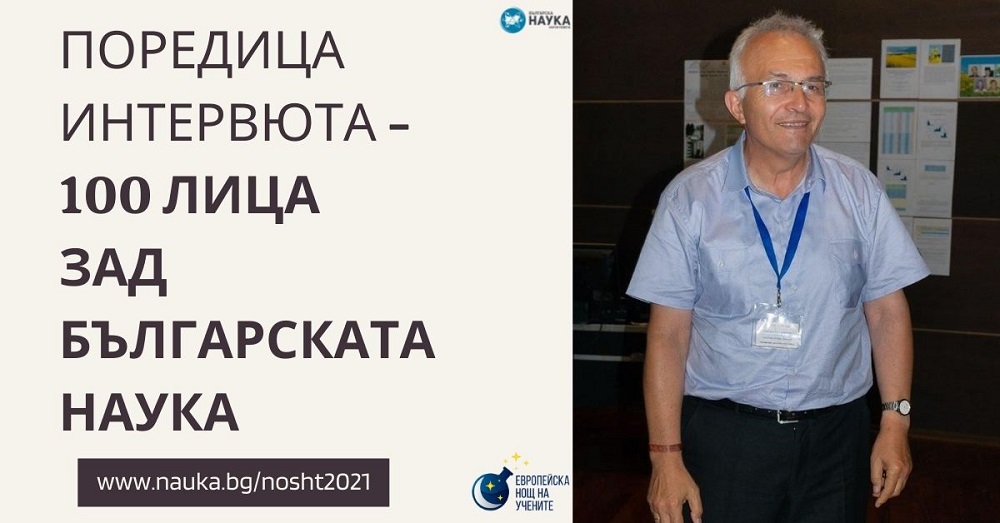
Mihail Todorov, professor at TU-Sofia, Faculty of Applied Mathematics and Informatics, PhD in Mathematics.
What do you do at your workplace? (The daily life of a scientist) – projects, research,
It is normal for a person to work at their workplace. However, this largely applies to a bureaucratic way of thinking. The workplace of a scientist is their brain. As my scientific supervisor used to say, a scientist must 'chew over problems in their head'. In the situation in which we are forced to live and work, the concept of a workplace has lost its meaning.
What are your scientific achievements (contributions) and what is their benefit to society and the economy?
In our field, achievements are not ostentatious and, due to their specificity, are difficult for the majority of society to understand and comprehend, and the economic effect is often indirect and requires time to find realization.
What motivates you to choose the profession of a researcher?
When I was in lower secondary school, in a Bulgarian language and literature class, we were given an essay with a reflection on the topic 'What do I want to become when I grow up'. There were different interpretations of this topic. I remember writing that it was too early to say and that I did not know the answer to this question. There are many factors – some obvious, others implicit, some conscious, others not. The environment is very important – family, school, friends, colleagues. The way and organization of thinking are also important. Choosing a profession is not a lottery, but a process that takes place over many years and does not always have a clear-cut outcome.
I am currently working on ……., which will…….
I am currently working on several things out of necessity, which is almost a constant state for me due to chronic time shortage. Specifically: I am editing a book for print, which contains about 100 articles from a conference, writing reviews for scientific competitions, trying to solve difficult equations that are part of an international scientific collaboration. I could continue, but I will stop here.
What problems do scientists in your field encounter (in their professional development and in their work)?
They encounter the problems they solve or try to solve, but do not know how. Our subject matter requires persistence, high qualification, and is generally of low efficiency. There are problems that take years of work before any reasonable results are achieved. I will not talk about administrative problems, which are unavoidable in real life.
What, in your opinion, needs to be fundamentally changed in Bulgaria regarding science?
If we talk about fundamental changes, that is equivalent to a revolution. I do not think we need such things. Science on a global scale hardly depends on fundamental changes in Bulgaria. Good management, competent administration, and/or funding are needed. We have enough intellectual resources.
Did you know: (a little-known and interesting fact about the specialty)
If you tell me, I will find out.
In my free time, I like to: (hobby, sport)
For scientists, hobby and profession are one and the same, and this is a guarantee of success. Success comes when the muse visits us. She has no working hours or workplace.
See the article here
Nauka.bg, 20.09.2021