

It is absolutely unacceptable to lead electrical wires out of a manhole, tied to a conductive fence, which is freely accessible. Not to mention that people walk over and alongside the manhole, it is located in a residential area, and this is happening on one of the busiest boulevards in Sofia. According to safety expert Assoc. Prof. Nikolay Vitkov, a lecturer at TU-Sofia, the issue is not open for discussion. The manholes in question are used for laying underground cable lines, which are led to electrical panels, secured in accordance with regulatory requirements - Regulation 3 for the design of electrical installations and power lines. It is absolutely unacceptable to make such extrusions, regardless of whether they are legal or illegal. This raises questions about how all the so-called movable objects in Sofia - pavilions and kiosks, which we encounter on almost every boulevard and city transport stop in the capital, are electrified. According to Articles 56 and 57 of the Spatial Planning Act, among the documents required for their placement, besides a sketch of the property according to the current zoning plan (cadastral plan, in cases where a movable object or advertising element is placed within the boundaries of a land plot or UPI), there must also be an approved sketch indicating the method of placement, as well as approved architectural and engineering designs, including external connection designs, compiled in accordance with the requirements of the Spatial Planning Act, CAB, KIIIP. Whether such designs exist will be investigated by the authorities, and as it became clear, the prosecutor's office expects information from many institutions. In any case, it is unlikely that there is a design for electrification at all, let alone in this manner. The tragic incident involving the deceased child is fully explainable through several scenarios, which should take into account, among other things, the road surface and how it was treated on the cold Sunday when temperatures did not reach positive values. Gravel may have been spread on the sidewalks and streets, which would only increase conductivity and consequently increase the effect of the current. And although there are many factors, including whether the child was wearing wet shoes, whether he fell or grabbed the parapet, the most essential question is why voltage appeared on the manhole. The possible probabilities are two: contact of live parts with the reinforced concrete structure of the manhole, and secondly, damage to the insulation of the outgoing conductor in contact with metal or reinforced concrete parts of the manhole itself.
POSSIBLE SCENARIOS FOR THE FATAL ELECTRIC SHOCK
Potential injuries with dry shoes with insulating soles in the worst-case scenario, fig.1
Assumptions:
1. The shoes have a resistance Rshoe = 5kΩ;
2. Resistance of the boy 0.5 kΩ;
3. Straddle S = 0.8 m;
4. One foot was placed on the edge of the manhole;
5. The rectangular manhole is connected to a hemispherical conductive object with a radius of 0.5 m;
6. The voltage of the manhole is approximately the phase voltage of 230 V.
The step voltage U_step is determined as the potential difference between the points of contact of the two feet with the ground. The potential at the point of contact of one foot is taken as the phase voltage of 230 V, and at the other, the potential of the ground surface φ(S = 0.8 m) at a distance of 0.8 m. As can be seen from Fig. 1, the potentials of the ground surface φ(x) decrease with distance from the manhole. The calculated voltage between the two feet (step voltage), taking into account the additional resistance of the shoes, is safe Uh ≈ 4.5 V. The current through the body is negligible and does not lead to physiological effects - safe current. The path of the current does not pass through critical organs - the heart and intercostal muscles.
Conclusion: it is very unlikely that the boy was wearing dry shoes, which would have protected him.
2. Potential injuries when wearing wet shoes (standing barefoot on the ground) Fig. 1
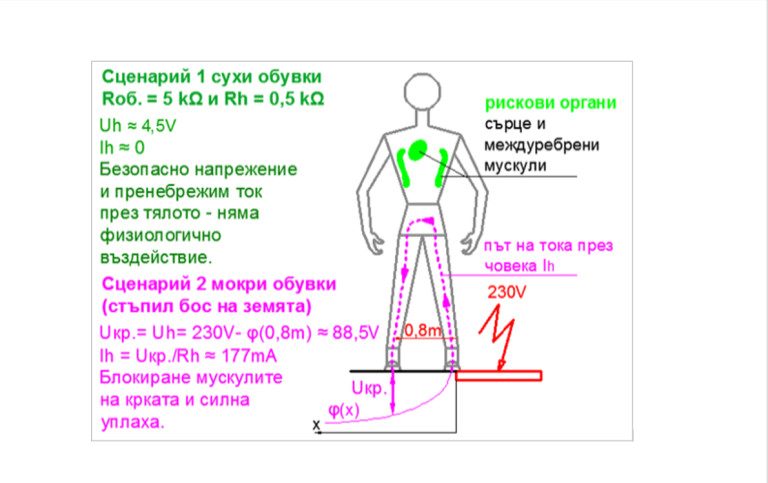
Under the same assumptions and calculation methodology, the step voltage U_step, which in this case is equal to the voltage between the two feet of a barefoot person Uh, is significantly above the safe level, Uh ≈ 88.5 V. Taking into account the fact that it is a child, less than half of the average resistance of an adult human body Rh = 0.5 kΩ is assumed (according to most sources, Rh = 1 kΩ is assumed). Thus, the calculated current, which is the main factor for the degree of injury and consequently physiological reactions, is obtained as Ih ≈ 177 mA, which is a dangerous current, but considering its path through the body - it does not pass through critical organs, would not lead to cessation of breathing and/or cardiac activity or loss of consciousness. A current of such magnitude would cause inability to move due to loss of control over the leg muscles, possible loss of stability or balance with strong fear and panic. In such a scenario, it is most logical for a person to grab a nearby stable object, lose balance, and fall.
2.1. Grasping a grounded conductive object in the touchable zone Fig. 2
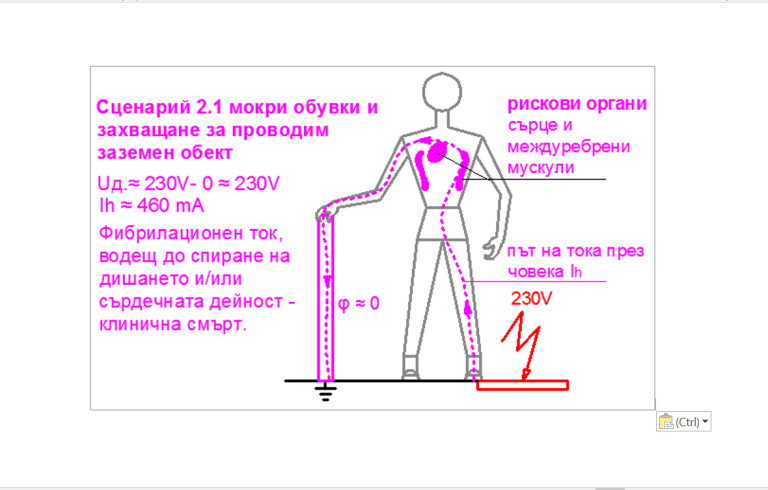
This is a particularly dangerous case. The potential φ of one leg is taken as 230V, and that of the hand is the same as that of the grounded object, i.e., ≈ 0V. Under the above assumptions, the touch voltage is Uд ≈ 230V, and the current through the body Ih ≈ 460mA, which leads to cessation of breathing and/or cardiac activity with probable loss of consciousness, i.e., clinical death. The time to begin resuscitation actions with a high probability of restoring vital functions and, above all, saving the brain is up to 5 min after the electric shock. After this period, the probability of revival with return to consciousness decreases sharply.
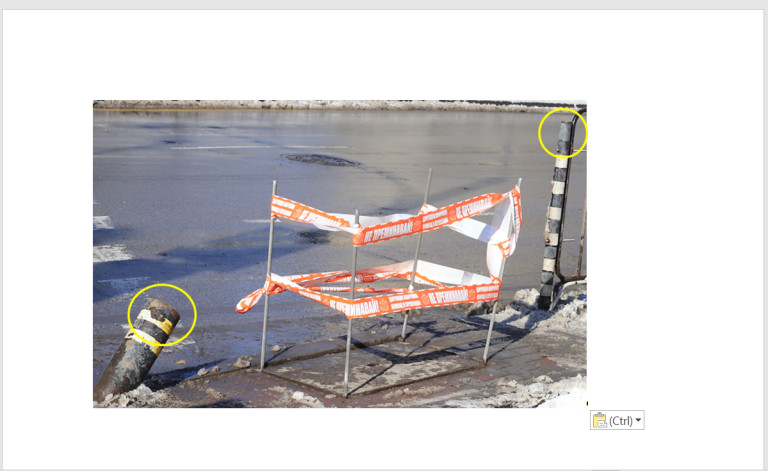
According to the available photographic material, Fig. 3, the considered scenario is potentially possible because the photo shows two objects with good contact with the ground in the zone accessible to a person who has stepped on the edge of the shaft, but from the published accounts of witnesses it is not clear whether the boy had contact with them, which is why the scenario is more hypothetical.
2.2. Falling forward onto the ground Fig. 4
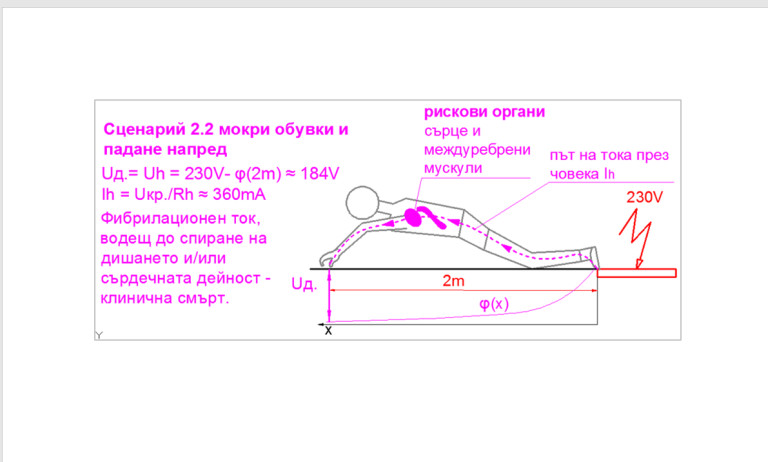
In this case, the distance to the farthest point from the shaft is the hands.
The problem statement and assumptions are identical to scenario 2, but instead of a stance S = 0.8m, the distance between the foot with a wet shoe touching the metal edge of the shaft and the fingertips is taken as S = 2m.
The calculated touch voltage Uд is equal to the voltage on the person Uh with an approximate value of 184V, which is a dangerous voltage. The calculated current through the boy's body is about 360mA, and the consequences are almost identical to scenario 2.1.
This is the most likely scenario, as abrasions on the hands and knees were found during the autopsy, which were likely due to uncontrollable convulsions under the influence of the flowing current, the weight of the body, and the rough surface.
See the article here
News.bg, 16.02.2021