
16.07.2020

Every alliance of higher education institutions receives up to EUR 5 million from Erasmus+ and up to EUR 2 million from the Horizon 2020 programme for research and innovation. Bulgaria is already represented by 5 universities in the new 24 European alliances of higher education institutions approved by the European Commission. These are Sofia University "St. Kliment Ohridski", University of National and World Economy, New Bulgarian University, Technical University – Sofia, and University of Agribusiness and Rural Development – Plovdiv. South-West University "Neofit Rilski" – Blagoevgrad is also included as an associated partner to one of the consortia. Among the applicants in the European University Alliances initiative are also Medical University – Sofia, Ruse University "Angel Kanchev", N. Y. Vaptsarov Naval Academy, Varna Free University "Chernorizets Hrabar", University of Economics – Varna, and University of Chemical Technology and Metallurgy – Sofia. Under the second call of the Erasmus+ programme, 62 applications were received, 12 of which with Bulgarian participation, involving over 380 higher education institutions from 32 countries – 26 EU Member States, 5 countries participating in the Erasmus+ programme, and the United Kingdom. Bulgaria is among the countries with an increased number of applying institutions, ranking third in this indicator after Germany. The participation of Bulgarian higher education institutions and their preparation was supported by the Ministry of Education and Science. The next call will be published no earlier than 2022.
The selected 24 new alliances include 165 higher education institutions from 26 member states and other countries participating in the Erasmus+ programme. They will join the first 17 alliances of the European University Alliances initiative, selected in 2019. Joint work will improve their ability to address societal challenges such as the ecological transition and digital transformation. "I am glad that Bulgarian universities are now part of the European university alliances. We now have 41 alliances, including 280 higher education institutions. They will provide their students, teachers, and researchers with the necessary skills and competencies to tackle the challenges of the ecological transition and digital transformation. They are a key building block of the European Education Area," stated Bulgarian Commissioner Maria Gabriel. European universities are transnational alliances of higher education institutions that come together to develop long-term cooperation for the benefit of students, teachers, and society. Each alliance consists of an average of 7 universities. Some are comprehensive and cover all disciplines, while others focus, for example, on sustainable development, health and well-being, digitalization and artificial intelligence, art, engineering, or space. According to Maria Gabriel, by developing inter-university campuses, exchanging online courses, data, and digital infrastructure, they can be more effective in preparing students for future jobs. European university alliances also aim to support lifelong learning by providing learners of all ages with the opportunity to earn micro-credentials upon completion of short courses or modules. The Commissioner also emphasized the importance of creating a European educational degree. EU support for these 41 university alliances amounts to up to 287 million euros. In addition to the Erasmus+ programme, and at the proposal of the Bulgarian Commissioner, additional funding has been secured under the Horizon Europe programme. These funds will be focused on activities in the alliances' research and innovation strategies. "This demonstrates the real added value of the synergies we create between programmes. Each alliance receives up to 5 million euros from the Erasmus+ programme and up to 2 million euros from the Horizon 2020 programme. We intend to continue these synergies in the future Multiannual Financial Framework. Funding from both programmes is an important step in strengthening the link between the European Education Area and the European Research Area," announced Bulgarian Commissioner Maria Gabriel.
Sofia University "St. Kliment Ohridski"
The "Transformation for Europe (T4E)" Alliance, in partnership with Sofia University "St. Kliment Ohridski", unites 7 European universities: Saarland University (Germany), University of Alicante (Spain), Estonian Academy of Arts, University of Silesia in Katowice (Poland), SU "St. Kliment Ohridski" (Bulgaria), University of Trieste (Italy), and Vytautas Magnus University in Kaunas (Lithuania). 5 million euros are allocated to the transnational "T4E" Alliance to launch a joint strategy for consolidating the European university ecosystem.
University of National and World Economy
UNSS together with 6 leading European universities in the field of-
the of the economy and social sciences created the ENGAGE.EU alliance,
in which a total of over 100,000 students are enrolled. Partners in the European network are: University of Mannheim (Germany) – coordinator, Luiss Guido Carli University (Italy), NHH – Norwegian School of Economics (Norway), Tilburg University (Netherlands), UNSS (Bulgaria), University of Toulouse 1 (France) and Vienna University of Economics and Business (Austria).
Technical University – Sofia
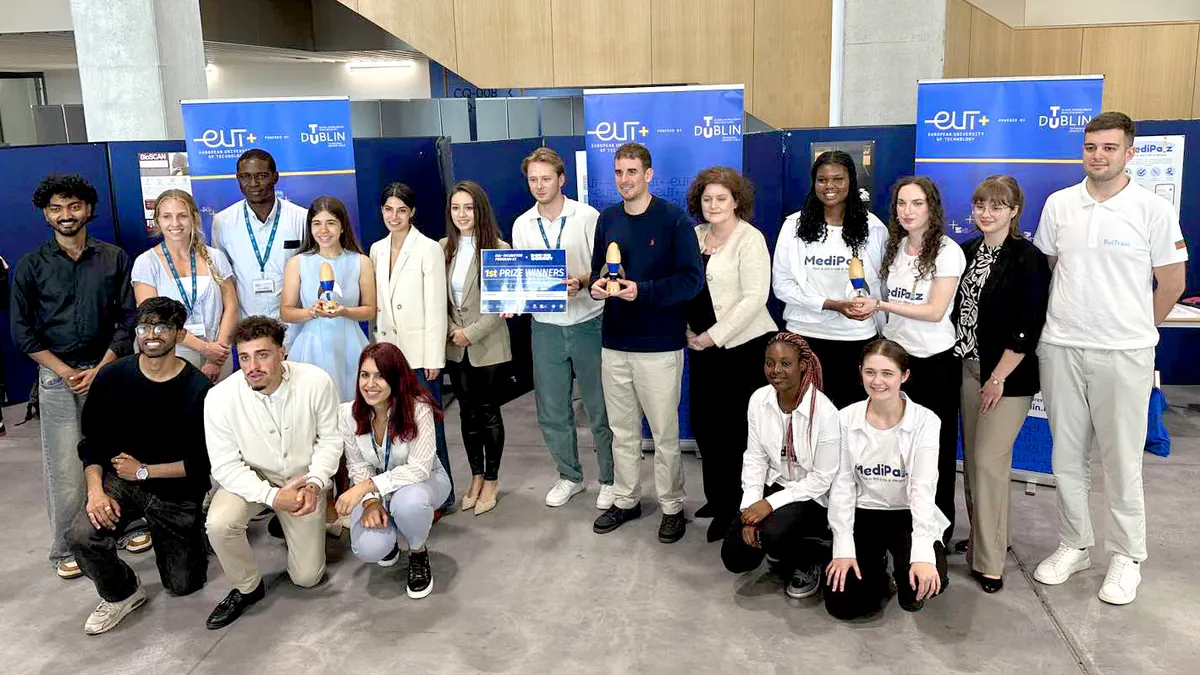
TU – Sofia, along with 7 other universities, have united in the European Technological University EUt+ alliance. The eight members of the EUt+ alliance are: TU – Sofia (Bulgaria), Cyprus University of Technology (Cyprus), Troyes University of Technology (France), Darmstadt University of Applied Sciences (Germany), Dublin Institute of Technology (Ireland), Riga Technical University (Latvia), Technical University of Cluj-Napoca (Romania), and Polytechnic University of Cartagena (Spain). Humanities are at the core of the European Technological University Eut+, to shape engineers and technicians who are aware of global challenges and are highly technologically responsible citizens.
Higher School of Agribusiness and Rural Development – Plovdiv
The Higher School of Agribusiness and Rural Development – Plovdiv has become a full partner in the European University Alliance "Innovations for Regional Sustainability – INVEST". It is aimed at cooperation for the implementation of joint innovative education and study programs, the application of multilingual education based on theoretical training and the acquisition of practical skills, and European mobility for students, teachers and non-teaching staff. INVEST unites 5 universities: coordinators are the Slovak University of Agriculture in Nitra (Slovakia), the University of Thessaly (Greece), the Karelia University of Applied Sciences (Finland), Van Hall Larenstein University of Applied Sciences (Netherlands) and the Higher School of Agribusiness and Rural Development (Bulgaria).
See the article here
Press.azbuki.bg, 16.07.2020.