
01.07.2020
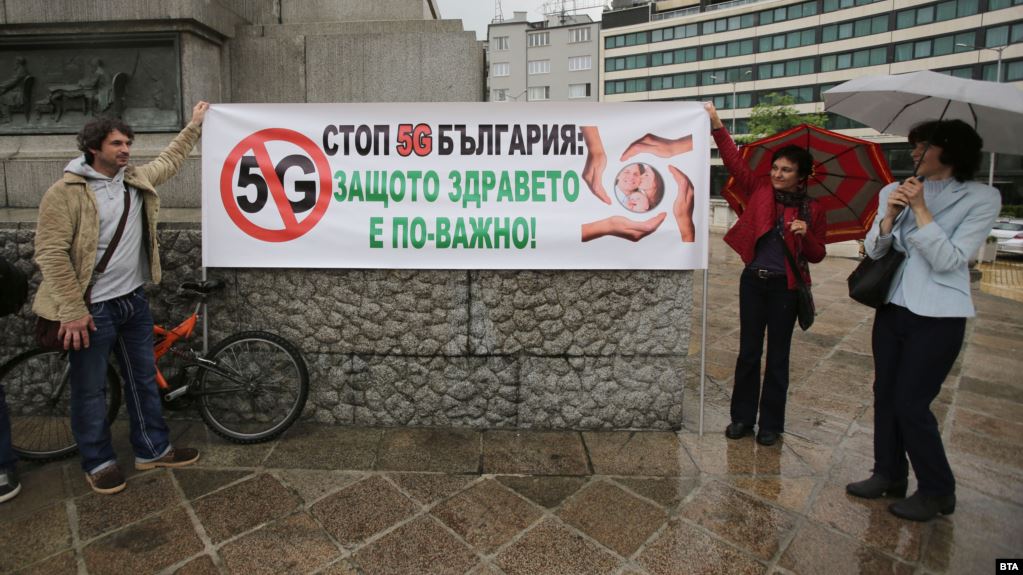
Tinka Kirilova is from Varna. She is one of the most active participants in the Facebook group "Stop5G Bulgaria", which has over 78,000 members. Her profile on the social network does not have a photo of a face, but a sign that crosses out 5G. "If you wish and are not prejudiced (many people are, due to relations with telecommunications and business), I will send you a lot more information," are her words from the very beginning of our communication. However, Tinka is not alone. The campaign against the introduction of 5th generation mobile networks is clearly visible. It is mainly on social networks, but a number of publications are also involved with alarming headlines on the topic. Even politicians are participating. At the same time, 5G does not yet exist in Bulgaria. This was confirmed by the three major mobile operators to Radio Free Europe in May. The Minister of Transport, Information Technology and Communications Rosen Zhelyazkov also confirms it. There is also no scientific evidence of the harm of 5G on human health. However, the campaign does not stop. Therefore, we decided to tell you who the participants are and who is involved in spreading fear and concern among Bulgarians.
What is "Stop5G Bulgaria"
The largest group in Bulgaria that unites on Facebook people convinced that the technology kills birds and creates the prerequisites for numerous diseases is "Stop5G Bulgaria". Only one of the administrators, who are currently six (but at the time we sought their opinion there were three), responded to our messages. Initially, she agreed to answer several questions, but later politely apologized that at this stage the admins had decided not to speak. Unlike a large part of the active participants in the group, Yana Ill has a profile picture with a human face. There are others who stand behind this campaign with their real names. Tinka Kirilova explains that she does not engage in other public initiatives because she believes that "now the most important thing is to clarify what we are facing with the introduction of this new technology". She has submitted a petition to the National Assembly (NA), calling for an end to all changes to the Spatial Planning Act (SPA) that facilitate the construction of new mobile stations, which could accelerate the introduction of 5G technology in Bulgaria. 679 people who signed the petition also insist on a "full and unconditional moratorium" on the testing, implementation, and operation of 5G technologies. 679 people who signed the petition also insist on a "full and unconditional moratorium" on the testing, implementation, and operation of 5G technologies, including the cessation and dismantling of existing ones so far. Kirilova says that this is the second petition she has submitted to parliament and it was made in just a week. In early April, she sent another one, signed by over 2,000 citizens. Kirilova explains that "only the advantages in a technological aspect are highlighted, but there is no official information on health impacts", especially in Bulgaria. Meanwhile, on June 17, 2020, the National Civic Initiative "Stop 5G in Bulgaria, because health is more important" submitted another petition with the same demands as Kirilova's. They are supported by "32,000 signatures of Bulgarian citizens, collected in the months of the state of emergency and exceptional situation in Bulgaria through online petitions and 377 signatures collected on paper", the organizers write and add that they expect the National Assembly to make a decision within a 3-month period. Against this background, there were not many surprised by the results of the "Trend" survey announced in early June - over a third of those surveyed believe that 5G technology is dangerous. "Traditionally, on all issues, people with higher education are more informed than those with lower educational status," the agency summarizes. Nevertheless, sociologists note that among the highly educated, the share of those who consider 5G dangerous is the highest - 44% compared to 16% who do not consider it dangerous.
What politicians are doing
The 5G activists found support in the person of BSP MEP Ivo Hristov. In an interview with BNR, he commented that in Bulgaria, "the fears of the masses are viewed with irony and mockery," and stated that there are not many studies on the impact of the 5G network on human health and the environment. Hristov announced that he has initiated the preparation of a study through the Scientific Panel of the European Parliament, which should be ready by September at the latest. This is not the first time Hristov has taken active public participation in controversial issues. In 2014, as a member of "Solidarity Bulgaria," he was an organizer and active participant in the protests against the signing of the Transatlantic Trade and Investment Partnership (TTIP). One of his motives then was that TTIP would help circumvent the legal ban on shale gas exploration. Earlier, Hristov participated in the campaign in support of the Belene Nuclear Power Plant. The former presidential advisor, who is currently a member of the Group of the Progressive Alliance of Socialists and Democrats in the European Parliament, is not the only politician who takes a position in the debate on the 5G network. Such a position is also held by the "Volya" MP Elena Pesheva. She has been a Member of Parliament since 2018 and during this period has submitted over 40 questions to the relevant ministers on various issues, some of which are related to "gender ideology," the well-known case of sex education in schools in Pernik, and "the lack of appropriateness in presenting the topic of drugs in approved textbooks." Pesheva submitted two questions on the 5G topic respectively to the Minister of Health Kiril Ananiev and to the Transport Minister Rosen Zhelyazkov in May. "A lady wrote to me that during the state of emergency she noticed that they were installing something in the park in the "Kyuchuk" quarter. In an interview with Radio Free Europe, Pesheva commented that she was not satisfied with the answers from the relevant ministers. "Nowhere do they answer me that there is a truly independent study on the impact of 5G on human health," she points out. In her questions, published on the website of the National Assembly, she expresses doubt about the legitimacy of the non-governmental organization International Commission on Non-Ionizing Radiation Protection (ICNIRP). It is the body that recommends limits for electromagnetic radiation. "I am not the one questioning the activities of this non-governmental organization. Respected scientists, doctors, and professors from prestigious world universities do so in their articles," Pesheva told Radio Free Europe, without naming names. Pesheva raised her questions after "dozens of people" wrote to her with their concerns about the 5G network. "A lady wrote to me that during the state of emergency she noticed that they were installing something in the park in the "Kyuchuk" quarter. She thought they were lamps, but the workers told her they were antennas."]
"Foreign players and third countries"
From the "Trend" study, it becomes clear that the fear of new technology is successfully coupled with the fear of coronavirus. One of the conclusions is that "one in ten agrees with the statement that the coronavirus spreads through 5G technology." The reason sociologists included such questions in their study is that this is one of the conspiracy theories that have gained "popularity in recent months." In early June, the European Union published a document on a coordinated approach against the "infodemic," stating that "foreign actors and third countries, especially Russia and China, are involved in targeted influence operations and disinformation campaigns in the EU." This is quite palpable in Bulgaria. Besides the example from Plovdiv, similar stories exist in other cities in the country. In April, the mayor of Ruse announced via his Facebook profile that he had sent official inquiries regarding the level of 5G network construction in the territory of the Ruse municipality. The mayor of Berkovitsa, Dimitrinka Kamenova, took a similar step. The reason was that "information was actively circulated in the public sphere that a 5G network has been built in the territory of the Berkovitsa municipality," Kamenova told Radio Free Europe. "Several inquiries regarding the credibility of the information in the public sphere were received," Kamenova added, stating that citizens are informed "through various channels." Most often, claims about the harmful effects of 5G networks can be found on social media. These are usually posts without cited sources. They present circumstantial texts, accompanied by photos of antennas, illustrations, diagrams, and colorful images that attract attention. Proponents of the theory about the harm of 5G networks and conspiracy theories, such as the spread of coronavirus, often publish links to YouTube videos and posts in media outlets. However, these media outlets have unclear origins, and the information published in them lacks sources.
What specialists say
Kliment Angelov is an engineer and lecturer at the Department of "Radio Communications and Video Technologies" at the Technical University of Sofia. He states that currently, mobile networks of three generations - 2G, 3G, and 4G - operate in parallel, being configured to work together so that subscribers receive service with the best possible quality and data speed. For this reason, the antenna systems that scare people so much do not emit in just one, but in three radio frequency ranges. However, the power levels with which the antennas are supplied are not so large and do not create radiation that is extremely harmful to people. "Of course, the concern is that they should not stand directly in front of the antenna at a distance of less than 20-50 m, depending on the specific situation. However, this is mostly the case, because no one stays permanently on the roofs. If a person is inclined to look for a place where the radiation will be above certain norms, such a place will definitely exist," Angelov says. "We come to claims from the field of the occult, related to the tracking of individuals and infecting them with various types of infections from a distance." He adds that people's fear of antennas comes from the fact that they are not familiar with the specifics of organizing radio coverage. "We come to claims from the field of the occult, related to the tracking of individuals and infecting them with various types of infections from a distance," the lecturer also says. Regarding the 5G network, he explains that it is planned to use three radio frequency ranges - 600÷700 MHz, 2.5÷3.7 GHz, 25-39 GHz. The first is basic, which will provide coverage everywhere, the second provides higher data speeds, mainly in urban areas, and the highest is for high-speed data transfer. "Generally, concepts are not changed, as the upgrade aims to perfect the idea of the parallel operation of 2G, 3G, and 4G in parallel. In this regard, the new 5G networks do not have significantly different effects on human health compared to those of current mobile communication networks," Kliment Angelov concludes in his statement. However, Tinka Kirilova is convinced that 5G has a very good alternative, and that is the development of cable internet, "which ensures low levels of EMF" (electromagnetic fields). Like the MP Elena Peshova, she draws attention to the ICNIRP standards, pointing out that they are from 1998, and in the last revision from 2020, the organization introduced only two new restrictions, which are related to increasing temperature at frequencies >6 GHz and short-term exposure to EMF for more than 6 minutes. The petition submitted by Kirilova to the National Assembly was also sent to the Minister of Health Kiril Ananiev, the Minister of Environment and Water Emil Dimitrov, the Mayor of Varna Ivan Portnih, and the Minister of Transport, Information Technologies and Communications Rosen Zhelyazkov. Kirilova received a response from the Minister of Transport, in which it is pointed out that "contrary to what you wrote that "our limit values do not protect against the harm caused by 5G", in our country some of the highest requirements in Europe are applied to potentially harmful emissions." According to the minister, in Bulgaria, recommended limit values for population exposure to electromagnetic fields were established as early as 1991 by Ordinance No. 9 and much earlier than those of ICNIRP.
See the article here
Svobodnaevropa.bg, 01.07.2020