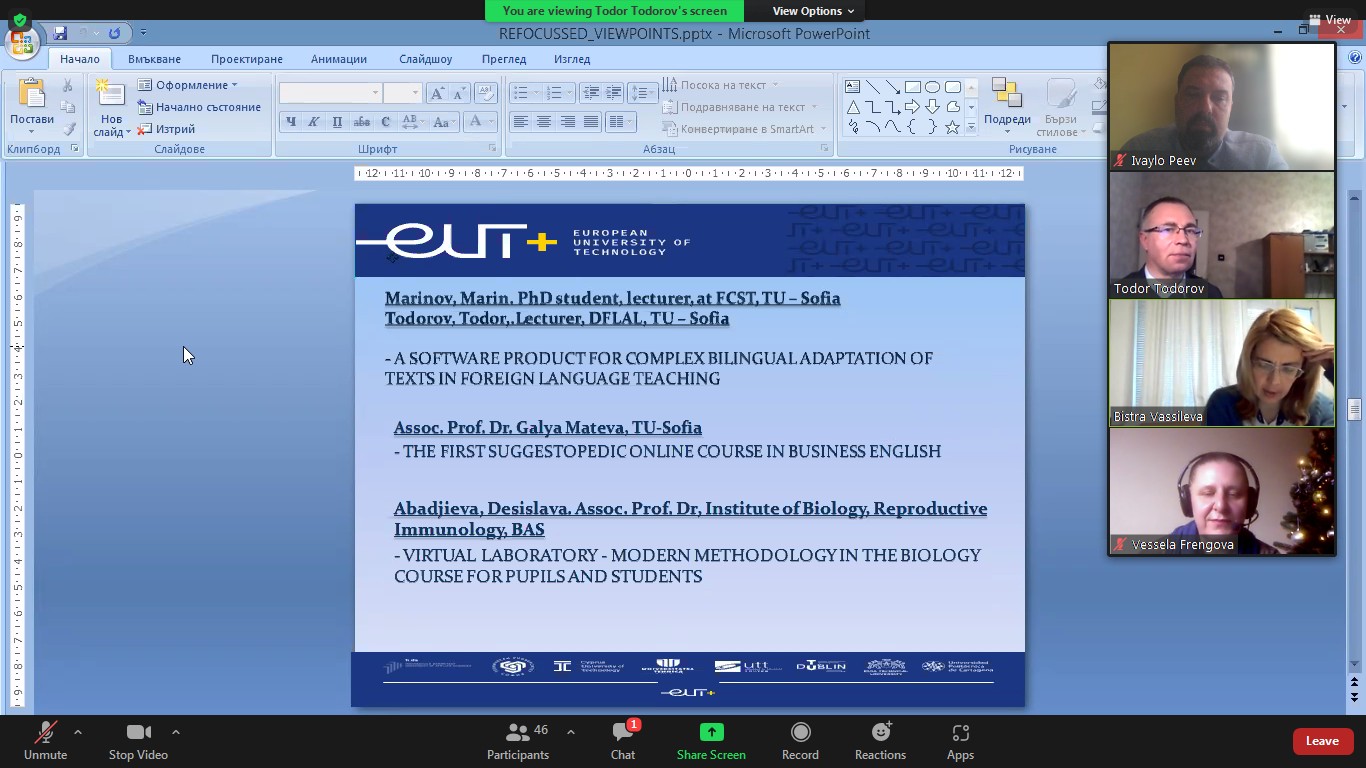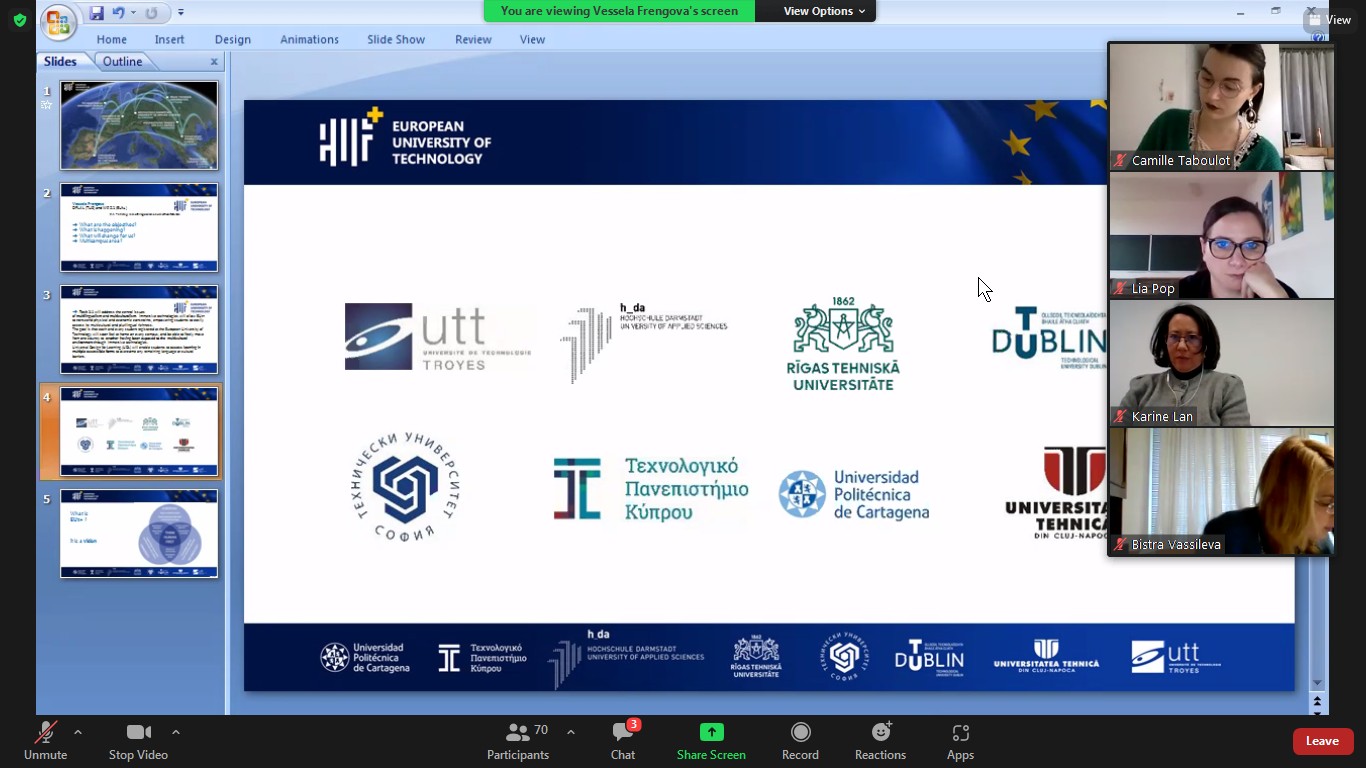

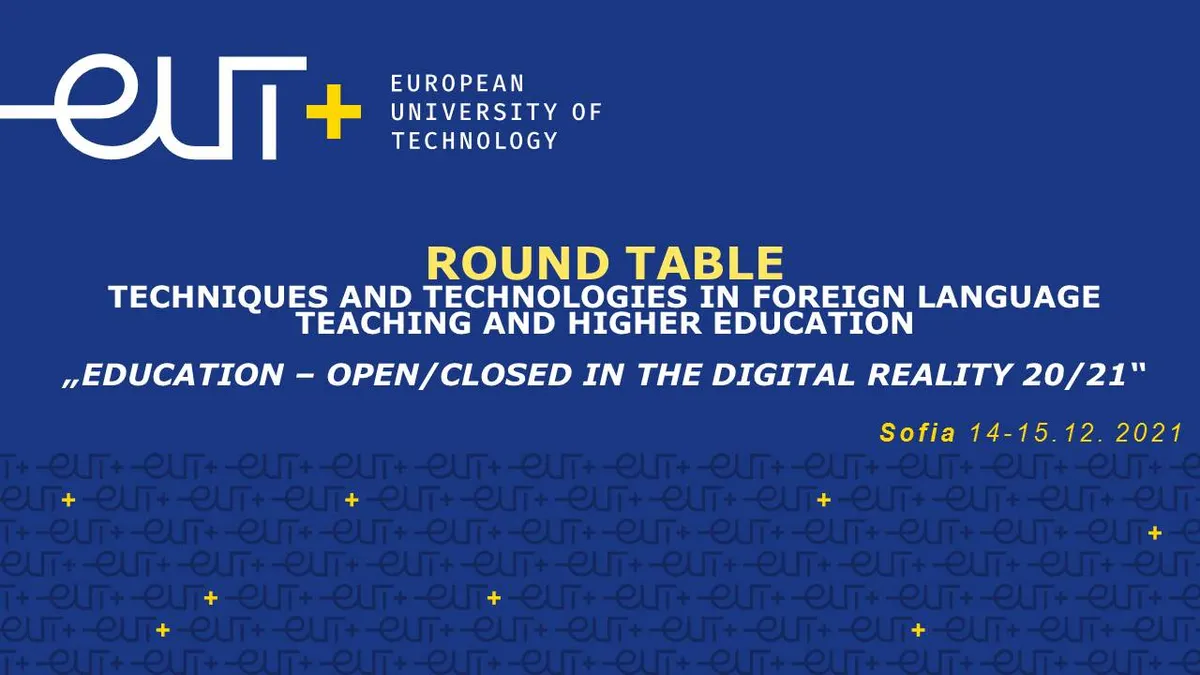
Over 100 participants from the 8 partner universities of the EUt+ project and from 5 Bulgarian higher education institutions took part in a Round Table at TU – Sofia, held on December 14th and 15th, 2021.
This year's edition of the traditional round table "Techniques and Technologies in Foreign Language Teaching and Higher Education" by the DCHOLPL, TU – Sofia, was part of the initiatives of the Laboratory for Pedagogical Applied Research and Student-Centred Learning (ELaRa), a work package of the "European Technological University (EUt+)" project. The forum was held under the motto "Education – Open/Closed in Digital Reality 20/21". Over 100 participants – presenters and guests – joined the online event.
Among the presenters, besides the hosts from TU, were teachers and researchers from Technical University of Cluj Napoca – Romania, Cyprus University of Technology, UTT – France, as well as from Sofia University "St. Kliment Ohridski", University of Mining and Geology "St. Ivan Rilski", University of Chemical Technology and Metallurgy – Sofia, and the National Sports Academy "Vasil Levski".
The scientific discussion forum was opened by Prof. Dr. Eng. Lyubomir Dimitrov, Vice-Rector for Educational and Academic Affairs and coordinator from TU for the EUt+ project, who in his welcome speech emphasized the importance of pedagogy and pedagogical research for representatives of the academic community, as we are all teachers first and foremost, and in this sense – innovative pedagogical approaches and methods are an integral part of the scientific activities of every university teacher, he emphasized.
The moderator of the event (14.12.) was Senior Lecturer Vesela Frengova, DCHOLPL, TU, who effortlessly and with a positive attitude led the forum by presenting the presentations and organizing the discussions, in which dozens of participants from several European countries shared questions and opinions. Senior Lecturer Frengova also contributed with a presentation on the topic: "Multilingualism and multiculturalism – Empowering EUt+ Students on their Path to European Citizenship", which served as an opportunity for representatives of work packages WP2 and WP3 to exchange information and ideas from their work on the project and the specific tasks they are carrying out.
In the first panel, presentations by our European partners were presented: "Presenting the European Laboratory for Pedagogical Action Research and Student-Centred Learning (ELaRA)" – Lia Pop, PhD (Technical University of Cluj Napoca, Romania); "Education during the pandemic: The case of the Cyprus University of Technology" – Elis Constantinou, PhD (CUT, Cyprus); "Presenting ELaRA’s Autumn Symposium – Conclusions and Reflections" – Chloe Duvivier (UTT, France), which definitely aroused the interest of the guests, judging by the dozens of questions and opinions shared in the discussion part of the panel.
The focus of the second part was on the pedagogical and scientific research pursuits and achievements of our Bulgarian colleagues. Lecturers from leading universities in the capital participated with presentations in English. The discussions were lively again, and some of the conclusions reached by the participants were that the challenges faced by university lecturers are quite similar. The questions that remain to be resolved regarding e-learning generated a number of potential answers, thanks to the exchange of experience and the sharing of good practices from the work of each speaker at the forum.
On the second day of the Round Table (15.12.), the working language was Bulgarian, and representatives of TU-Sofia, SU "St. Kliment Ohridski", and NSI "Vasil Levski" shared their developments and research on the current topic – online learning in a digital environment.
The organizers from the Department of Foreign Language Teaching and Applied Linguistics at TU-Sofia – Assoc. Prof. Dr. Ivaylo Peev, Senior Lecturer Todor Todorov, Senior Lecturer Bistra Vasileva, and Senior Lecturer Vessela Frengova – define the scientific forum as more than successful not only due to the large number of participants, but primarily because of the exceptionally lively and constructive discussions, in which opinions and impressions, ideas and those aimed at making sense of and improving e-learning were heard. The student presence and participation at the forum, alongside young scientists and established lecturers, should not be overlooked.