
Dr. Bozhidar Stefanov believes that Bulgarians are more smiling and that his place is here
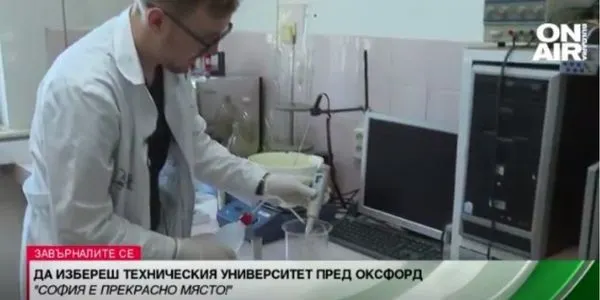
Watch the interview with Assoc. Prof. Dr. Bozhidar Stefanov from the Department of Chemistry, Faculty of Electronic Engineering and Technologies at the Technical University – Sofia on bgonair.bg here
Assoc. Prof. at the Department of Chemistry at the Technical University Dr. Bozhidar Stefanov chose Bulgaria over Oxford. He is a chemist, son of an engineer and an economist. He wanted to become a programmer. He graduated with a bachelor's degree in "Computational Chemistry" and a master's degree with a specialization in "Nanotechnology and Nanomaterials" from Sofia University. Today, the love of his life is chemistry.
His main scientific interests are in the field of nanostructured materials, functional coatings, and photocatalysis. In his free time, he loves to embroider. Proof of this is his personal apron, on which the Periodic Table, flasks, chemical compounds, and formulas can be seen. Bozhidar's passion for embroidery was unlocked during the coronavirus pandemic.
Before staying here, where he feels best, Dr. Stefanov declined a job offer from Canada and went to Sweden. Thus, in 2011, the Bulgarian began to engage in science at the oldest Swedish university – that in Uppsala. Bozhidar stayed in the Kingdom for 5 years. He successfully defended his doctoral thesis and received the opportunity to continue in Oxford
He stayed in the Mecca of academia for a year. "After that, I was totally burned out, I was so exhausted. I returned to Sofia just for a little while. The plan was to then go to the University of California, and after 3 months I saw that Sofia is a wonderful place, the people seemed more smiling to me. I had been away for only 6 years, perhaps for the people here no major change was visible, but for me it was", Bozhidar states in "Bulgaria Morning".
Although Bozhidar wanted to settle permanently in Bulgaria back then, he was forced to leave his homeland once again. He failed to find a job. Thus, in 2017, he headed to Durham University in England. In Durham, Bozhidar undertook perhaps the shortest postdoctoral fellowship in history – 3 days. He realized that this was not his place and decided to take a risk in Bulgaria despite the negativity with which he was received. Thus, Bozhidar returned permanently, and this time luck was on his side. He was appointed to the Department of Chemistry at the Technical University, which gave him the peace of mind to conduct science as he understands it.
"In Oxford, I had quite a few restrictions. I like to build my own equipment. There, they did not allow me to do that. Sometimes, if I needed something electronic that was very specific, they said they would not make it. I was not allowed to have a soldering iron. I remember that we smuggled it in. I ordered parts with great difficulty. I had discovered where they threw away the laboratory waste, and at night I would sneak in there," shared the chemist with Bulgaria ON AIR.
Unlike in Oxford, Bozhidar can also teach here. This is an advantage that should not be underestimated. The scientist found understanding and support from the management of the Technical University upon joining.
"I was received surprisingly well; they were very motivated to help make this happen because PhDs from abroad are not recognized in Bulgaria. What I brought, according to my colleagues, is optimism. The most important thing I received from Sweden was that one does not need to immediately think about the greatest discovery one has in mind," believes Dr. Stefanov. With the same optimism, Dr. Stefanov is now working on several projects. "Currently, I have one research project with national funding. What I do – I research how we can use light to utilize chemical processes occurring on a given surface to deposit material there," explained Bozhidar.
He also receives numerous awards for his scientific work.
"The awards I am proud of are 3. The first is from the Ministry of Education and Science competition 'Young Scientists'. The other two are for science. One is from the Swedish Commercial Bank for my doctoral dissertation. They give about 3 such awards every year. The second is from the Royal Scientific Society," pointed out the chemist.
This award amounts to 25,000 Swedish kronor and is awarded annually to only 6 scientists from around the world.
"We developed a technology through which window glass can purify the air in a room by using light," clarified Dr. Stefanov.
The motivation to start working on this project is the so-called "sick building syndrome" – tired people who are ineffective at their workplace due to dirty air. As part of this project, Bozhidar receives an invitation to work for a company in New York. He declines this offer to remain in Bulgaria.