
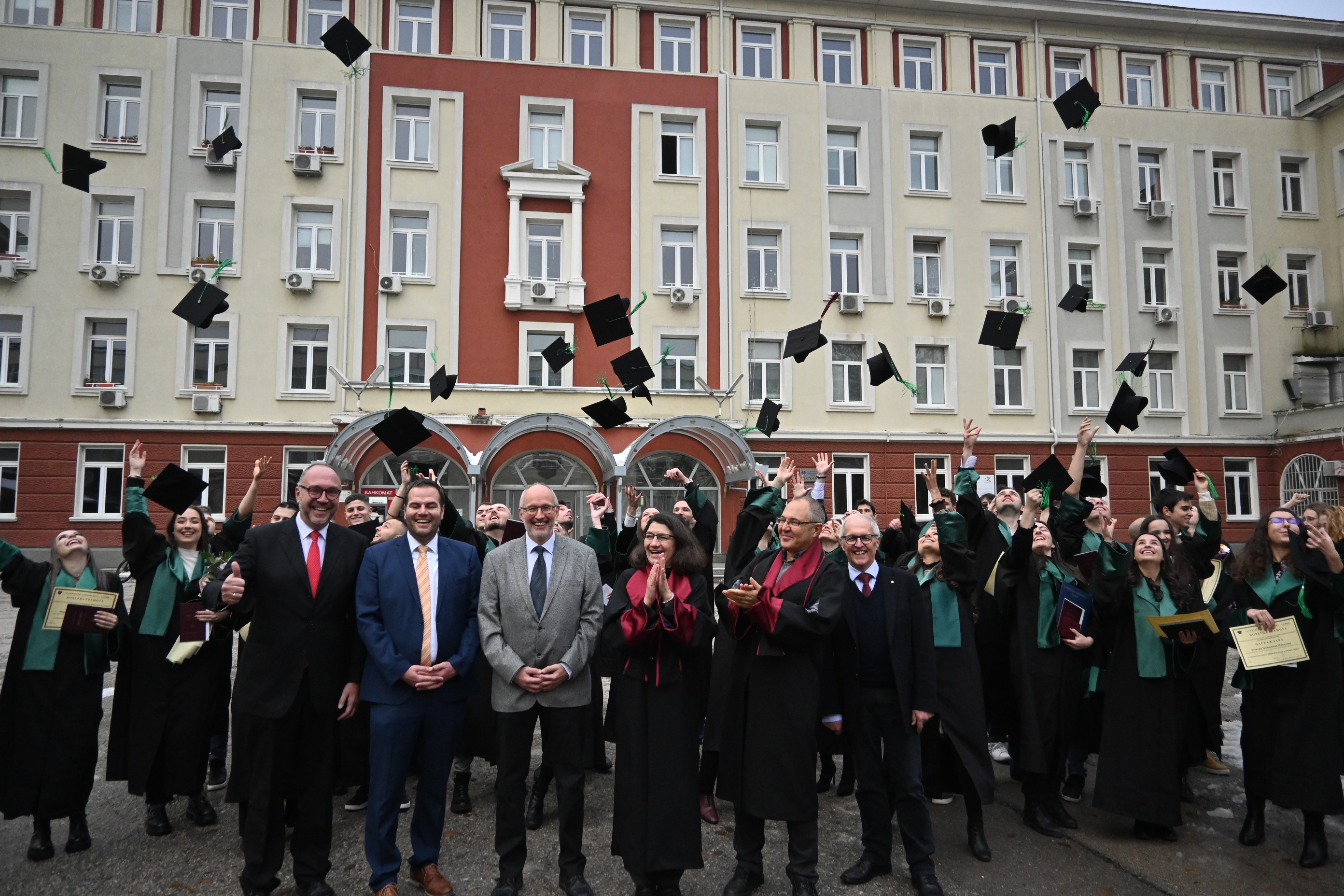
In 1990, the German Faculty was established at the Technical University of Sofia. At the time, this was a real sensation. Today, its graduates head German companies in Bulgaria and hold responsible positions in Germany itself.
"You sit here, you get there" - The German Faculty of the Technical University of Sofia (or more precisely, the Faculty for German Engineering Education and Industrial Management, as its official name is) tries to attract students with this slogan. It has been doing so successfully for over 30 years - according to German standards and programs. And one of the testimonies to its significance is this: the long list of high-ranking German politicians who have visited it over the years. Former European Commissioner Günter Verheugen, Rita Süssmuth, who was President of the Bundestag for 10 years, the seventh President of Germany Roman Herzog (1994-1999), the tenth Federal President Christian Wulff (2010-2012), former Federal Foreign Minister Klaus Kinkel, and former Chancellor Gerhard Schröder have all been there.
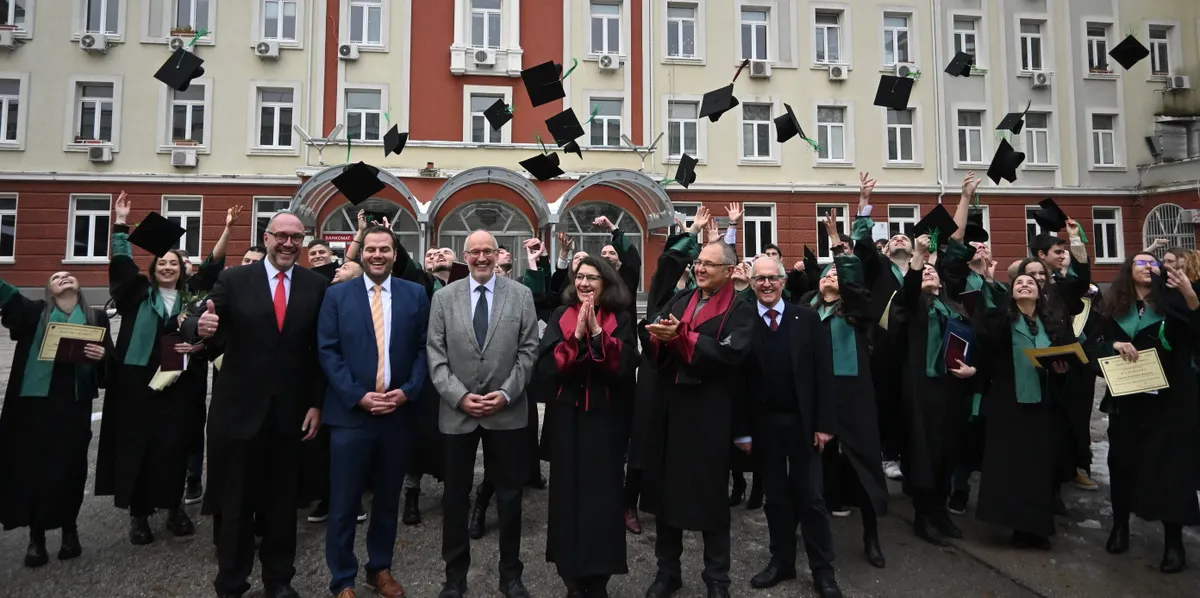
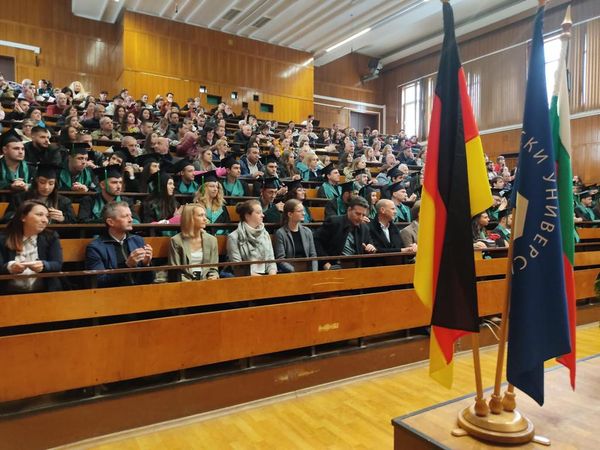
The Faculty was established in 1990, and at the time this was a real sensation because it offered its students the unique opportunity to obtain diplomas valid not only in Bulgaria but also in Germany. Meanwhile, its graduates number 2,086, and the positions held by some of them are certainly quite high: heading German companies in Bulgaria and holding responsible positions in companies in Germany itself. Today, such training in Bulgaria is probably no longer such a big sensation - countless young people can go to the Federal Republic and complete their studies on site. But interest in the German Faculty of the Technical University (TU) remains a fact - with its several specialties: computer systems and technologies, business informatics, mechatronics and information technology, industrial management and business administration.
A guarantee of the German quality of education is also the participation of German lecturers in the process - from higher education institutions in Magdeburg, Karlsruhe, Braunschweig, and Essen. Bilyana Mihaylova speaks with one of them - the economist Professor Franz-Peter Lang from the private University of Applied Sciences and Management in Essen, who is an honorary doctor of the TU in Sofia. He has been teaching at the German Faculty since its establishment, and in Germany he has worked at 14 higher education institutions.
Do you see differences between German and Bulgarian students?
Prof. Lang: When I started teaching there in 1990, the difference was indeed large - first, there were many older people who already had higher education but wanted additional qualifications, and others were young girls and boys who had just graduated and did not ask any questions - they were very reserved. And the explanation was either that they blindly believed in the teacher or were afraid of asking an inappropriate question. Today, everything is completely different - today's students in Sofia are the same as their colleagues in Germany. There is no difference.
Do you see differences in the opportunities available to students in Bulgaria and Germany?
Prof. Lang: In terms of content, the training is identical. Bulgarian graduates could work with the same success for a company in Germany as for a German company in Bulgaria. In this case, the second option would be better, since Bulgarian is their native language. This is one side of the matter; the other is that graduates of the German Faculty at TU Sofia could also do an excellent job in a German company, but the number of German companies in Bulgaria is limited, and consequently, the opportunities are not the same as for working in Germany.
The initial idea - that graduates of this faculty would work for German companies in Bulgaria - is still valid, but this can only be part of the whole.
Today, students can work throughout Europe. However, this depends heavily on their language skills. Many graduates of the German Faculty at TU Sofia speak German excellently, almost without an accent, but there are others who are not as proficient with the language, which could make their employment in a given company problematic. These are smart people, educated just as well as others, but they do not speak German well, which is a hindrance in the eyes of some German managers. Therefore, it is important that language skills are sufficient at least for a good job interview presentation - targeted work in this direction is necessary, as currently, such a specialized approach is lacking, and this is what opens doors. It is also necessary to improve presentation techniques. Students often use fonts that are too small, too many lines, and too much text - they have room to improve in this regard to present themselves in the best possible way.
What else could be improved, in your opinion? For example, considering dual education?
Prof. Lang: Many of today's students are forced to work to support themselves. In this regard, true dual education (combining theoretical education with work in the same specialty) could be very useful. If this form existed, as it does in private higher education institutions in Germany, such as the University of Applied Sciences and Management in Essen, it would be very beneficial for students. However, even in Germany, dual education is not yet applied in state universities.
Furthermore, it would be good if people from abroad could study in Sofia - from Greece, Serbia, Turkey, North Macedonia, and Albania. These are matters that require development, and in this sense, more advertising is needed - so that young people in Bulgaria and neighboring countries can say: I will study here.
How do you see the future of the German Faculty?
Prof. Lang: Currently, it benefits from the strong support of DAAD - the German Academic Exchange Service. The agreements are updated every five years, but, of course, everything depends on budgetary funds - which are reduced in times of crisis. That is, it is not guaranteed that the German Faculty will always be supported, which is why it must slowly but surely stand on its own feet - if subsidies are reduced or stopped. There are opportunities to recruit students not only in Bulgaria, so it is good to do more advertising in neighboring countries. Considering that these are young people who would find it easier to study in Sofia than in a more distant foreign country, where it would also be more expensive. There used to be a Balkan initiative of the EU, within the framework of which a considerable number of people from Serbia, Albania, and North Macedonia were trained at the faculty, but this program has ended. And the regional markets must be developed in the name of lasting stability.
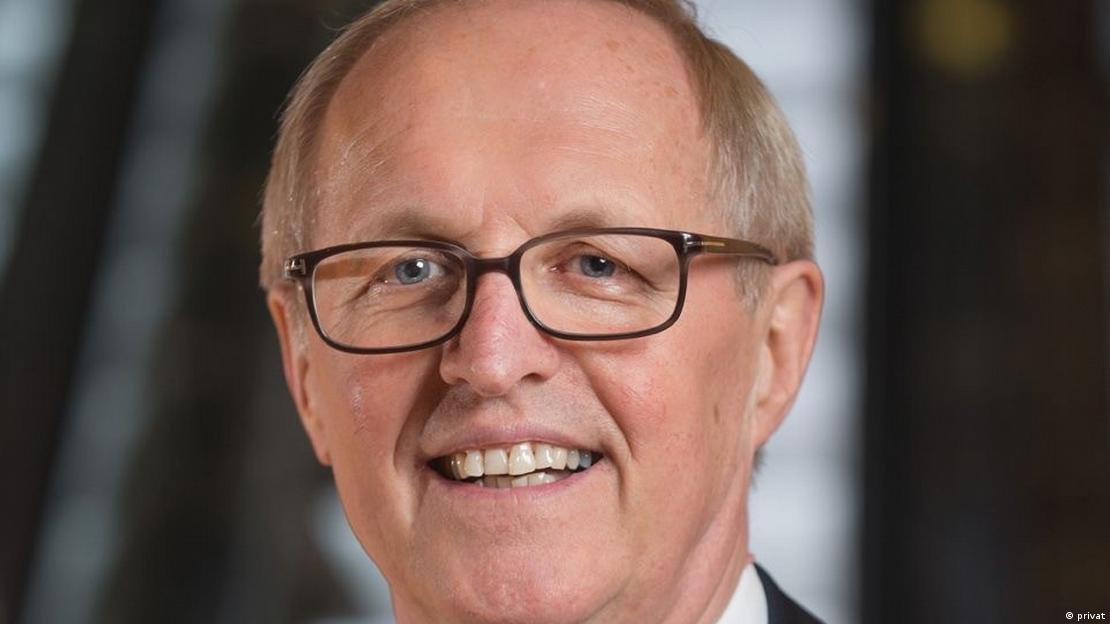
Prof. Franz Peter Lang
Source: dw.com, see here