
Dear PhD students and students at TU-Sofia,
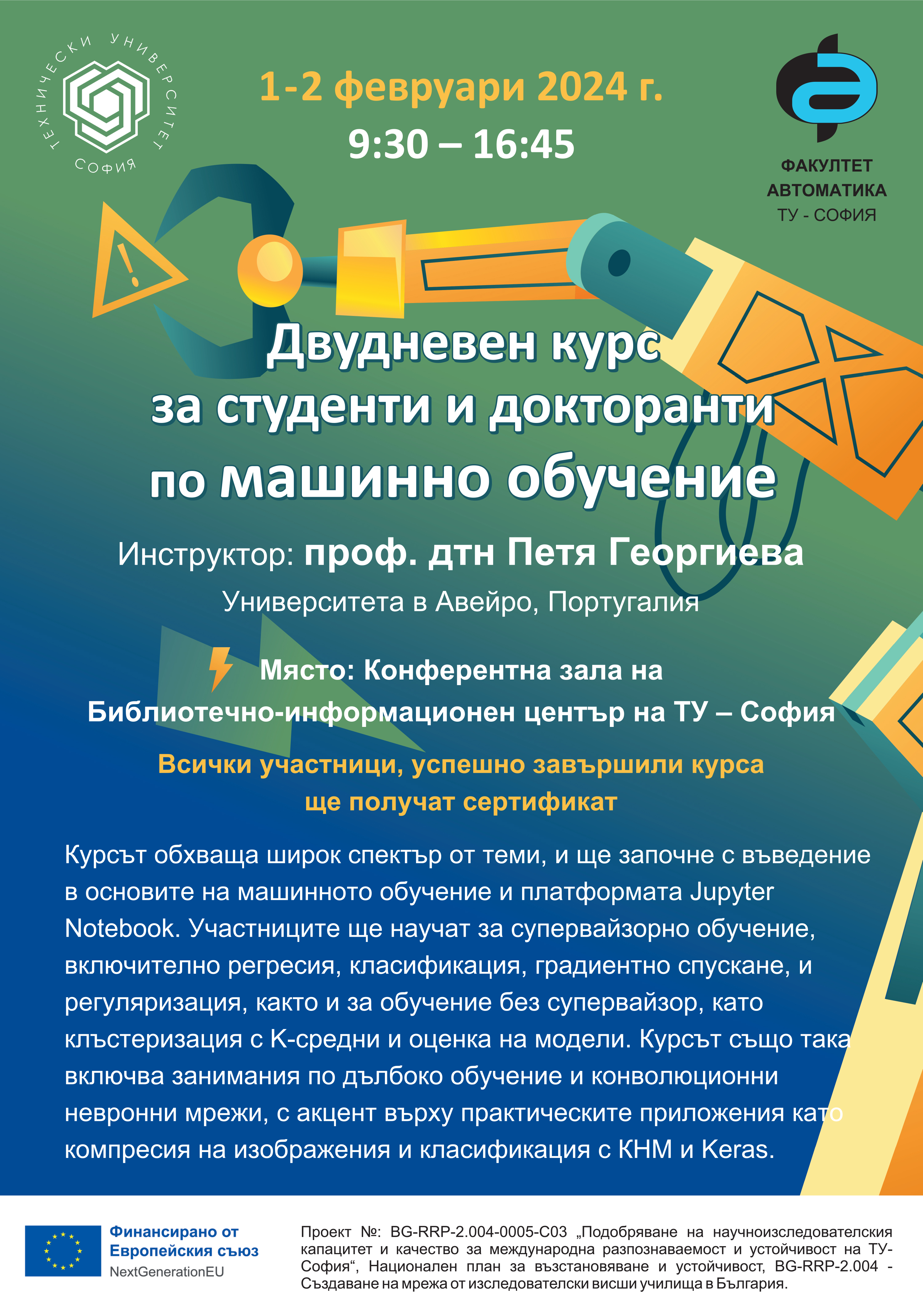
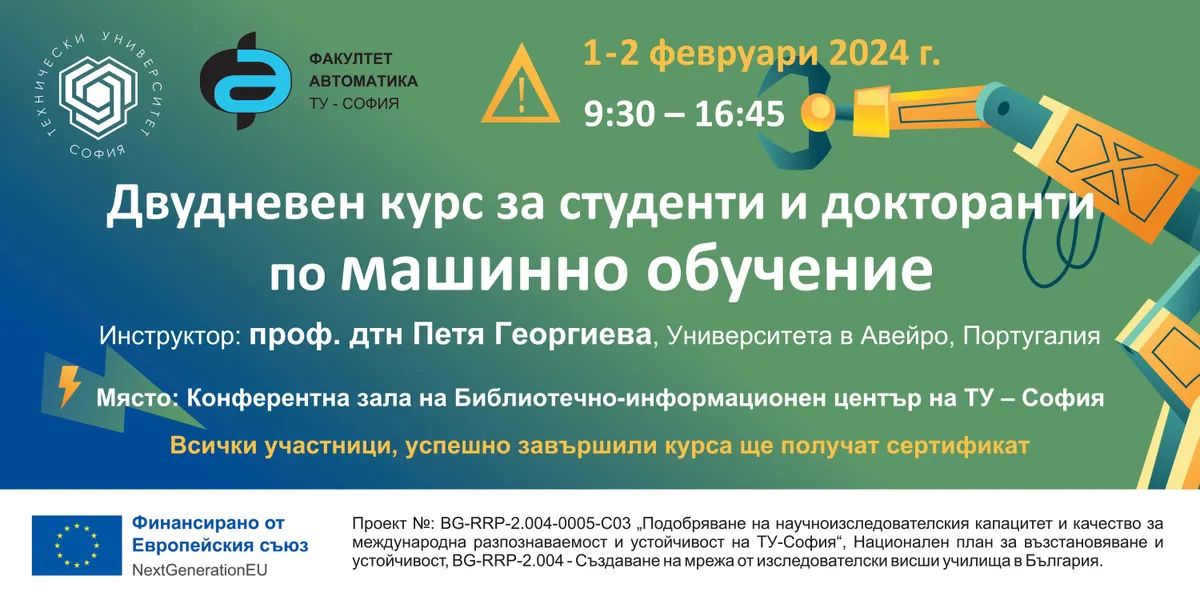
The Faculty of Automation is pleased to invite you to participate in a two-day machine learning course on February 1st and 2nd at 9:30 AM in the conference hall of the BIC at TU-Sofia. The course will be led by Prof. Dr. Petia Georgieva from the University of Aveiro and covers a wide range of topics, starting with an introduction to the fundamentals of machine learning and the Jupyter Notebook platform. Participants will learn about supervised learning, including regression, classification, gradient descent, and regularization, as well as unsupervised learning, such as K-means clustering and model evaluation. The course also includes sessions on deep learning and convolutional neural networks, with a focus on practical applications such as image compression and classification using CNNs and Keras.
Successful completion of the course will result in a certificate of participation.
The event program is as follows:
PROGRAM
February 1-2, 2024, 9:30 AM – 4:45 PM
Date, time |
Theoretical course |
Practical course |
Date, time |
1.02.2024, 9:30 - 10:45 |
Introduction to Machine Learning |
Introduction to Jupyter Notebook, NumPy |
1.02.2024, 11:00 - 12:15 |
1.02.2024, 14:00 - 15:15 |
Supervised learning - regression and classification. loss function; gradient descent; model overfitting; regularization; logistic regression; linearly and non-linearly separable data |
Part 1: Logistic regression; Part 2 - Regularized logistic |
1.02.2024, 15:30 - 16:45 |
2.02.2024, 9:30 10:45 |
Unsupervised learning: K-means clustering; model validation; model quality metrics, model selection: bias, variance, K-fold Cross-validation |
K-means clustering - image compression |
2.02.2024, 11:00 - 12:15 |
2.02.2024, 14:00 - 15:15 |
Deep learning; convolutional neural networks (CNNs) - basic structural elements; classical CNNs - LeNet-5, AlexNet, VGG |
Classification with CNNs and Keras |
2.02.2024, 15:30 - 16:45 |
!!!!Requirements for prior preparation and equipment:
- Each participant will need their own laptop.
- Install Anaconda 3 for Python 3 on your computer platform https://www.anaconda.com/download Jupyter Notebook (part of Anaconda) will be used
- If you are not familiar with Jupyter Notebook, start learning how to use it: https://www.dataquest.io/blog/jupyter-notebook-tutorial
Participants will need to have basic Python programming skills