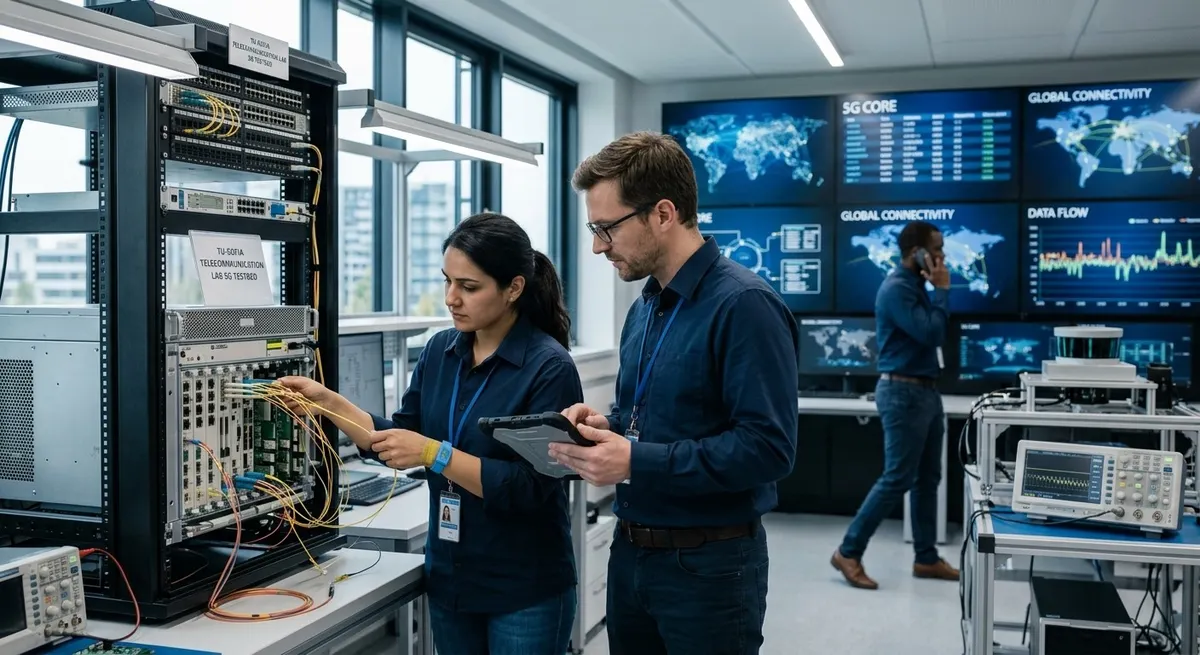
Master engineers acquire specialized knowledge in various areas of telecommunications, such as wireless communications, teletraffic theory, audio and video technologies, modern design technologies in telecommunications, multimedia systems and networks, telecommunication protocols and Internet communications, subscriber access networks, microwave devices, digital radio and television broadcasting, satellite communications, spread spectrum systems, and intelligent networks. To ensure mobility and meet specific student interests, blocks of elective disciplines have been introduced in the fields of radio communications, communication networks, and audio and video systems. The elective modules are open to the introduction of new disciplines, allowing flexible responses to the needs of the telecommunications market, in accordance with the dynamically changing landscape in the field of telecommunications. In this way, the possibility is provided to create specialists who meet the future personnel needs of the industry. The master's graduate must possess the following general skills: to develop various systems, tools, and software for the research and design of telecommunication devices, systems, and networks; to be able to work in a team and demonstrate professional ethics; to possess skills for independent problem-solving in critical situations; to have management skills. Masters must be able to communicate clearly and unambiguously both with specialists and non-specialists regarding acquired knowledge and to formulate conclusions. They must possess the ability to continue their education with the highest degree of independence. Masters in telecommunications must also possess specialized skills in the field of research, design, and production of telecommunication elements, nodes, devices, systems, and networks. During their studies, the master engineer who graduated with a major in "Telecommunications" acquires the following important specialized skills:
- to use modern mathematical methods for the analysis and design of communication systems and technologies;
- to produce, operate, and maintain specialized digital communication systems for general and specialized purposes;
- to apply creative professional thinking based on the most advanced scientific methodology;
- to be able to design and manage communication networks, as well as to configure, detect, and troubleshoot faults in the main types of systems;
- to develop habits for self-learning.
Graduates of the master's program possess competencies for implementing the most current information and communication technologies in the following areas:
- They design and construct radio-electronic modules, devices and systems for fixed and mobile networks, radio and television broadcasting.
- Develop software for computerized management of telecommunications, satellite facilities, multimedia and security systems.
- Build communication networks and means of connection with stationary and mobile objects, including specialized equipment.
- Create diagnostic tests and maintenance of complex telecommunications systems.
- Upgrade their qualifications through corporate training, postgraduate qualification, or doctoral studies in the same specialty.